Malaysia country guide Places and experiences
What should a first-time traveler see in Malaysia beyond the obvious highlights?
The short answer
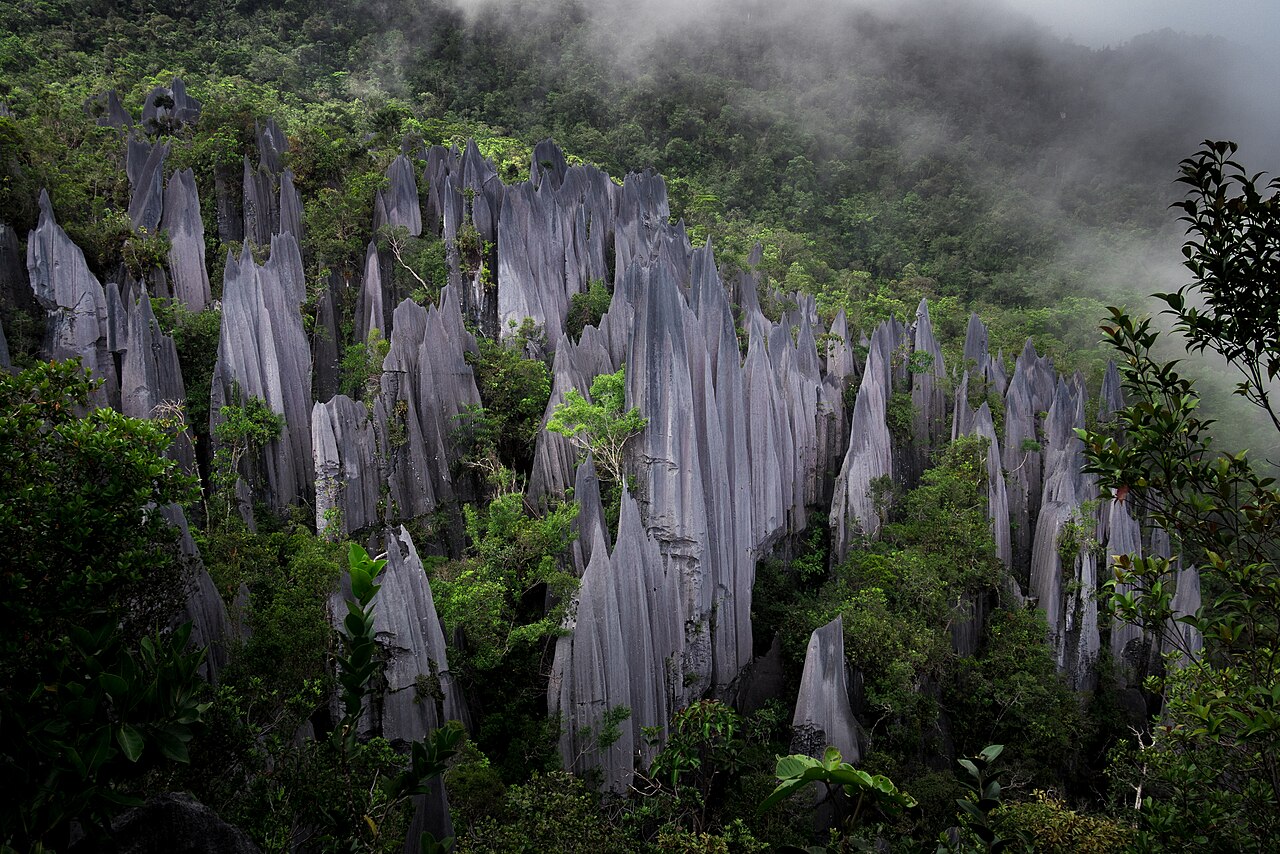
Sarawak — Gunung Mulu National Park, inscribed by UNESCO in 2000, holds the limestone Pinnacles on Mount Api, and the Niah cave complex was added to the World Heritage List in 2024.
The answer, with local context
Malaysia's World Heritage list is weighted toward Borneo and toward the country's older history, not toward the cities most first visits cover. Six properties are inscribed: Kinabalu Park in Sabah and Gunung Mulu National Park in Sarawak, both natural and both from 2000; Melaka and George Town in 2008; the archaeological heritage of the Lenggong Valley in 2012; the Niah National Park cave complex in 2024; and the Forest Park of the Forest Research Institute Malaysia in Selangor in 2025. Malaysia's Department of National Heritage records Mulu and Kinabalu as natural properties and Melaka–George Town and Lenggong as cultural.
Each of those opens a different Malaysia. Lenggong, in inland Perak, is an archaeological landscape rather than a monument — Malaysia's deep prehistory, inscribed on its own terms. Kinabalu Park is a mountain protected area in Sabah. Gunung Mulu is karst: a limestone massif whose Pinnacles rise as a field of blades near the top of Mount Api. Niah's caves, listed in 2024, are the newest reason to route a trip through Sarawak. The FRIM forest park in Selangor, added in 2025, is the one within easy reach of Kuala Lumpur.
What it costs to walk into the Sarawak properties is set by the Forest Department of Sarawak, and it is priced by category rather than by park. Entry to a World Heritage site is sold as a five-day pass: RM 30 for a foreign adult, RM 10 for a child aged six to under eighteen and free below six, against RM 15 for a Sarawakian adult — where an ordinary national park charges a foreign adult RM 20. Guided activity is billed separately and capped by party size. Adventure trekking at a World Heritage site is RM 500 per guide for an eight-hour day covering three to eight people, adventure caving RM 600 per guide for the same day and a maximum of eight, and leisure trekking RM 50 per guide per hour for groups of up to ten. A park guide licence itself is RM 100 and runs three years. The caps matter as much as the prices: the state's own rate card tops out at eight people to a guide for anything it classes as adventure.
Beyond the World Heritage list, two other UNESCO designations matter. Langkawi was designated a UNESCO Global Geopark in 2007, which makes the archipelago a geological site as well as a beach one. And Mak Yong theater, the Malay dance-drama of the northeast, was proclaimed a UNESCO masterpiece of oral and intangible heritage in 2005 — a cultural form rooted in Kelantan and Terengganu, states most itineraries never reach.
Picture the place
The Pinnacles are a field of sharp limestone blades standing near the top of Mount Api, formed by rainwater dissolving the rock along vertical joints. They sit well above the rainforest canopy that covers the rest of the Mulu massif, which is why they appear abruptly rather than as part of a ridgeline.
The easily missed detail
Four of Malaysia's six World Heritage properties lie outside Peninsular Malaysia's tourist spine, and two of them are in Sarawak. Combining Mulu and Niah in one Sarawak leg is far more efficient than treating either as a standalone side trip from the peninsula — and it is the only way to see both of the state's inscriptions on a first visit.
A practical rhythm
- Sarawak — Gunung Mulu, inscribed 2000, and Niah, inscribed 2024, in a single leg.
- Sabah — Kinabalu Park, the country's other natural property from 2000.
- Peninsula — Lenggong Valley in Perak, the FRIM forest park in Selangor, and Langkawi's 2007 Global Geopark.
What could complicate the plan
Borneo is not a domestic hop in document terms. The State Department notes that travelers entering or leaving Sabah and Sarawak must show a passport even on a domestic flight, which means a Mulu or Kinabalu leg needs the same paperwork discipline as an international one. The advisory for Malaysia is to exercise normal precautions, with the note that some areas carry increased risk and eastern Sabah a separate higher-level warning — worth reading against any Sabah coastal plan.
What to do next
The Malaysia when-to-visit question in this chapter covers George Town and the inscribed Penang core, and the trip-planning question sets out how to sequence the peninsula and Borneo without rushing.
Sources
- UNESCO World Heritage Centre, Malaysia properties — all six inscribed properties and their years
- Department of National Heritage, Malaysia, UNESCO recognitions — property categories and the Mak Yong proclamation
- US Department of State, Malaysia country information — Borneo passport rule and advisory wording
- UNESCO Global Geoparks — Langkawi designation, 2007
- Forest Department Sarawak, national park and nature reserve entry fees — the World Heritage site and national park entry bands, child and resident rates, guided-activity day rates, party-size caps and the park guide licence fee