Mali country guide When to visit
When is the best time to visit Mali for Djenné?
The short answer
November to February — Mali's national meteorological agency puts the southern dry season at about six months, November to April, and Djenné's Old Towns have been on UNESCO's List of World Heritage in Danger since 2016.
The answer, with local context
Mali has one wet season a year, not two. The Agence Nationale de la Météorologie describes rainfall as unimodal and monsoon-driven: in the south the rains run May to October, in the northern regions June to September. The dry season that follows lasts roughly six months in the south — November to April — and about eight months in the north, October to May. Djenné sits in the Niger's inland floodplain, in the belt that follows the southern pattern, which is why the practical window is the early dry season, before the heat builds.
The heat is the reason to go early rather than late in that window. In 2025 the agency recorded a maximum of 117.0°F (47.2°C) at Yélimané in May, the highest figure of the year nationally. At the other end, minimum temperatures fell to 46°F (8°C) at Nioro du Sahel and Baraoueli, mostly in January. Those are 2025 observations rather than long-term normals, but they frame the year accurately: January mornings are genuinely cool and May afternoons are extreme.
Djenné's own status is the second half of the answer. The Old Towns of Djenné were inscribed on the World Heritage List in 1988, under reference 116 rev, on cultural criteria (iii) and (iv). UNESCO's World Heritage Committee added the property to the List of World Heritage in Danger at its 40th session in 2016.
Picture the place
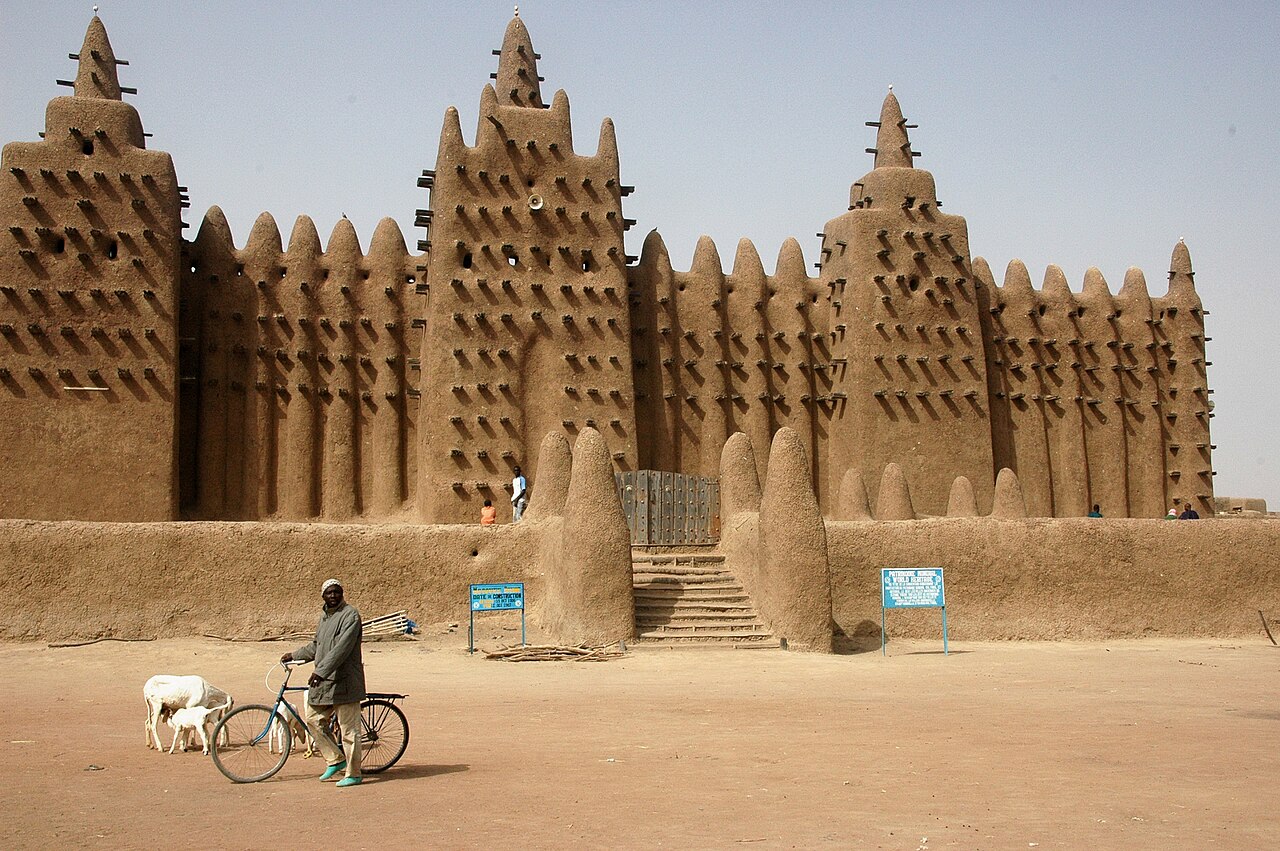
Djenné is built of banco — sun-dried earth rendered with mud plaster — so the whole town is one color, and in the low dry-season sun the mosque's buttresses and the projecting toron beams throw hard horizontal shadows across the facades.
The easily missed detail
Earthen architecture is maintained annually rather than permanently, and the maintenance is tied to the rains: the plaster has to be renewed after each wet season or the walls erode. That makes the dry months the time the buildings look their most intact, and it makes the end of the rains the point in the year when the town's upkeep work is most visible. The danger listing since 2016 reflects pressures on exactly that cycle of care.
A practical rhythm
- November to January — Coolest and driest in the southern belt; nights in the Sahelian interior drop close to 46°F.
- February to April — Still dry but heating fast toward the pre-monsoon peak.
- May to October — The single wet season in the south; the inland delta floods and roads soften.
What could complicate the plan
The UK Foreign, Commonwealth and Development Office advises against all travel to Mali. For anyone traveling regardless, a yellow fever vaccination certificate must be shown on entry. The rains do more than inconvenience: Djenné sits in a floodplain where the wet season changes road access rather than merely dampening it.
What to do next
The Mali trip-planning answer in this group covers visas, documentation and the practical sequence of a trip; the places answer covers Timbuktu, the Bandiagara escarpment and the inland Niger delta.
Sources
- Agence Nationale de la Météorologie du Mali, État du climat 2025 — unimodal rainy season, regional season months, dry-season length, 2025 temperature extremes
- UNESCO World Heritage Centre, decision 12 COM XIV.A — Djenné inscription year, reference and criteria
- UNESCO World Heritage Centre — Old Towns of Djenné added to the List of World Heritage in Danger at the Committee's 40th session, 2016
- UK Foreign, Commonwealth and Development Office — travel advice and yellow fever certificate requirement