Marrakech / Morocco When to visit
When should I visit Marrakech, Morocco, for the best experience?
The short answer
March to May, or late September into November — Marrakech's monthly mean temperature sits between 62°F and 71°F (16.7°C and 21.8°C) in those months, against 84°F (28.7°C) in July, and the medina is a city you cross on foot.
The answer, with local context
The numbers are stark at both ends. WMO climatological normals for Marrakesh station put the July mean at 83.7°F (28.7°C) and August at 83.8°F (28.8°C), with January down at 53.8°F (12.1°C) and December at 55.9°F (13.3°C). Those are 24-hour means, so afternoon maxima in July run considerably higher than the figure suggests.
Rain is almost a non-event in summer and never heavy in winter. July averages 0.06 inches (1.4 mm) across the entire month, August 0.14 inches (3.5 mm). March is the wettest month at 1.3 inches (33.6 mm), followed by November at 1.2 inches (29.4 mm). The annual total is about 8.4 inches (212 mm) — Marrakech is a dry city in every month, which is why a shoulder-season visit rarely costs you a day.
The city sits at 464 m (1,522 ft) at 31.6°N, on the plain below the High Atlas. That altitude and that latitude together explain the swing: hot days, and in winter nights cold enough that unheated riad rooms are genuinely chilly.
Opening hours matter more than weather for the museums. The Musée National du Tissage et du Tapis Dar Si Said opens Tuesday to Sunday, 10:00 to 18:00, and closes on Monday — which is the single most useful thing to know when building a three-day itinerary, because a Monday arrival loses it.
Picture the place
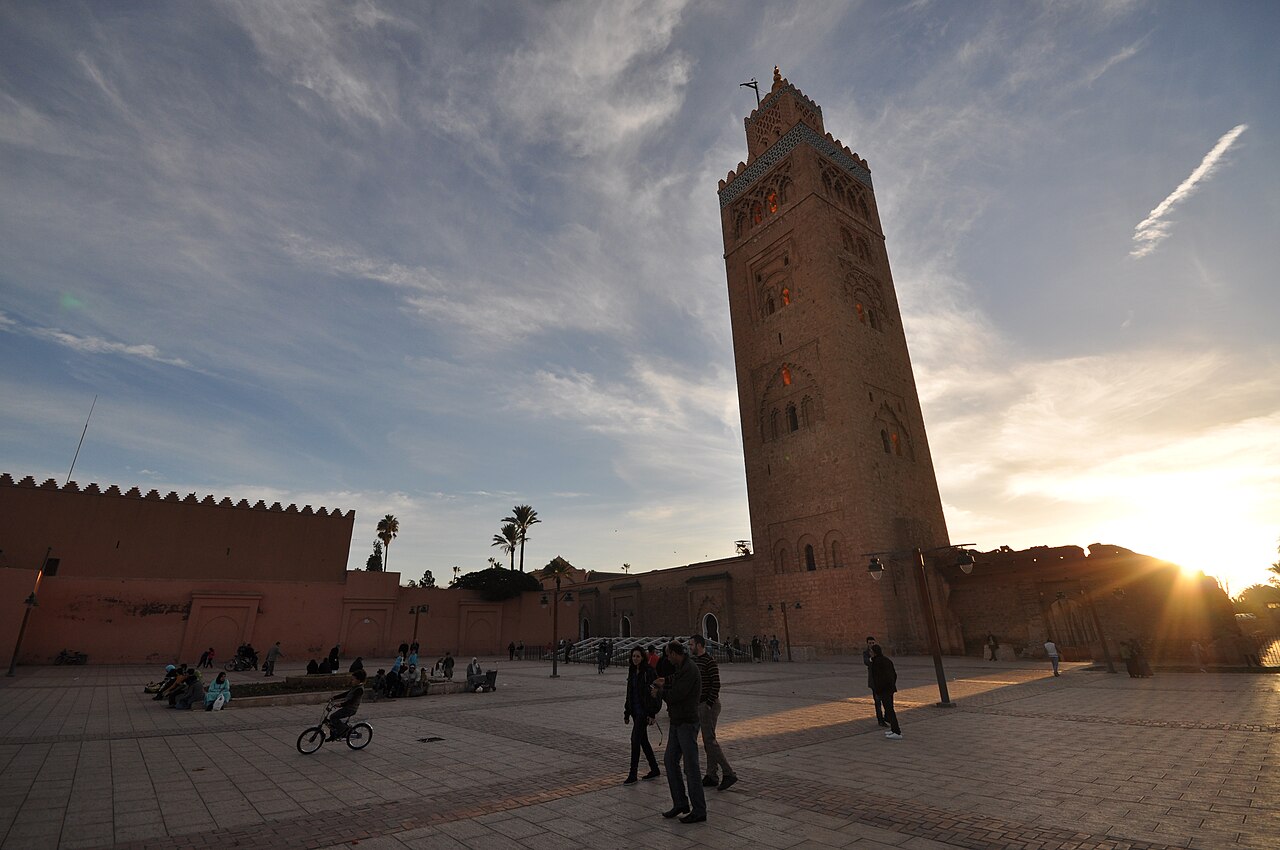
The medina's lanes are narrow enough that in the shoulder months one side is in deep shade while the other is in full sun, and the temperature difference between them is obvious within a few steps. Pisé walls hold the day's heat and give it back after sunset, which is why the square fills up in the evening rather than at midday.
The easily missed detail
Jemaa el-Fna is not just the medina's main square; it is a UNESCO-listed element in its own right. Inscribed on the Representative List of the Intangible Cultural Heritage of Humanity in 2008 and originally proclaimed in 2001, the listing covers the square's cultural practices — storytellers, poets, snake charmers, Berber musicians, Gnaoua dancers, senthir players and bards — not its buildings. UNESCO's description notes the activity runs all through the day and well into the night, which is a timing instruction as much as a description.
A practical rhythm
- Morning — Monuments and museums, while the lanes are still shaded and Dar Si Said has just opened at 10:00.
- Mid-afternoon — Indoors or in a courtyard. In July and August the mean alone is 84°F (28.7°C), and the afternoon runs well above it.
- Evening — Jemaa el-Fna, which UNESCO describes as busiest into the night.
What could complicate the plan
The US Department of State has Morocco at Level 2, Exercise Increased Caution, issued 21 April 2025, citing terrorism. The CDC lists Rabies in Morocco as a Level 1 notice, Practice Usual Precautions, and includes Morocco under its Global Measles Level 1 listing. The UK Foreign, Commonwealth & Development Office states that British citizen passport holders need a passport expiring at least three months after the date of arrival, and that anyone arriving from a polio-affected country must carry a certificate proving polio vaccination. Ramadan shifts earlier by about eleven days each year and changes café and restaurant hours across the medina.
What to do next
The three-day itinerary question in this group turns these windows into an actual plan. For what to eat once you are there, see the food and drink question.
Sources
- WMO climatological normals, Marrakesh station 60230, published via the Japan Meteorological Agency — monthly mean temperature and precipitation, station coordinates and elevation
- UNESCO Intangible Cultural Heritage, Cultural space of Jemaa el-Fna Square — inscription and proclamation years, performers and trades, time-of-day pattern
- Fondation Nationale des Musées du Maroc — Dar Si Said opening hours and closing day
- US Department of State, Morocco travel advisory — advisory level and date
- US Centers for Disease Control and Prevention, travel notices — rabies and measles notice levels
- UK Foreign, Commonwealth & Development Office, Morocco entry requirements — passport validity and polio certificate rules