Marrakech / Morocco Food and drink
Where should I eat in Marrakech, and which local food or drink is worth trying?
The short answer
Eat in the medina at both ends of the day — the souk's food stalls and juice carts by afternoon, the Jemaa el-Fna grills after dark — and the dish to order that belongs to this city rather than to Morocco generally is tanjia, the Marrakchi clay-urn braise.
The answer, with local context
Jemaa el-Fna's food trade is part of what UNESCO protects. The intangible heritage listing for the square explicitly includes the sale of fruit and traditional food among its everyday activities, alongside water-carrying and the performers, and records that this goes on all through the day and well into the night. Eating there is participating in the listed element, not watching it.
Tanjia is Marrakech's own, and it is defined by its vessel: a two-handled earthenware urn, loaded with meat, preserved lemon, cumin and saffron, sealed, and cooked slowly in gentle ambient heat rather than over a flame. It is distinct from a tagine, which is a conical lid over a shallow dish and is cooked across Morocco. Asking for tanjia in Marrakech gets you something you will not be offered in Fez or Essaouira.
Argan oil belongs on the table as well as in cosmetics. UNESCO inscribed "Argan, practices and know-how concerning the argan tree" on its Representative List in 2014, covering the Arganeraie Biosphere Reserve in south-west Morocco, and its description names cooking, traditional medicine and cosmetics among the oil's uses and the preparation of recipes and derived products as part of the element. The culinary form most travelers meet is amlou, argan oil blended with almonds and honey.
Mint tea is poured everywhere and the mechanics are consistent: green gunpowder tea, a large bundle of fresh mint, sugar added in the pot rather than the cup, and poured from height to aerate it.
Picture the place
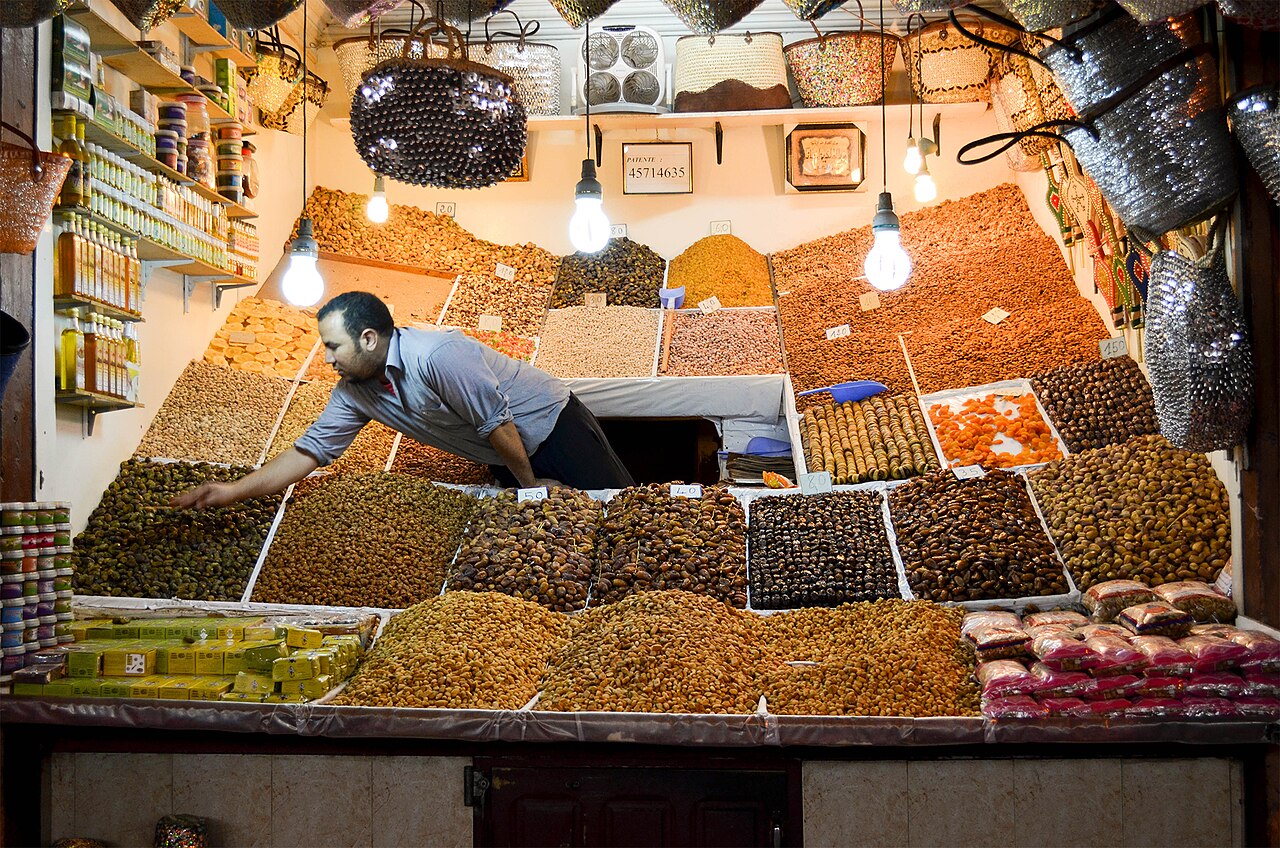
The dried-fruit and nut stalls in the souk are built as walls of produce — dates, figs, apricots and almonds stacked into blocks at chest height, with the vendor working from a narrow gap behind them. The spice stalls nearby trade in cones of ground cumin, paprika and ras el hanout that hold their shape until someone scoops into them.
The easily missed detail
Morocco's argan economy is organized around women's cooperatives. A WIPO case study records roughly fifty argan oil cooperatives run by women in south-west Morocco by 2010, and notes that the region became a UNESCO Man and the Biosphere reserve in 1998. UNESCO's heritage listing describes the work as done mainly by rural women, known as argan women, who teach their daughters from a young age. Buying oil from a cooperative rather than a tourist shop is a different transaction, and the price difference reflects where the processing happened.
A practical rhythm
- Late morning — The souk stalls, for dried fruit, nuts and spices, which is where the city shops rather than where it dines.
- Afternoon — Mint tea on a terrace; the pour from height is standard, not a performance for visitors.
- After dark — Jemaa el-Fna's grills and soup stalls, part of the UNESCO-listed activity that runs into the night.
What could complicate the plan
The CDC lists Rabies in Morocco as a Level 1 notice and includes Morocco in its Global Measles Level 1 listing, so routine vaccinations matter more than food caution. Tap water is treated in Marrakech but travelers commonly stick to bottled; unpeeled salads from street stalls are the usual culprit rather than the grills. Tanjia takes hours and is frequently cooked to order, so it is a dish to arrange a day ahead rather than to find on a stall. During Ramadan, which moves earlier by about eleven days each year, daytime food service across the medina contracts sharply and the square's evening trade starts later.
What to do next
The things-to-do question in this group covers the monuments and the museum hours around which you will be planning meals. For the months when eating outdoors in the evening is comfortable, see the when-to-visit question.
Sources
- UNESCO Intangible Cultural Heritage, Cultural space of Jemaa el-Fna Square — food and fruit trade as listed activity, day-into-night pattern
- UNESCO Intangible Cultural Heritage, Argan, practices and know-how concerning the argan tree — inscription year, region, culinary and medicinal uses, role of rural women
- World Intellectual Property Organization case study on argan oil — number of women's cooperatives by 2010, Arganeraie Biosphere Reserve designation in 1998
- US Centers for Disease Control and Prevention, travel notices — rabies and measles notice levels for Morocco