Marshall Islands country guide When to visit
When is the best time to visit Marshall Islands for Majuro?
The short answer
February — Majuro's driest month in NOAA's 1991–2020 normals (about 7.6 inches / 194 mm against 13.8 inches / 350 mm in October), with the northeast trades at their steadiest and the calmest lagoon seas of the year for outer-atoll boats.
The answer, with local context
The Marshall Islands' seasons are written by the trades, and the country's own weather service framing (carried in the WMO country diagnostics) is the authority: a relatively dry season from December to April, at the height of the northeasterly trade winds, and a wet season from May to November, with the wettest months October and November. There is no temperature season at all — Majuro, at 7°N, sits between 78°F (26°C) at night and 87°F (30°C) by day in every month of the year. What changes is water. Majuro receives about 3,334 mm (131 inches) of rain a year, among the wettest capitals in the Pacific, distributed so unevenly that February averages under 200 mm while October exceeds 350 mm. February is therefore the statistical summit: driest month, trade winds brisk enough (12–22 knots in season) to cut the humidity, and seas at their most cooperative for the small-boat trips — Eneko Island, Arno Atoll, the lagoon's WWII-wreck dives — that make a Majuro stay.
The national picture doubles the point, because this nation of 29 atolls and 5 islands — 181 km² of land inside an EEZ of roughly 2 million km² — runs on a steep rainfall gradient: the southern atolls (Majuro, Jaluit) take 3,000–4,300 mm a year, while the northern chain (Bikini, Enewetak, Rongelap) takes only about 1,500–1,800 mm and has a genuine dry season (January–March months under 1.6 inches / 40 mm). A February trip is thus the 1 window that serves both ends of the country at once: Majuro at its least rainy, and the north — the Bikini diving season's approach, the outer atolls' field-trip boats — at its driest and calmest. Entry, for Americans, is the easiest in this entire batch of guides: under the Compact of Free Association, U.S. citizens need no visa at all (the State Department's Marshall Islands page confirms it; a passport with 6 months' validity is recommended), the currency is the U.S. dollar, and the only toll is the $20 airport departure fee (ages 13–59; $2 on domestic departures).
The anchor itself: Majuro Atoll is a 64-islet ring around a 40-km lagoon, with almost all of its roughly 25,000 residents along the eastern DUD strip (Delap–Uliga–Darrit) and the road running 48 km west to Laura village and its beach — the atoll's ocean-side swimming shore. The capital runs a compact social circuit (the Tide Table at the Robert Reimers Hotel, the Marshall Islands Resort at the lagoon's edge, the Alele Museum with its stick charts), and February weekends put local boats out to Eneko and the picnic islets in their best conditions. A declared dengue outbreak in the capital (Ministry of Health, August 2026) is the current asterisk — repellent discipline is part of the February kit until the all-clear. Choose February; if the trip must slide, January and March are its honest shoulders, and May 1 (Constitution Day) is the wet season's consolation prize.
Picture the place
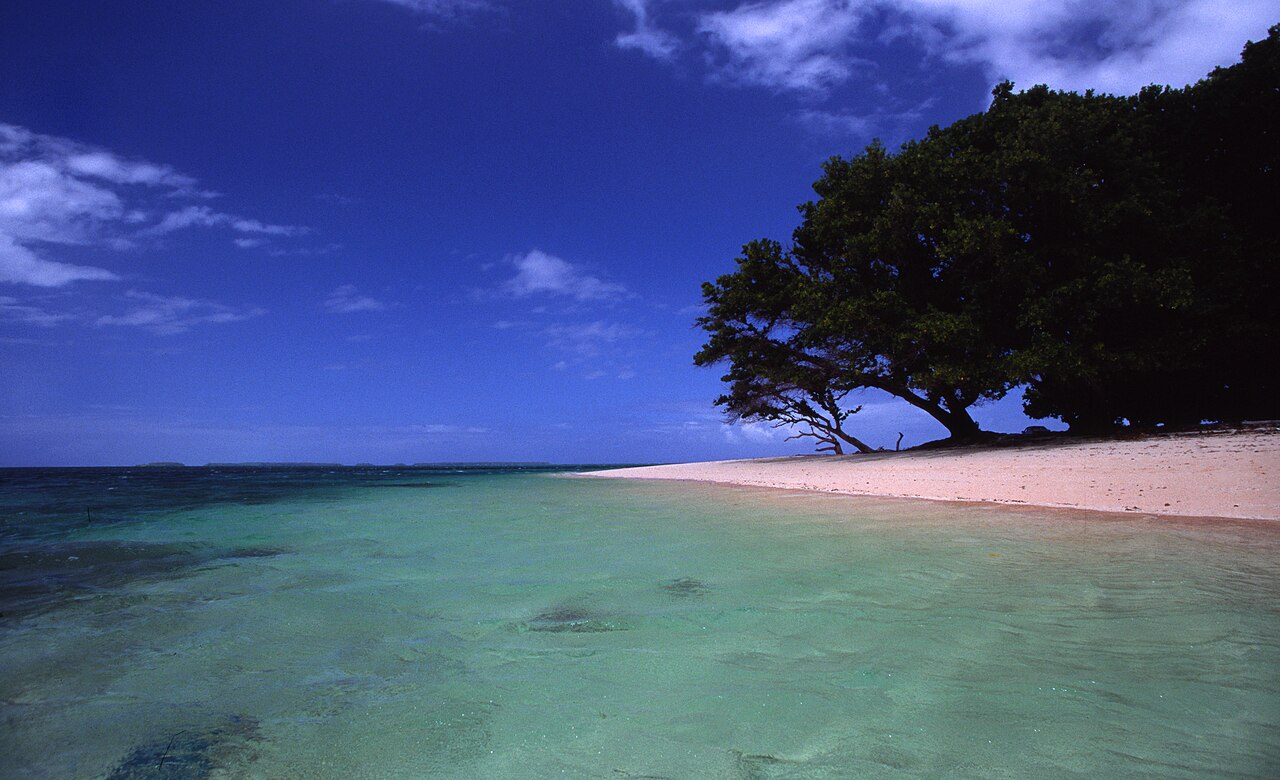
Laura Beach on a trade-wind morning: ironwood shade, white sand falling to reef shallows, local families under the palms and the whole Pacific beyond the surf line.
The easily missed detail
February's dryness hides a flood: the year's highest king tides cluster around February–March, and Majuro's ocean-side strip — barely 2–3 m above the sea, in places a few hundred meters wide with lagoon on 1 side and ocean on the other — can take swell overtopping even in dry weather, especially when distant storms send in long-period swells. Locals read the tide calendar the way farmers read rain. The second detail is the water paradox: the driest month is when Majuro's reservoirs and catchments run lowest (shortages traditionally bite by late March), so the traveler's February comes with island-wide water discipline — short showers are not politeness, they are plumbing.
A practical rhythm
- DUD on foot and by bus — The eastern strip's markets, museum and docks in the cool of morning, taxi-buses at a dollar a ride
- Lagoon days midweek — Eneko and the picnic islets by hotel boat while the trades hold the water glassy
- Laura at the weekend — The 48-km road west on Saturday, when the beach fills with Majuro families
What could complicate the plan
Flight scarcity rules: Majuro is served by United's Island Hopper (Honolulu–Guam, stopping at Majuro in both directions) a few times a week and by Nauru Airlines' north-Pacific route — a cancelled flight re-times the whole trip, and hotels fill around the Hopper's schedule, not the tourist season. Health is the active file: a dengue outbreak was declared in Majuro in August 2026 (check its status at booking), measles vaccination proof has been required of arriving travelers (ages 6 months to 62 in the current rules — verify before flying), and Majuro Hospital is the ceiling of care for most of the country (Ebeye and the outer atolls have less; medevac insurance matters). Cash is the medium (the State Department warns ATMs are very limited — bring sufficient dollars), cards work mainly at the 2 resort hotels, and king tides, dry-season water rationing and Sunday quiet (this is a church-going nation; most commerce stops) all shape the week more than any attraction's hours do.
What to do next
Anchor the trip to the Island Hopper's February timetable, book Majuro's rooms the same day, and pack the repellent and the water bottle as seriously as the mask and snorkel.
Sources
- NOAA — Majuro climate normals 1991–2020 (annual rainfall 3,334 mm; February 194 mm, the driest month; October 350 mm)
- WMO / RMI Weather Service Office country diagnostics — dry season December–April, wet season May–November; the north–south rainfall gradient
- U.S. Department of State — Marshall Islands country information (no visa required for U.S. citizens under the Compact; passport validity; $20 departure fee for ages 13–59; ATMs very limited, bring cash)
- RMI Ministry of Health and Human Services — dengue outbreak declaration, Majuro (August 2026)