Mendoza / Argentina Food and drink
Where should I eat in Mendoza, Argentina, and which local food or drink is worth trying?
The short answer
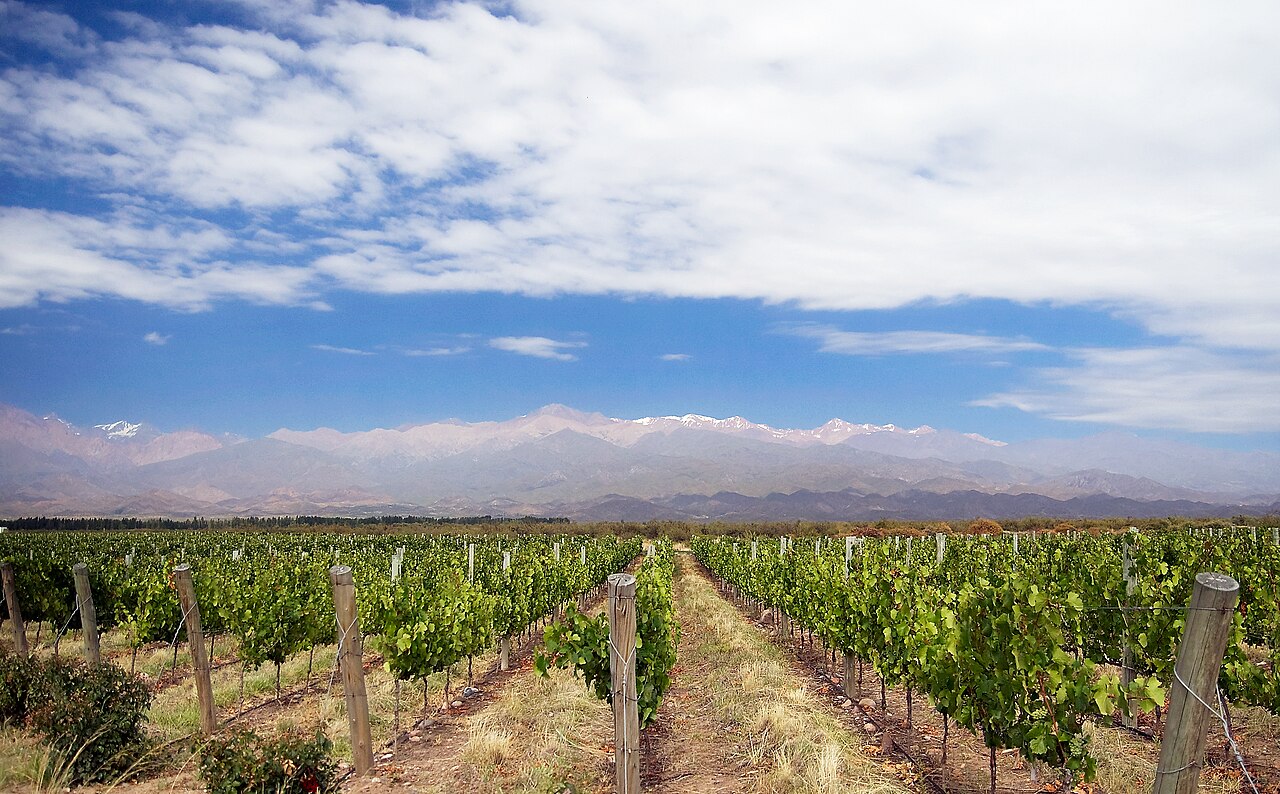
Drink Malbec where it is actually grown — Mendoza holds 39,856 hectares of Malbec, 84.7 percent of Argentina's national total of 47,064 hectares, and Luján de Cuyo alone accounts for 8,920 of them.
The answer, with local context
The Instituto Nacional de Vitivinicultura's April 2025 report, with areas measured as at 31 December 2024, makes Malbec the most planted variety in the country: 47,064 hectares, 23.5 percent of Argentina's entire vineyard area and 42.1 percent of its red wine-grape plantings. Within Mendoza, Malbec takes 27.9 percent of the province's 142,785 hectares of vines. San Juan, with 2,862 hectares, and Salta, with 1,714, are distant second and third nationally.
The departmental breakdown is the practical map for eating and drinking here. Luján de Cuyo leads with 8,920 hectares, or 22.4 percent of Mendoza's Malbec, followed by San Carlos with 5,863 hectares, Tunuyán with 5,679, Tupungato with 5,042 and Maipú with 4,070. The 3 Valle de Uco departments — San Carlos, Tunuyán and Tupungato — together hold 41.6 percent of the province's Malbec, which is why a tasting itinerary splits naturally into a Luján de Cuyo day and a Valle de Uco day.
Export figures show what leaves and what stays. Malbec varietal wines and blends accounted for 1,308,900 hectolitres of exports in provisional 2024 data, worth US$453.7 million FOB, or about US$3.47 a liter. Pure Malbec exports reached 1,269,138 hectolitres, up 4.8 percent on 2023, going to 119 countries with the United Kingdom and the United States as the main destinations.
The easily missed detail
One variety carries the whole export business. INV's figures put Malbec and its blends at 72.5 percent of Argentina's exported varietal wine by volume and 70.8 percent by revenue, which means the grape poured by the glass in a Mendoza restaurant is also the one funding the industry you are sitting in. That concentration cuts both ways for a visitor: a cellar door's Malbec list will be the deep one and everything else the short list, and a tasting that ignores the other varieties in the glass is skipping the quieter half of what the province actually grows.
A practical rhythm
- Luján de Cuyo — 8,920 hectares of Malbec, the single largest departmental concentration in the country.
- Valle de Uco — San Carlos, Tunuyán and Tupungato hold 41.6 percent of provincial Malbec between them.
- Maipú — 4,070 hectares, the closest of the big five to the city.
What could complicate the plan
Paying for a meal is the part worth preparing for. The State Department's Argentina record, last updated 16 July 2026, states you must show your passport to exchange money, keep all receipts related to buying pesos, and exchange only at banks, hotels and money changers with actual storefronts. It also lists hepatitis A, yellow fever, dengue, typhoid, rabies and hantavirus among prevalent diseases and advises being up to date on CDC-recommended vaccinations; the FCDO notes yellow fever is a risk in Argentina and a certificate may be needed for onward travel elsewhere, and that cash or travelers' cheques worth more than US$10,000 must be declared. Bodega visits are spread across 5 main departments, so a tasting day needs a driver.
What to do next
The Mendoza things-to-do answer covers Aconcagua's permit tiers alongside the winery network; the when-to-visit answer gives the park season and the advance permit calendar.
Sources
- Instituto Nacional de Vitivinicultura (INV), Informe Malbec, April 2025 — national and provincial Malbec hectares, shares, departmental ranking, Valle de Uco share, export volumes, values and destinations
- Gobierno de Mendoza, Dirección de Estadísticas e Investigaciones Económicas, Dossier económico — registered and tourism-open bodegas, national shares, provincial wine production
- US Department of State, Argentina country travel information — currency-exchange rules, prevalent diseases, vaccination guidance, last-updated date
- UK Foreign, Commonwealth and Development Office, Argentina entry requirements — cash declaration threshold, yellow fever note