Meteora / Greece Things to do
What are the most worthwhile things to do in Meteora on a first visit?
The short answer
Climb to the Great Meteoron and Varlaam for the great frescoed churches, cross to small St Nicholas Anapafsas for Theophanes' 1527 paintings, walk the old monk paths between the pillars, and take sunset from the Psaropetra viewpoint — three monasteries, one trail, one evening.
The answer, with local context
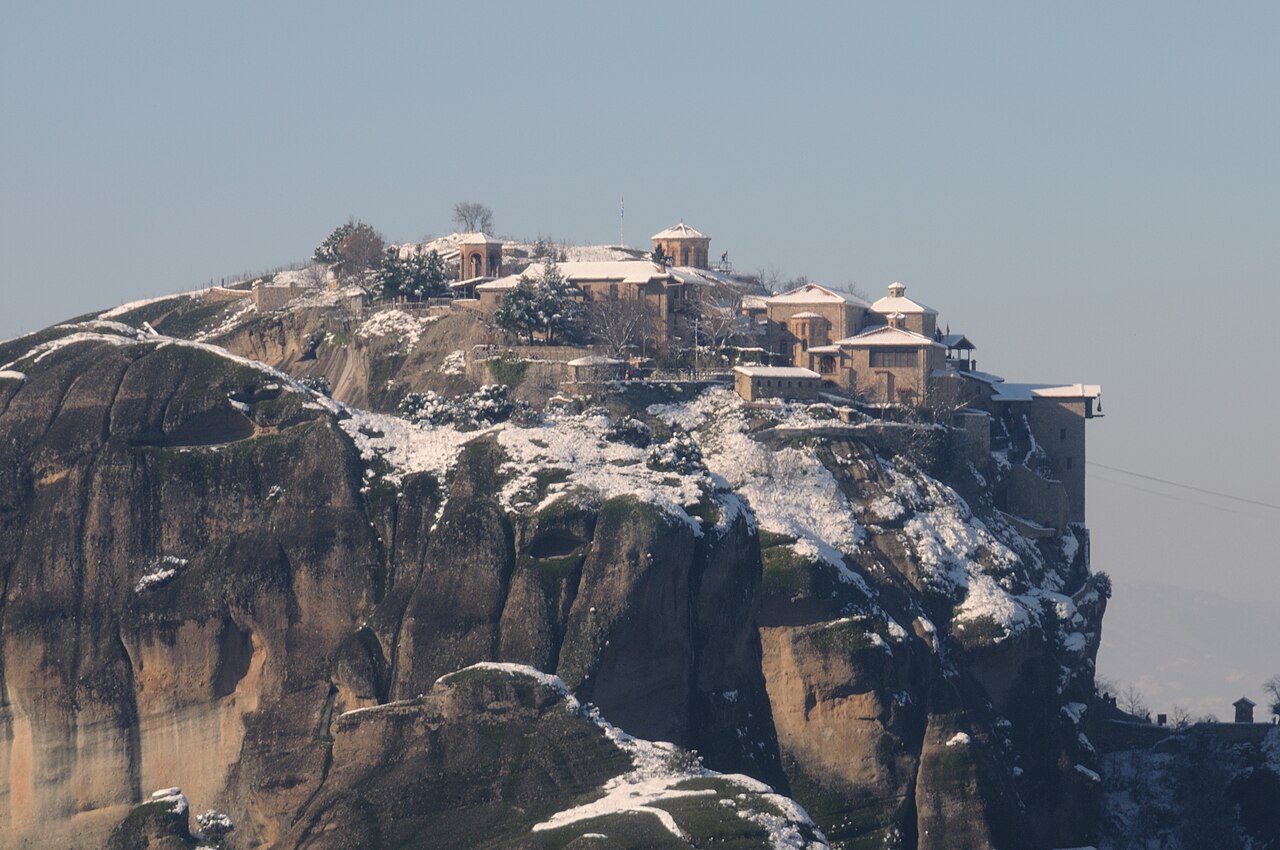
Of the 24 monasteries built here between the 14th and 16th centuries, six remain active, and a first visit should choose by what each holds. The Great Meteoron — founded around 1340 by St Athanasios the Meteorite, the largest house, on the broadest pillar — is the essential interior: its katholikon (the Church of the Transfiguration, 1387–88, rebuilt 1544–45) carries full fresco cycles of 1552, and its museum fills the old refectory and hospital with icons, manuscripts and the monastery's wartime story. It publishes summer hours of 9:30–15:00 (closed Tuesdays), so it goes first in the day, and the climb rewards it: the route crosses by bridge and stair from the neighbouring rock, past the winch tower where goods — and once monks — rose in nets. Varlaam, second largest and next door, stores the proof in its museum: the great rope-winch and the barrel said to have carried the monastery's supplies up for centuries, plus 16th-century frescoes by Frangos Katelanos (1548).
The connoisseurs' third is the smallest. St Nicholas Anapafsas, tucked against the road near Kastraki, squeezes its church onto a narrow rock top in stacked levels, and its katholikon was painted in 1527 by Theophanes the Cretan — the foundational frescoes of the Cretan school, the painter at his most intimate scale. Rousanou (a nunnery, its church dense with 1560 frescoes) and Holy Trinity (the hardest climb, ~140 steps, the most isolated pillar, and a James Bond appearance in For Your Eyes Only, 1981) fill a second day; St Stephen, reached by a flat bridge with no stairs, is the kindest to tired legs and the sunset crowds know it. Entry everywhere is €5 cash per house; there is no combined pass, so the plan is arithmetic: three houses, €15, one dress code.
Between the pillars, walk. The old network of monk paths — cobbled kalderimi threading the conglomerate towers' feet — links Kastraki village to the monasteries below the road's switchbacks: the path from Kastraki up to St Nicholas and on toward the abandoned Ypapanti monastery (14th century, built into a cliff hollow, reachable only on foot) gives the pillars at walking pace, with the geology underfoot: sandstone and conglomerate laid down ~60 million years ago and carved by weather into towers. The sunset assembly point is the Psaropetra viewpoint on the upper road — arrive forty minutes early in season — and the bases are Kastraki (the village inside the rocks, quieter) and Kalabaka (the town, with the station: trains from Athens and Thessaloniki, about 4–5 hours from the capital). The KTEL bus loops from Kalabaka up past the monastery doors (€2.00) for those not driving.
Picture the place
The winch tower at Varlaam: a stone turret overhanging three hundred feet of air, the great net folded below the beam like a fishing creel for giants.
The easily missed detail
Look for the barrels and the rope: until the 1920s there were no stairs at all, and everything — wine, grain, timber, visitors in the net — rose by windlass from the valley. The Great Meteoron's tower still keeps its windlass room, and the older travel accounts of being hauled up in the net ("the rope is replaced when it breaks — when the Lord wills," a monk famously told one trembling visitor) are displayed beside it. The stairs you climb are younger than the motor car. Modern Meteora's real miracle is not the monasteries' height; it is that the height was ever the point.
A practical rhythm
- Great Meteoron first — Its 15:00 summer closing is the day's binding constraint; Varlaam after, St Nicholas on the way down
- Dress once, climb all day — Long trousers or skirt and covered shoulders from the morning; wrap skirts wait at each door but the queue for them costs the cool hours
- Cash in fives — €5 per house, cash only at every gate; carry the day's total in small notes
What could complicate the plan
The weekly closures shape everything: St Stephen shuts Mondays, the Great Meteoron Tuesdays, Rousanou Wednesdays, Holy Trinity Thursdays, and Varlaam and St Nicholas Fridays — a Friday arrival halves the choice, while weekends open all six. Summer hours run April 1–October 31; winter shortens them and adds closures (the Great Meteoron also closes Wednesdays and Thursdays, and all of February). Coaches bunch at the Great Meteoron and Varlaam between 10:30 and 13:30; the independent traveler's countermove is the early start or the late afternoon. Photography is forbidden inside the churches everywhere.
What to do next
Pick two nights, fix the three-house route around the closing days, and be at the Great Meteoron's gate for opening with cash and covered shoulders.
Sources
- UNESCO World Heritage List — Meteora (1988): 24 monasteries of the 14th–16th centuries, six active; the katholikon frescoes of the Great Meteoron (1552) and Theophanes' 1527 paintings at St Nicholas Anapafsas
- Holy Monastery of the Great Meteoron — visiting hours (summer 9:30–15:00, closed Tuesdays), the winch tower and the museum collections
- The monasteries' published visitor information — €5 cash entry per house, no combined ticket, the weekly closing-day pattern and the dress code
- KTEL Trikala — the Kalabaka–Meteora bus loop (€2.00) connecting the town, Kastraki and the monastery doors