Montevideo / Uruguay Things to do
What are the most worthwhile things to do in Montevideo on a first visit?
The short answer
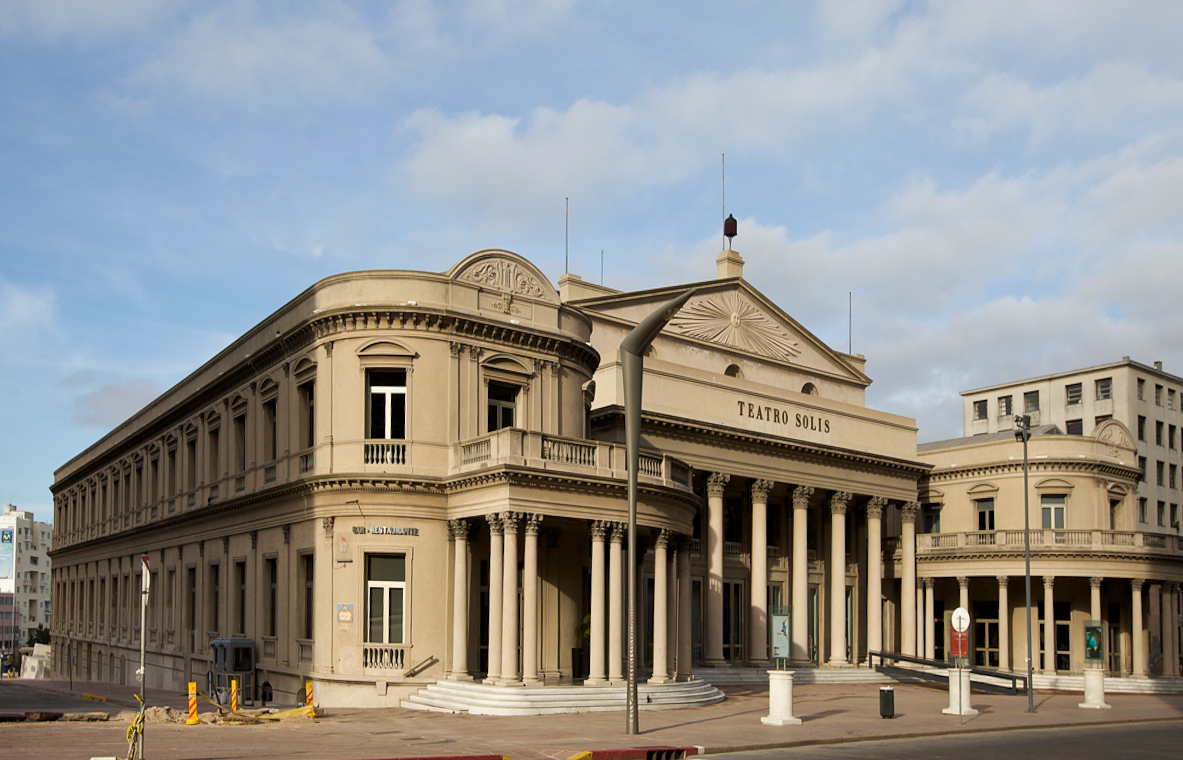
Start at the Teatro Solís, inaugurated on 25 August 1856 with Verdi's Ernani — the city has owned it since 1937, runs 5 different guided-tour formats in several languages, and takes about 40,000 people through it a year.
The answer, with local context
The Solís is the clearest single window into how Montevideo built itself. A shareholders' society formed on 25 June 1840 to put up a theater; the inauguration in 1856 was attended by President Gabriel Antonio Pereira; the lateral wings went up between 1869 and 1874 to a design by the French architect Víctor Rabu. The Intendencia bought the building in 1937 and still operates it as a public service, with programming set by an advisory artistic council.
Its interior is more varied than a single auditorium. The Sala Principal is configured for 1,144 seats for music, 850 for theater, 812 for opera and 710 for cinema. The Sala Zavala Muniz holds 288 in a flexible black-box arrangement and the Sala Delmira Agustini 150 on the second floor. In the basement, the Sala Estela Medina exhibition space runs a main corridor 25 m by 3 m with a 2.4 m ceiling, there is a 20-seat audiovisual room, and the CIDDAE documentation and research center sits one level down. Three resident ensembles use the house: the Comedia Nacional, created on 2 October 1947, the Orquesta Filarmónica de Montevideo, and the Banda Sinfónica de Montevideo, created on 14 October 1907.
The counterweight to all that gilt is outdoors and free. UNESCO's heritage listing describes candombe moving through Sur, Palermo and Cordón, led by the most prestigious drummers from families with generations of practice, with other drummers marching behind them in rows and dancers alongside. The call-and-response between the three districts both links them and signals which one you are standing in.
Picture the place
The two experiences sit a short walk apart and could not be less alike: a neoclassical house whose gilded second-floor foyer is used between acts, and a street where the drums are tuned over a fire before anyone moves. One has a seating chart; the other has a route.
The easily missed detail
Heritage Day is the day to be here if you want the city to open its doors — the Solís alone counts about 15,000 visitors on it, against 40,000 across the entire rest of the year on guided tours. For visitors who want the city's audience-development side, the theater also reports 20,000 people a year at talks, congresses and seminars and 800 at workshops.
A practical rhythm
- Daytime — A guided tour of the Solís; the organization runs 5 formats and employed 89 staff as of its 2019 chart.
- Sunday — Candombe, which UNESCO records as weekly, with gatherings forming around communal fires before the march begins.
- One day out — Canelones, where the Ministry of Tourism counts about 50 wineries and vineyards open to visitors nationally and Las Piedras hosts the National Vendimia Festival on 11 and 12 March.
What could complicate the plan
Candombe is a living community practice on public streets, not a scheduled performance with a ticket, so there is no guaranteed start time and the three neighborhoods are the frame rather than a venue. The Solís has been closed for long stretches before — from November 1998 to 25 August 2004 — and the restoration passed through three successive design teams, so a venue-led itinerary deserves a check against the current program. Uruguay reports its climate as yearly observations, and the national yearbook shows single months above 9 inches of rain, which can shut down a street-based plan without notice.
What to do next
The Montevideo food question in this group covers Tannat and Uruguay's vineyard figures; the when-to-visit question sets out the rainfall tables and the Sunday rhythm in more detail.
Sources
- Intendencia de Montevideo, Teatro Solís institutional dossier — 1840 society, 1856 inauguration, Rabu wings, 1937 purchase, hall capacities, resident ensembles, visitor and staff figures
- UNESCO Intangible Cultural Heritage, Candombe and its socio-cultural space: a community practice — the three neighborhoods, procession structure, weekly frequency
- Ministerio de Turismo (Uruguay), Vendimia 2022 — wineries open to visitors, Las Piedras festival dates
- Instituto Nacional de Estadística (Uruguay), Anuario Estadístico Nacional 2025, chapter 1.2 Clima — observed monthly precipitation by station