Norway country guide When to visit
When is the best time to visit Norway for Bergen?
The short answer
Late May and June — Bergen's own 1991–2020 May precipitation normal is 4.29 inches (109.0 mm), roughly half the monthly average implied by its extraordinary annual total of 98.2 inches (2,495 mm), and the long northern daylight is already in place.
The answer, with local context
Bergen's rainfall is in a category of its own among European cities. The Meteorological Institute's Florida station, in the city itself, gives a 1991–2020 annual precipitation normal of 2,495 mm — 98.2 inches — against an annual mean temperature of 47.1°F (8.4°C). To put that in perspective, the station logged 213 separate days with more than a millimeter of precipitation in 2024, and a 2024 annual total of 110.5 inches (2,806.1 mm). Even a comparatively dry recent year, 2021, still produced 171 wet days.
The seasonal shape is what makes late spring the answer. The May normal at Florida is 109.0 mm with a monthly temperature normal of 51.3°F (10.7°C). Spread the annual normal evenly across twelve months and you get about 208 mm; May comes in at barely half of that. The rain does not stop, but it thins, and the gap between May and the autumn is wide enough to decide a trip on.
Nationally, this is also when Norway's interior opens up. The country runs more than a thousand miles from the Skagerrak to the Barents Sea, and mountain passes, high-altitude roads and fjord-head trailheads clear progressively through May and June. A Bergen-first itinerary that carries on inland — up the Sognefjord arms, over to Røros, or north — is far more practical once the snowline has lifted, and the same window gives the far north its midnight-sun season while the southwest coast is at its driest.
Picture the place
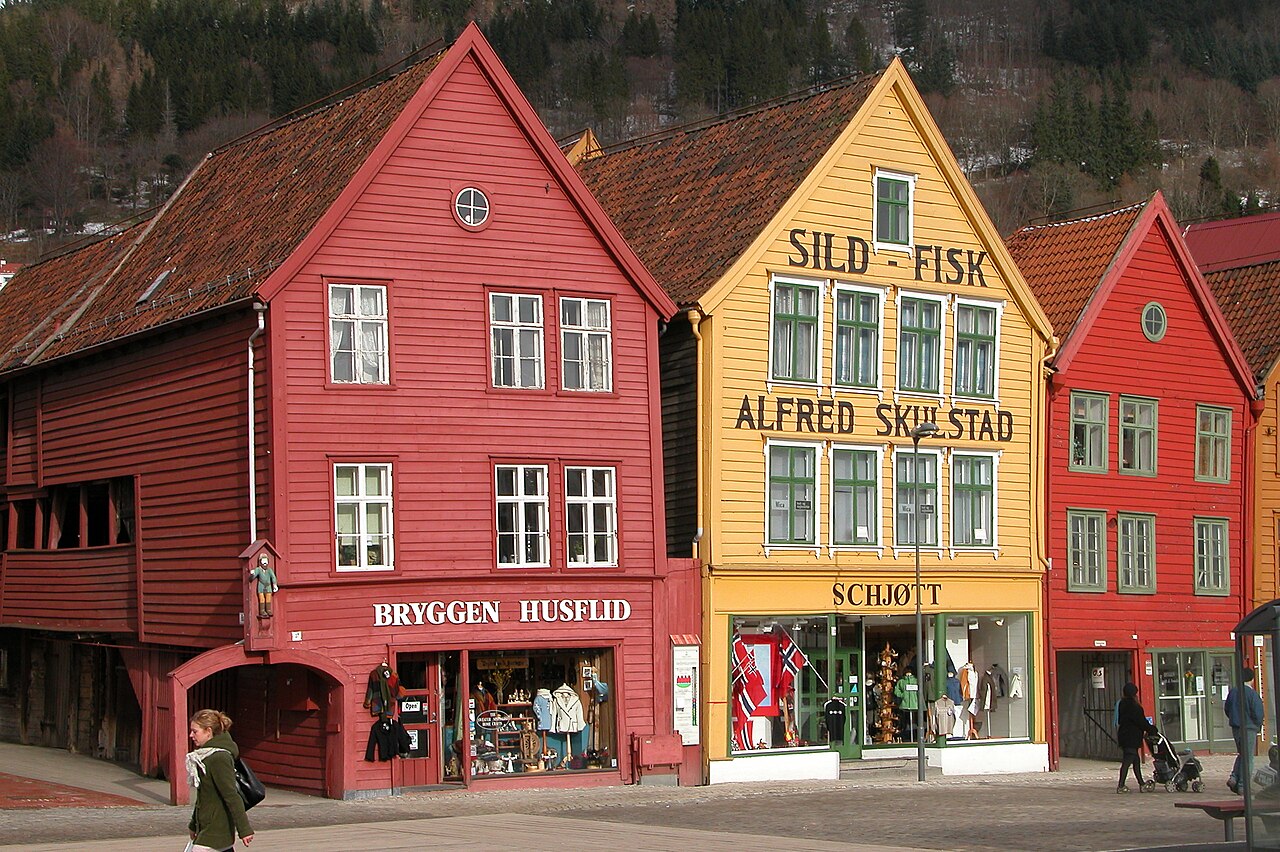
Bergen sits in a bowl between seven hills at the head of a fjord, and the topography is why the rain behaves as it does: Atlantic air is forced up the moment it hits the coast. The wooden Hanseatic frontage of Bryggen faces the inner harbor on its eastern side, so the gable ends catch the low northern light directly in the long evenings of June.
The easily missed detail
Bryggen was inscribed on the World Heritage List in 1979 under criterion (iii), and what survives is about 62 buildings of the former townscape. The reason it looks the way it does is fire. Bryggen burned repeatedly, was rebuilt each time on the same property lines using the same methods, and its present appearance dates largely from after the fire of 1702 — with the most recent fire as late as 1955. That rebuilding discipline is the heritage: the plots, the alley widths and the construction technique are medieval even where the timber is not. It also means the site rewards walking the alleys between the buildings rather than photographing the frontage from across the water.
A practical rhythm
- Late May — The driest month on the Florida record and the point at which inland routes begin to open. Pack for rain anyway.
- June — Long daylight, mild temperatures near the May–June normal, and the fjord excursions running at full frequency.
- September to January — Precipitation climbs steeply toward the annual total; useful for a short city visit, hard on a multi-stop itinerary.
What could complicate the plan
The rain is not a caveat, it is a planning constraint: with 171 to 213 wet days in a typical recent year, waterproof footwear is equipment rather than a precaution, and any itinerary built on a single clear-weather viewpoint will probably fail. Norway sits inside the Schengen Area, so US passport holders travel without a visa for short stays but are counted against the Schengen 90-days-in-180 allowance alongside any other time spent in the zone. Bryggen's alleys are uneven timber and stone, and the buildings themselves lean — access is limited in places. Anyone planning to camp on the hills behind the city in this window also meets the national fire rules: open fires in nature are prohibited from 15 April to 15 September, which covers the whole of the recommended season. And Bergen's cruise traffic overlaps exactly with the dry window, so the harbor front is at its most crowded in the months the weather is best.
What to do next
For where to go after Bergen, read the Norway places-and-experiences answer in this group; the Norway trip-planning answer covers the right-of-access rules that govern camping and fires.
Sources
- Meteorologisk institutt, via Bergen kommune — Bergen-Florida 1991–2020 annual precipitation and temperature normals, annual wet-day counts, 2024 annual total
- Norwegian Meteorological Institute / NRK (yr.no) — Bergen-Florida monthly May temperature and precipitation normals
- UNESCO World Heritage Centre — Bryggen criterion (iii), surviving building count, 1702 and 1955 fires, rebuilding on earlier property lines
- UNESCO World Heritage Centre — Bryggen inscription year, 1979
- Visit Norway (official national tourism board) — national prohibition on open fires in nature from 15 April to 15 September