Oslo / Norway Things to do
What are the most worthwhile things to do in Oslo on a first visit?
The short answer
Walk the Opera House roof and the Bjørvika waterfront, face The Scream in the National Museum, ride out to Bygdøy for the Fram and the open-air museum, and finish among Vigeland's two hundred granite figures — Oslo's first visit is a waterfront, two museums and a park.
The answer, with local context
Start at the water, where Oslo rebuilt itself. The Opera House (opened April 2008, by Snøhetta) rises from the fjord in white Carrara marble, its roof a public slope anyone may walk — the city's defining gesture, and still the best first hour: the fjord, the islands and the Barcode towers in one panorama. Bjørvika unfolds behind it: the MUNCH museum (opened October 2021), thirteen storeys holding the world's largest Edvard Munch collection, including a version of The Scream (1893's sibling, painted 1910) and the vast, unfinished canvases of his late years; and Deichman Bjørvika (2020), the main public library, worth entering for its architecture alone. Across the harbor, the National Museum (opened June 11, 2022 — the Nordic countries' largest) holds the other, most famous Scream: the 1893 tempera version, plus Norway's national-romantic landscapes and a design collection that runs from Viking metalwork to modern chairs. Between them, these two buildings are the strongest museum pairing in Scandinavia, and the Oslo Pass (the city's official card) covers both with all public transport.
The second act is the Bygdøy peninsula, reached by bus 30 or the summer ferry. Here the Fram Museum keeps the polar ship Fram herself (launched 1892), the strongest wooden ship ever built, which Froze into the Arctic ice under Nansen (1893–96) and carried Amundsen to the South Pole (1911) — visitors walk her decks and below them. Beside it, the Kon-Tiki Museum holds Thor Heyerdahl's 1947 balsa raft, and the Norwegian Museum of Cultural History spreads 160 historic buildings across its grounds, crowned by the Gol stave church (c. 1200). The honest gap, in capitals: the Viking ships are not here right now — the Viking Ship House closed on October 1, 2021, and the Oseberg, Gokstad and Tune ships reopen in the new Museum of the Viking Age on the same site, planned for 2027 (November is the reported target); until then, the Historical Museum downtown fills the breach with its VÍKINGR exhibition. Do not let any itinerary sell you the ships before then.
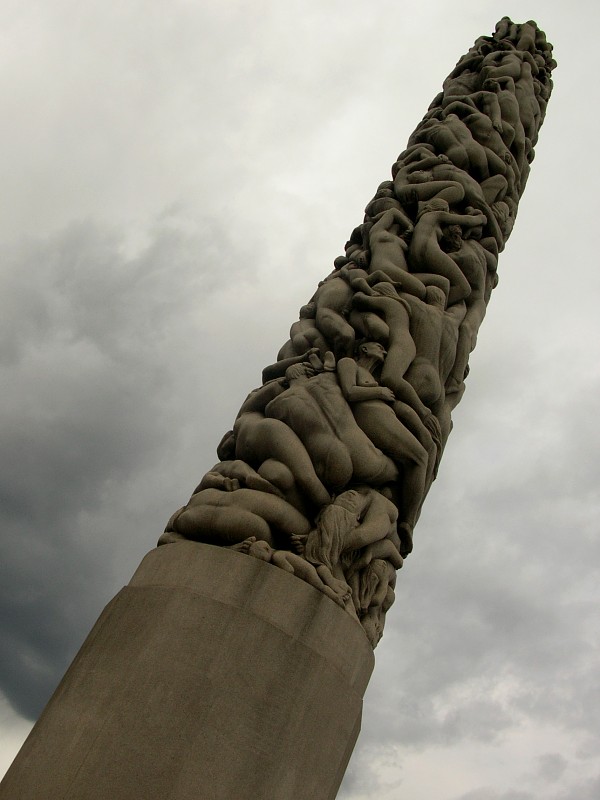
Above the center, Frogner Park holds the third act: the Vigeland Sculpture Park, Gustav Vigeland's life's work installed in the 1940s — 212 bronze and granite sculptures along one axis, the 46-foot Monolith carved from a single stone with 121 figures, the famous Angry Boy (Sinnataggen) on the bridge — free, open around the clock, and Norway's most visited attraction. Pair it with Holmenkollen, the ski jump in the hills (rebuilt 2010; its ski museum, founded 1923, is the world's oldest) for the city's great northward view, and close the circuit downtown: Akershus Fortress (begun 1299) on the harbor point, and City Hall (opened 1950), where the Nobel Peace Prize — the only Nobel awarded outside Sweden, by a committee of the Storting — is presented every December 10 in a hall painted with Norwegian history. The fjord finishes any itinerary it begins: an island ferry loop at golden hour, or a floating sauna and a cold plunge, the full Oslo baptism.
Picture the place
The Opera roof at 9 p.m. in May: a white granite hillside of picnics and wedding photos, the fjord going silver, and a ferry sliding toward the islands under a sky that refuses to darken.
The easily missed detail
In the National Museum, find the Scream room's quiet neighbour: Munch painted four versions of the image (plus lithographs), and Oslo holds the two greatest within 800 meters of each other — the 1893 tempera in the National Museum and the 1910 oil in MUNCH — so the world's most reproduced face can be compared with itself in a single morning, in the city where he painted it. Most visitors see one and never learn there was a choice. The versions differ: the National Museum's is rawer, pastel-edged, the fjord behind in blood bands; the MUNCH canvas is larger, calmer, almost resigned. Decide which one is yours.
A practical rhythm
- Waterfront first — Opera roof, MUNCH and National Museum on day one; the trio shares one harbor and one Oslo Pass
- Bygdøy by ferry in summer — The boat to the museums is half the pleasure; bus 30 for speed in the cold months
- Vigeland at the edges of the day — The park never closes; go early or at dusk and the axis is nearly private
What could complicate the plan
The Viking gap is the headline (ships closed until the Museum of the Viking Age opens in 2027; the VÍKINGR exhibition at the Historical Museum is announced only until December 2026), so Viking expectations need managing in writing. Beyond it: Oslo museum hours compress on Mondays (several houses close or open late), MUNCH's Scream rotates off-view for conservation at intervals (one version or another is sometimes resting), and the city's prices are the real itinerary constraint — the Oslo Pass pays for itself at three museums plus transport, which is the arithmetic most first visits satisfy by day two.
What to do next
Buy the Oslo Pass, spend day one between the Opera roof and the two great museums, and give Bygdøy and Vigeland the second day.
Sources
- National Museum, Oslo — opened June 11, 2022; the 1893 Scream and the national collections
- MUNCH, Oslo — opened October 22, 2021; the world's largest Munch collection, including the 1910 Scream
- Museum of the Viking Age (University of Oslo) — the Viking Ship House closed October 1, 2021; the ships reopen in the new museum, planned for 2027
- Fram Museum / Norwegian Museum of Cultural History — the Fram (1893–96, 1911) and the Bygdøy open-air collection with the Gol stave church
- The Vigeland Museum, Oslo Municipality — 212 sculptures and the Monolith, free and open at all hours