Pokhara / Nepal Things to do
What are the most worthwhile things to do in Pokhara on a first visit?
The short answer
Row out to the island temple on Phewa Lake at dawn, take the sunrise from Sarangkot, walk up to the World Peace Pagoda, and spend one afternoon in the caves and gorges the Seti River has cut through the city.
The answer, with local context
Everything in Pokhara radiates from Phewa Lake, one of 9 lakes in a 26,106-hectare valley basin listed as a Wetland of International Importance on February 2, 2016. Rent one of the gaudy wooden rowboats at the Lakeside ghats and make the first crossing of the day to Tal Barahi Temple, the two-story pagoda standing on its own small island in the lake, dedicated to the goddess Barahi in her boar aspect and reachable only by boat. On a clear morning the row out doubles as the city's great free show: the whole Annapurna wall reflected in the water, with three of the world's ten highest mountains — Dhaulagiri at 26,795 feet (8,167 m), Annapurna I at 26,545 feet (8,091 m) and Manaslu at 26,781 feet (8,163 m) — visible from a city street, a line-up few places on earth can match.
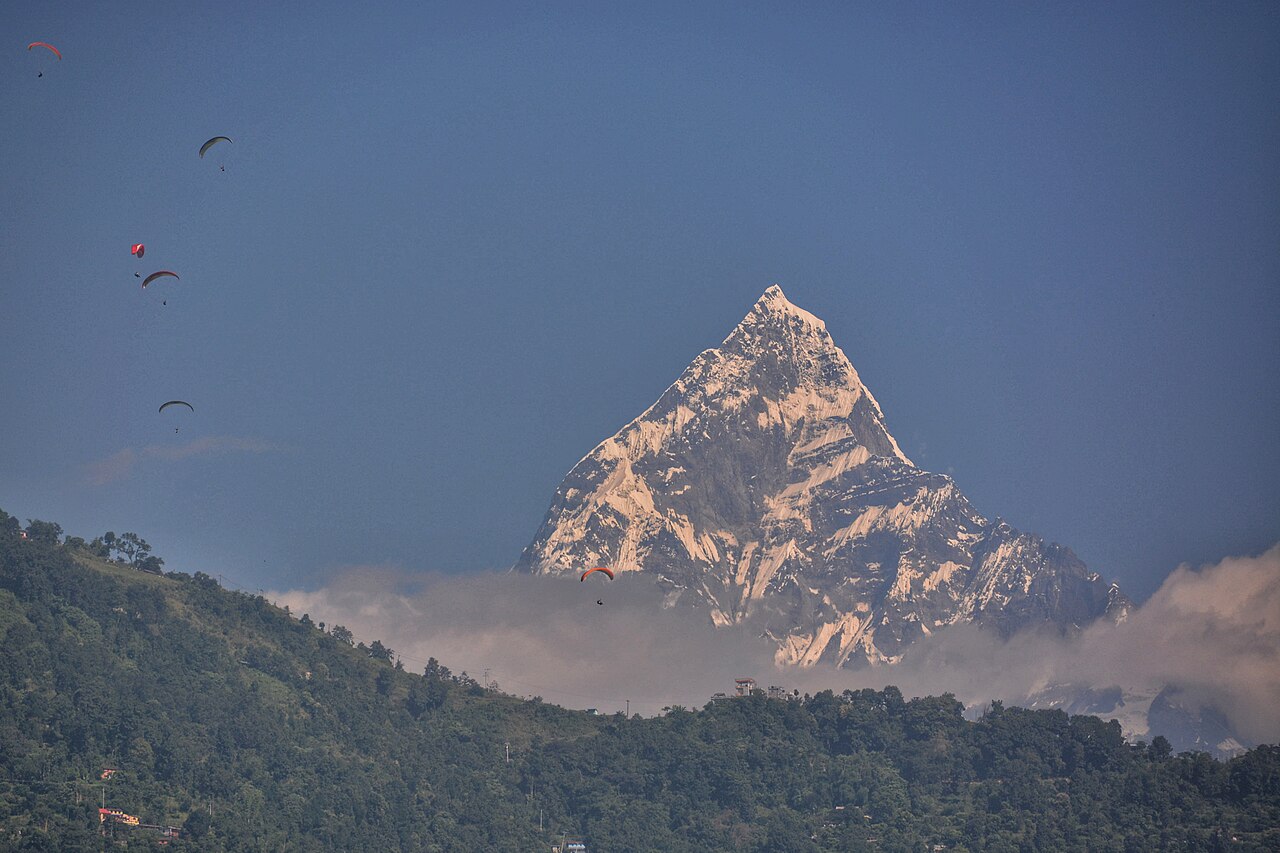
The viewpoints form a pair. Sarangkot, the ridge village northwest of the city, is the sunrise seat: the sun strikes Annapurna South and swings across to Machhapuchhre while the lake lights up below. It is also the paragliding hill — tandem flights now launch mainly from Mandredhunga at about 5,840 feet (1,780 m) for 25 to 30 minutes over the terraces — and the top station of the ZipFlyer, which drops 2,000 feet (610 m) over its 1.12-mile (1.8 km) run at speeds up to 75 mph. Across the lake, the white World Peace Pagoda crowns Ananda Hill: built by monks of the Japanese Nipponzan-Myohoji order with local supporters, it holds Buddha images gifted from Japan, Sri Lanka and Thailand, and the walk up through the Raniban forest from the boat landing is the best short hike in the city. Machhapuchhre itself, the pyramid in every view, is never climbed: sacred to Shiva, it has been closed to mountaineers since the sole 1957 expedition turned back below the summit, as promised to the Nepali government.
Pokhara's strangest sights are underground, carved by the milky-white Seti Gandaki. At Davis Falls — Patale Chhango in Nepali, the Fall of the Netherworld, 2 km southwest of Pokhara's airport on the Siddhartha Highway — the outflow of Phewa Lake drops into rock it has carved into caves and tunnels, and the English name commemorates a Swiss woman swept away here in 1961. Across the road, the Gupteshwar Mahadev cave, cut by the same water, leads down to a Shiva shrine that local worshippers keep busy and almost no visitor skips. The Seti itself runs through the middle of the city in a gorge narrow and deep enough that ordinary traffic bridges cross it unremarked. Finish with the International Mountain Museum, opened to the public on February 5, 2004 by the Nepal Mountaineering Association on 12.6 acres south of the airport: its halls on Himalayan peoples, the fourteen eight-thousanders and mountaineering history give the view from Sarangkot its names and stories.
Picture the place
From the Peace Pagoda terrace the city lies flattened between two waters — the lake directly below, milky-green and boat-dotted, and beyond the rooftops the white wall of the Annapurnas filling half the sky, close enough to feel like weather.
The easily missed detail
Pokhara has a second lake district that most first visits skip entirely. Begnas Lake, about 7 miles (11 km) east, has no paragliders, no Lakeside strip and a fraction of the boats — the same hills, the same fish restaurants on the shore, and the quiet that Phewa had a generation ago. One afternoon there balances the whole trip.
A practical rhythm
- First dawn — Tal Barahi by boat while the lake is flat, then the Peace Pagoda climb before the heat.
- Second dawn — Sarangkot for sunrise, a tandem paraglide down if the thermals are kind, and the caves and falls in the afternoon.
- Rainy or cloudy half-day — The International Mountain Museum, which is the one major sight that bad weather cannot spoil.
What could complicate the plan
Pokhara's sights are hostage to visibility: a cloudy week turns Sarangkot and the pagoda into viewpoints of nothing, so keep the museum and caves as the flexible days and seize the first clear dawn for the ridge. Boat hire on Phewa runs by the hour from the ghats and prices are set by the local boat association — agree the route and duration before casting off. Davis Falls in the dry months is a shadow of its monsoon roar, while in the monsoon the caves can close when water rises; the underground sights trade seasons just as the viewpoints do.
What to do next
Base in Lakeside within walking distance of the boat ghats, and let the next answer sort the eating — the thali houses and lake fish are concentrated in the same few streets.
Sources
- Nepal Mountaineering Association — the International Mountain Museum opened to the public on February 5, 2004, on 12.6 acres with more than 4,200 m² of exhibition space
- Ramsar Convention Secretariat, Information Sheet for the Lake Cluster of Pokhara Valley — the 9-lake cluster including Phewa, listed on February 2, 2016 over an official area of 26,106 ha at elevations from 622 m to 2,403 m
- Nepal Tourism Board — Davis Falls as Patale Chhango, "Fall of the Netherworld," about 2 km southwest of Pokhara Airport on the Siddhartha Highway, fed by Phewa Lake, named for a Swiss woman swept away in 1961, with the Gupteshwar Mahadev cave and its Shiva shrine on the far side