Pokhara / Nepal When to visit
When should I visit Pokhara, Nepal, for the best experience?
The short answer
October — the monsoon has just withdrawn, the Annapurna wall stands washed and sharp over Phewa Lake, and the rains that make Pokhara Nepal's wettest city have collapsed from a torrent to a trickle.
The answer, with local context
Pokhara's calendar is written in water. Sitting at 2,713 feet (827 m) directly beneath the Annapurna range, the city catches the monsoon clouds as they bank against the Himalaya and wrings out about 152 inches (3,868 mm) of rain a year — well over twice Kathmandu's total. The valley basin is formally classed as humid subtropical, mild and dry in winter and hot in summer, and the wetland record for its 9 lakes puts Pokhara among the highest-rainfall zones in its own region. The Department of Hydrology and Meteorology's normals put July alone at roughly 941 mm, while September still delivers about 635 mm, which is why autumn here does not begin until the DHM's normal monsoon withdrawal date of October 2 has passed. October's own rainfall falls to about 159 mm, November's to just 17 mm, and the exchange buys the clearest mountain air of the year: October days average 82°F (28°C), nights 63°F (17°C), and the dawn reflection of Machhapuchhre, the Fishtail Peak, lies flat and double on Phewa Lake.
October also stacks Pokhara's working calendar in the visitor's favor. The tandem paragliding season opens in earnest, with thermals building over Sarangkot by mid-morning; the Annapurna trails above the city are dry and staffed, since October is the trekking industry's biggest month; and in most years the month carries Dashain, Nepal's fifteen-day festival, when the city slows, swings go up in the villages and families travel home. It is the one month when the lake, the viewpoints, the air sports and the trailheads are all simultaneously in season.
The runners-up each surrender something. November keeps the clarity and drops the crowds, but nights cool toward 54°F (12°C) and the green drains out of the paddies. March and April return warmth and rhododendrons to the hills above the city, yet the pre-monsoon haze thickens week by week and May already averages some 14 inches of rain. Winter mornings can be crystalline, but Pokhara's famous view is a gamble in the valley fog that pools over the lake in December and January.
Picture the place
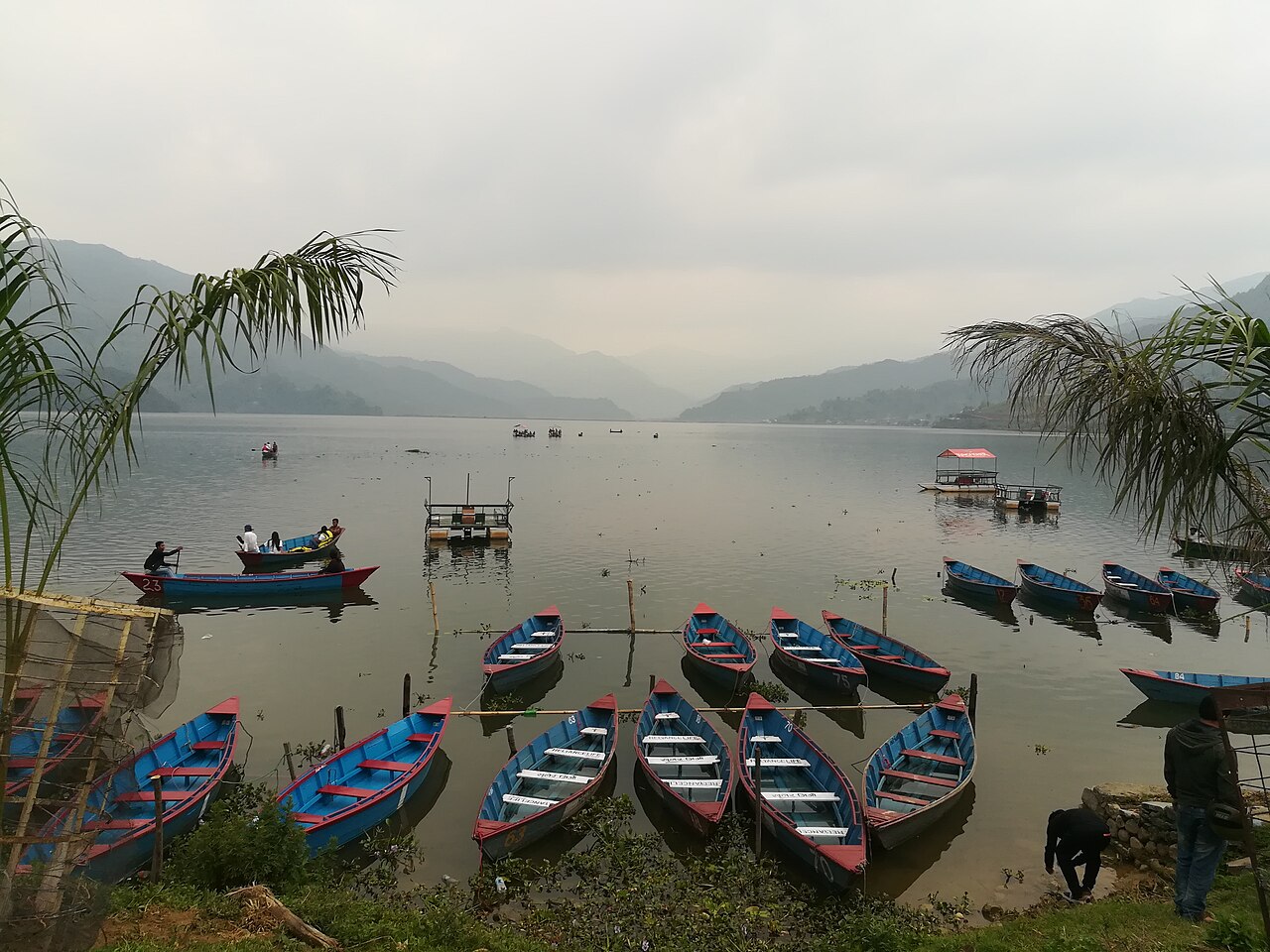
At six on an October morning the lake is a sheet of hammered tin: blue wooden boats knock at the Lakeside ghats, mist peels off the water in strips, and Machhapuchhre hangs upside down in the shallows, sharper than the real peak above it.
The easily missed detail
The view is a morning phenomenon with a closing time. Even in October, convection builds over the valley by late morning and the Annapurna wall commonly vanishes behind cloud by noon — travelers who schedule Sarangkot or the lake for the afternoon are buying the city's second-best product. Everything in Pokhara should be planned backwards from dawn.
A practical rhythm
- Dawn — Be on the water or on the Sarangkot ridge before sunrise; these are the only guaranteed mountain hours of the day.
- Midday — Caves, museums and lunch in the shade while cloud covers the range and the valley heats up.
- Late afternoon — A second, softer chance at the view from the World Peace Pagoda as the light rakes across the lake, then Lakeside for the evening.
What could complicate the plan
The monsoon does not read its own normals: in 2025 it lingered until October 10, eight days past the average withdrawal, and an early-October trip can still inherit landslides on the Kathmandu road and clouds over the lake. October's popularity also fills Lakeside hotels and pushes paragliding slots to book out days ahead. And Dashain, whenever it lands, empties some offices and overloads domestic transport as the whole country moves at once.
What to do next
Aim for the middle two weeks of October, after the withdrawal date but before the festival peak thickens, and read the next answer to spend those clear mornings properly.
Sources
- Department of Hydrology and Meteorology, Nepal — the 1991–2020 normals for the Pokhara station: annual rainfall about 3,868 mm, July about 941 mm, October about 159 mm and November about 17 mm, with normal monsoon withdrawal on October 2
- Nepal Tourism Board — October–November as the clearest post-monsoon window for Himalayan views, with October the peak trekking month
- Ramsar Convention Secretariat, Information Sheet for the Lake Cluster of Pokhara Valley — the valley's 9 lakes and its humid subtropical classification, mild and dry in winter and hot in summer, with Pokhara among the highest-rainfall zones of the area (sheet published February 2016)