Punta Cana / Dominican Republic When to visit
When should I visit Punta Cana, Dominican Republic, for the best experience?
The short answer
February and March — the driest months on the Dominican Republic's eastern coast, with highs around 83°F (28°C), nights near 69°F (21°C), and roughly two inches of rain a month.
The answer, with local context
Punta Cana occupies the far eastern corner of Hispaniola, where the coastline faces the open Atlantic and the trade winds come in almost unobstructed. That exposure keeps the temperature range unusually narrow. January averages a high of 83°F (28°C) and a low of 69°F (21°C); August reaches about 89°F (32°C) with nights near 75°F (24°C). There is no cold season and no genuinely cool one — the variable is water, not temperature.
Rain arrives in two waves rather than one long wet season. May brings the first, and October and November bring a second, heavier one, with those months averaging six to seven inches. February and March sit at the bottom of the curve. The National Hurricane Center's Atlantic season runs June 1 to November 30, and the Dominican Republic's eastern coast is squarely inside the basin, with the second rainfall peak falling in its latter half.
Entry is a formality but a mandatory one. The Dirección General de Migración requires every passenger to complete the digital entry and exit form online before entering or leaving the country; it serves both the migration authority and customs. The UK FCDO describes the same form as completable up to seven days before arrival and issuing a QR code that may be requested at check-in, on arrival or on departure, and notes that border officials take fingerprints and a photograph. There is no paper form to fill out on the plane.
Picture the place
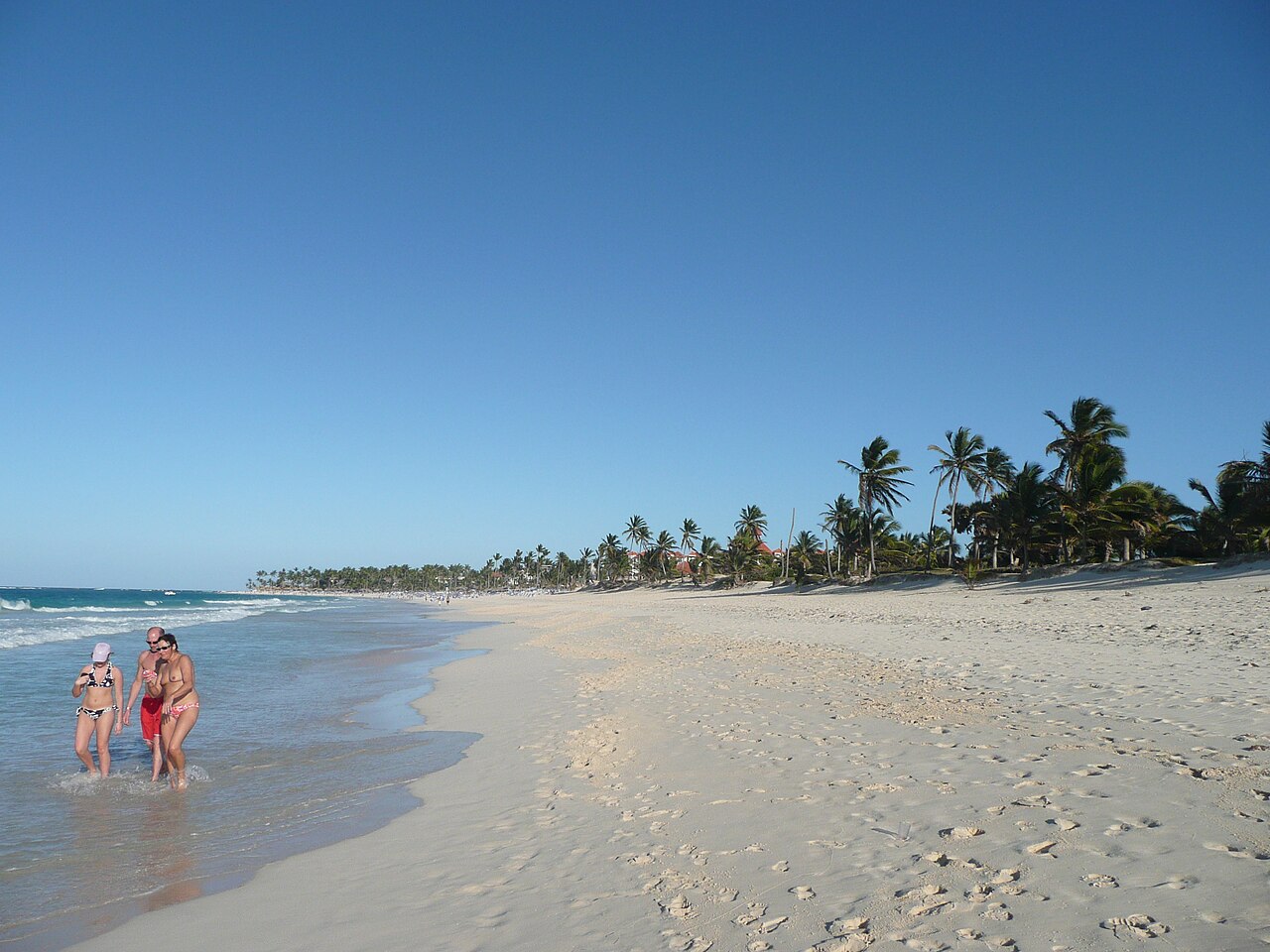
The coast here is a long reef-sheltered shelf, so the water inside the reef stays shallow and warm while the surf breaks offshore — and because the beach runs roughly north to south facing east, the sun comes up directly out of the sea and the light on the sand is at its best before eight in the morning.
The easily missed detail
Punta Cana is not the whole of this coast. The strip runs north from Punta Cana itself through Cabeza de Toro, Bávaro, El Cortecito, Macao and up to Uvero Alto, and the character changes along it: the southern end is calmer and more sheltered, while the northern beaches toward Macao and Uvero Alto take more swell and have fewer resorts behind them. Choosing a month matters less than choosing which part of a thirty-mile coast you are booking.
A practical rhythm
- February and March — Driest and breeziest, with the trade wind steady enough to take the edge off the afternoons; peak demand and peak pricing.
- April to early June — Still mostly dry before the first rainfall peak builds, with warmer water and thinner crowds.
- September to November — The heaviest rain of the year arrives in October and November, inside a hurricane season that runs to November 30.
What could complicate the plan
Tourist travel to the Dominican Republic does not require a visa, but the electronic entry and exit form is not optional and must be completed in both directions. The FCDO records that travelers may be refused entry without proof of onward or return travel, and that a visit can be extended for a fee up to 120 days through the Dominican immigration service. Strict customs rules apply to goods carried in and out, and anything prohibited or subject to duty must be declared. Depending on your circumstances a yellow fever certificate may be required.
What to do next
The Punta Cana things-to-do question in this group covers Cotubanamá National Park and the day trips inland, and the food question sets out what to eat along this coast.
Sources
- NOAA National Hurricane Center — Atlantic hurricane season dates
- Dirección General de Migración, Dominican Republic — the digital entry and exit form, its mandatory application to every passenger, and its role for both migration and customs
- UK Foreign, Commonwealth and Development Office, Dominican Republic travel advice: Entry requirements — seven-day completion window, QR code, customs declaration coverage, fingerprinting and photography at the border, proof of onward travel, paid extension to 120 days, possible yellow fever certificate
- Oficina Nacional de Meteorología, Dominican Republic — monthly temperature and rainfall normals for the eastern coast