Quebec City / Canada Things to do
What are the most worthwhile things to do in Quebec City on a first visit?
The short answer
Walk the 4.6 km circuit of the city walls, tour the Citadelle, and ride out to Montmorency Falls — the three stops that explain how this city was built, defended and supplied.
The answer, with local context
Start with the founding layer. Samuel de Champlain established Quebec on July 3, 1608, and his fortified habitation stood at what is now Place-Royale in the Lower Town. Above it, the Upper Town still sits inside the only surviving fortified walls of a North American city: a 4.6 km circuit of ramparts, bastions and four gates — Saint-Louis, Saint-Jean, Kent and Prescott — that you can walk end to end. That walled district of about 135 hectares went onto the World Heritage List in 1985, inscribed under criteria (iv) and (vi) as an exceptional example of a fortified colonial town and for its link to the European colonization of the Americas.
The Citadelle caps the circuit at the highest point of Cap Diamant. Built by the British between 1820 and 1850, it is the largest British fortress in North America and remains an active garrison, home to the Royal 22e Régiment. Entry is by guided tour only, and in summer the regiment performs the Changing of the Guard at 10 a.m. from late June to Labour Day. Just outside the walls, the Plains of Abraham are where the 1759 battle between Wolfe and Montcalm was decided; both generals died of their wounds, and French Canada changed hands with the result.
The skyline's other anchor is the Château Frontenac, completed in 1893 to a design by Bruce Price for the Canadian Pacific Railway — a working hotel, but its terrace, Dufferin Terrace, is public and gives the classic view over the river narrows.
Picture the place
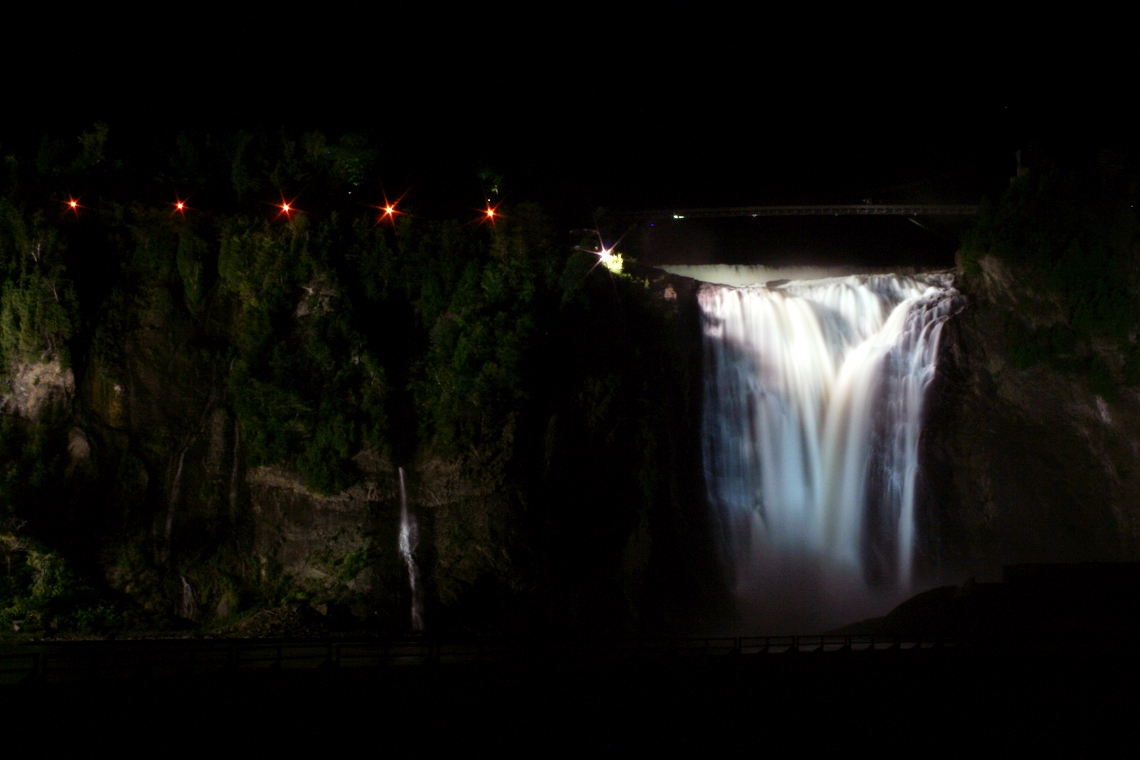
At Montmorency Falls the river drops in a single white sheet and the spray drifts across the 487-step staircase fixed to the cliff beside it; in deep winter the frozen spray builds a cone of ice at the base that climbers scale.
The easily missed detail
The Citadelle doubles as an official residence of the Governor General of Canada, which is why parts of it are furnished state rooms rather than barracks — and why there is no self-guided option at any time of year. The guided tour is the only way in, and it includes the regimental museum.
A practical rhythm
- Morning — Tour the Citadelle first to catch the 10 a.m. Changing of the Guard in summer, then walk the walls from the Saint-Louis Gate.
- Midday — Come down to Place-Royale and the Lower Town lanes, where the 1608 settlement began.
- Afternoon — Take the 15-minute drive northeast to Montmorency Falls and cross the suspension bridge over the crest.
What could complicate the plan
The falls stand 83 m (272 ft) high — 30 m taller than Niagara — but the experience is weather-bound: the staircase and bridge are exposed, and winter ice closes some viewpoints. Inside the old town, the Upper–Lower Town climb is steep and cobbled, so the day needs pacing if stairs are a problem; a funicular links the two levels beside Dufferin Terrace.
What to do next
Match these stops to a season using the when-to-visit question in this group, then use the food question to plan where to eat between them.
Sources
- Parks Canada — fortifications history, 1608 founding, wall circuit and gates
- Sépaq, Parc de la Chute-Montmorency — falls height, staircase, suspension bridge and cable car
- La Citadelle de Québec — the Royal 22e Régiment's active garrison: Citadelle construction, guided-tour-only access, the regimental museum and the Changing of the Guard schedule
- UNESCO World Heritage Centre — the Historic District of Old Québec, on the World Heritage List since 1985 under criteria (iv) and (vi), covering about 135 ha, with its provincial boundaries set by decree in 1964 under the Cultural Property Act of 1963