Quito / Ecuador Things to do
What are the most worthwhile things to do in Quito on a first visit?
The short answer
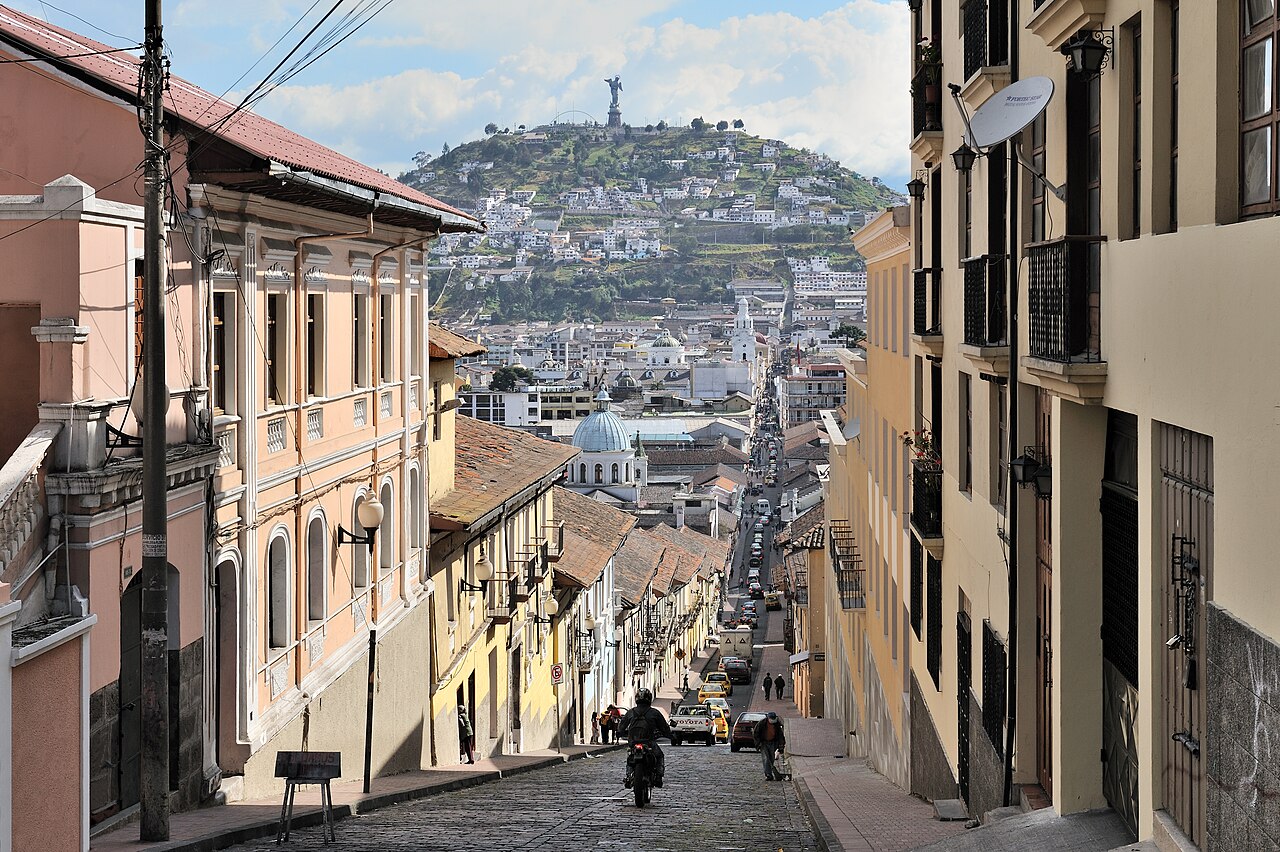
The historic center, which was one of the first places anywhere to be listed — UNESCO inscribed the City of Quito in 1978 under criteria (ii) and (iv), making it property number 2 on the World Heritage List.
The answer, with local context
The listing's low number is not trivia. UNESCO's documentary record for the property runs back to an Advisory Body evaluation and a review of nominations in 1978, Decision 02COM VIII.38, and it includes a 1979 Committee item, Decision 03COM XVIIc).61, concerning a Charter on Cracow–Quito — a reminder that Quito was being discussed alongside the other earliest listings rather than retrofitted into them. What it protects is a whole working center rather than a monument, and the most documented building inside it is the Jesuit church, La Compañía de Jesús. UNESCO's own record for the property sets out its chronology: construction began in 1605, the dome was completed in 1689 and the tower in 1690. Earthquakes in 1859 and again in 1868 collapsed that tower, and the church has stood in its present form since 1929. An intensive restoration ran from 1992 to 2005 without touching the tower.
The tower then became the property's long-running conservation story, and it is worth knowing before you go because it explains what you will and will not be able to climb. Under a 2005 agreement with the Community of Madrid, the Society of Jesus planned a reconstruction that included a viewing point at 46 meters. UNESCO records that a panoramic elevator was installed between July 2008 and March 2009, altering the original brick fabric and reducing the thickness of the tower walls to make room, along with a metal spiral staircase, and that a joint UNESCO/ICOMOS reactive monitoring mission visited from 2 to 4 March 2009 and concluded the elevator could not be removed without major damage. Ecuador's national heritage institute had asked for the project to be suspended; the Municipal Commission of Historic Areas approved continuing it in July 2008. The Committee asked for the reconstruction to stop under Decision 33 COM 7B.136, and at its 34th session in Brasília in 2010, under Decision 34 COM 7B.109, it was still awaiting a new proposal for the bell tower. The same decision shows the property and buffer zone boundaries being finalised only under the Retrospective Inventory for Latin America and the Caribbean, and asked for technical documentation and an environmental impact assessment for the Tren Ligero transit project.
UNESCO's record also puts a visitor number on the church: about 140,000 in the year before the 2009 mission.
Picture the place
The Jesuit church is a record of what this ground does. Its tower was finished in 1690 and collapsed in the earthquakes of 1859 and 1868, and the building has stood in its present form only since 1929 — and the 46-meter viewing point proposed in 2005 was high enough to need a lift threaded through walls that had to be thinned to take it.
The easily missed detail
A property can be inscribed for decades without a formal statement of its own value. UNESCO's record notes that the City of Quito lacked a Statement of Outstanding Universal Value, defined boundaries and a buffer zone as of the 2009 mission, with the boundaries still being settled in the 2010 decision. The practical consequence for a visitor is that the edge of the World Heritage area is not marked on the ground the way a fenced site's would be — and that the Committee's attention has been directed at a single building's tower rather than at the center as a whole for much of the property's recent history.
A practical rhythm
- Centre first, on foot — The inscription covers the historic center as a living place; criteria (ii) and (iv) were awarded for the ensemble, not one monument.
- La Compañía with the dates in mind — Begun 1605, dome 1689, tower 1690, twice felled by earthquake, standing in its present form since 1929.
- Higher ground later — The CDC advises adding an acclimatization day for every 1,000 meters of sleeping-altitude gain and, above 3,000 meters, raising sleeping altitude by no more than 500 meters a day.
What could complicate the plan
The Jesuit tower's reconstruction has been the subject of repeated UNESCO decisions, and the bell tower proposal was still outstanding at the Committee's 34th session, so what is accessible at the church has changed more than once and may change again. The US Department of State's Ecuador advisory of 18 August 2026 sits at Level 2 overall but names a substantial list of Level 3 and Level 4 provinces and districts elsewhere in the country, so a Quito trip that adds Esmeraldas, Guayaquil or Manabí needs checking against that list rather than against a general impression. Day trips to higher ground run into the CDC's ascent limits: above 3,000 meters it recommends no more than 500 meters of additional sleeping altitude per day and an extra acclimatization day for every 1,000 meters gained, which constrains how quickly a Quito base can be used as a springboard.
What to do next
The Quito when-to-visit answer covers the altitude timings and the months to avoid; the food answer sets out the CDC's food and water precautions and how payment works in the city.
Sources
- UNESCO World Heritage Centre, City of Quito state of conservation record, documents list and Committee decisions — inscription year and criteria, the 1978 and 1979 decision codes, Compañía de Jesús chronology, earthquake dates, restoration period, 46-metre viewing point, elevator installation dates, 2009 monitoring mission, visitor figure, decision codes, boundary and buffer-zone status, Tren Ligero request
- CDC Yellow Book 2026, High-Altitude Travel and Altitude Illness — ascent-rate limits above 3,000 metres and the acclimatization day per 1,000 metres
- US Department of State, Ecuador country information — advisory level, date, and the existence of named Level 3 and Level 4 areas elsewhere in Ecuador