Rwanda country guide When to visit
When is the best time to visit Rwanda for Volcanoes National Park?
The short answer
June through August is a practical time to visit Rwanda for gorilla tracking in Volcanoes National Park, during the country’s main dry season, when mountain trails are generally less muddy than in the longer rains.
The answer, with local context
Rwanda’s seasons vary by altitude. Visit Rwanda describes the main wetter stretch as approximately mid-February to May, with a second rainy period from mid-September to mid-December. The relatively dry period extends from June to mid-September. Kigali is much milder than many tropical capitals, but the Virunga mountain area is colder and wetter, so a warm day in the capital does not indicate a warm morning at a high-altitude gorilla-tracking trailhead.
The permit, rather than a scenic viewpoint, determines this trip. Rwanda Development Board currently lists a standard US$1,500 gorilla-tracking permit for foreign visitors, with advance booking essential. Tracking registration is at 7 a.m.; gorilla viewing is limited to one hour; organized groups are limited to eight visitors; and participants must be at least 15 years old. These published rules should be revisited close to sale, but they are central facts for itinerary design.
At national scale, Volcanoes is only one part of Rwanda. Nyungwe in the southwest protects montane rainforest and offers forest walks, and Akagera in the east offers savanna and wetland wildlife landscapes. Lake Kivu borders Rwanda on the west, while Kigali connects the longer cross-country legs. A trip restricted to the gorilla park would miss these contrasts.
Picture the place
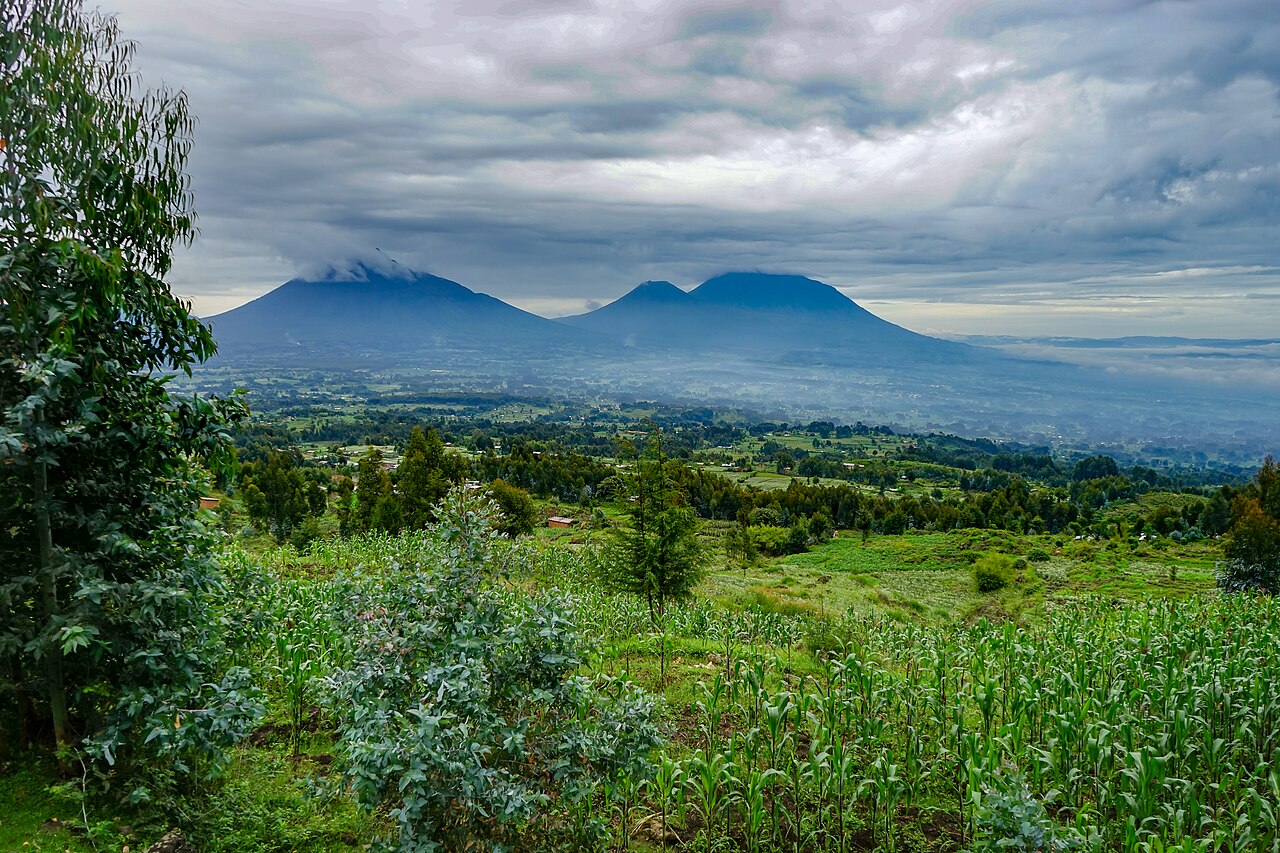
The Virunga volcano slopes are green and steep, with mist and dense mountain vegetation often replacing the open views familiar from lowland safari country.
The easily missed detail
The one-hour viewing limit starts once the assigned gorilla group has been reached, not when the trek begins. Actual walking time varies widely with where the gorillas are that day.
A practical rhythm
- Before travel — Secure the official tracking permit and lodging near Volcanoes National Park.
- Tracking morning — Attend the 7 a.m. registration, then follow the assigned guide’s route and instructions.
- Following days — Use Kigali as a connection to Lake Kivu, Nyungwe or Akagera rather than trying to combine all regions with tracking day.
What could complicate the plan
Steep, muddy footpaths and high elevation require suitable boots and physical readiness. The minimum age is 15, the group cap is eight, and the viewing limit is one hour. Entry to Rwanda also involves visa/passport formalities for U.S. visitors, and park access is a separate paid activity. One geographic constraint sits close to this particular park: the U.S. State Department's Rwanda advisory, dated July 16, 2025, places the country at Level 2, Exercise Increased Caution, while carrying a Level 4 Do Not Travel designation for the parts of Rubavu and Rusizi districts within 10 km of the Democratic Republic of the Congo border, on account of armed violence spilling across a poorly marked line. Volcanoes National Park itself lies east of that strip, but Rubavu is the district travelers pass through on the Gisenyi–Kivu route, so the western loop deserves checking against the advisory rather than a map alone.
What to do next
gives the strongest experiences outside Volcanoes; lays out the travel sequence.
Sources
- Rwanda Development Board, gorilla booking — permit, briefing, duration, age and group limits
- Visit Rwanda, national tourism authority — rain seasons and altitude-dependent climate
- UN Tourism, Rwanda gastronomy — isombe, plantains, coffee and tea
- Visit Rwanda — tracking terrain and equipment
- U.S. State Department, Rwanda Travel Advisory, dated July 16, 2025 — the Level 2 national advisory and the Level 4 Do Not Travel designation within 10 km of the DRC border in Rubavu and Rusizi districts
- U.S. State Department — visa and entry requirements