San Marino country guide Places and experiences
What should a first-time traveler see in San Marino beyond the obvious highlights?
The short answer
The republic beneath the postcard: the State Museum's deep history, the Basilica and the Liberty statue, the stamp-and-coin world that made San Marino famous before tourism, the ghost railway of 1932 under the old town, and the 8 castelli beyond the capital — Borgo Maggiore, Serravalle, Montegiardino and the rest.
The answer, with local context
Begin with the collectors' republic. San Marino issued its first postage stamps in 1877, and for a century its stamps and coins were the state's famous export — the Stamp and Coin Museum (in Borgo Maggiore) tells that story through the issues collectors still hunt, and the philatelic-numismatic office still sells current sets; the republic's euro coins, minted under its monetary agreement with the EU, vanish into collections so fast that finding one in change is a small event. The State Museum in the Palazzo Pergami Belluzzi (collections assembled since 1899) runs the long story — prehistoric and Roman finds, the Domagnano treasure's kin (the great Ostrogothic gold hoard unearthed at Domagnano in the 1890s, now split between the British Museum and Nuremberg), medieval art and the republic's own regalia — and the Pinacoteca, in the 14th-century church and convent of San Francesco (the old town's oldest church, begun 1361), holds the paintings, Guercino's among them. The Basilica di San Marino (built 1826–1838, neoclassical) keeps the relics of the founder under its altar, and in Piazza della Libertà the marble Statue of Liberty — carved by Stefano Galletti and inaugurated September 30, 1876, a gift from a German countess — predates her New York sister by a decade.
Then go down the mountain. Borgo Maggiore, the republic's market town, rides the cable car down from the Città (the funivia, running since 1959) to a historic center of its own, a modernist sanctuary church by Giovanni Michelucci, and the Thursday market in its square — the weekly rhythm of the whole republic. The other castelli complete the national picture: Serravalle, whose Dogana district is the republic's largest settlement and shopping floor, with a medieval castle above it; Acquaviva, named for the spring where Marinus is said to have found water; Montegiardino, the smallest municipality (under 1,000 residents) and a university town in miniature; Faetano, Chiesanuova, Fiorentino and Domagnano in their green valleys. The state's population, about 33,600, lives mostly down here — the Città is the ceremonial crown, not the country.
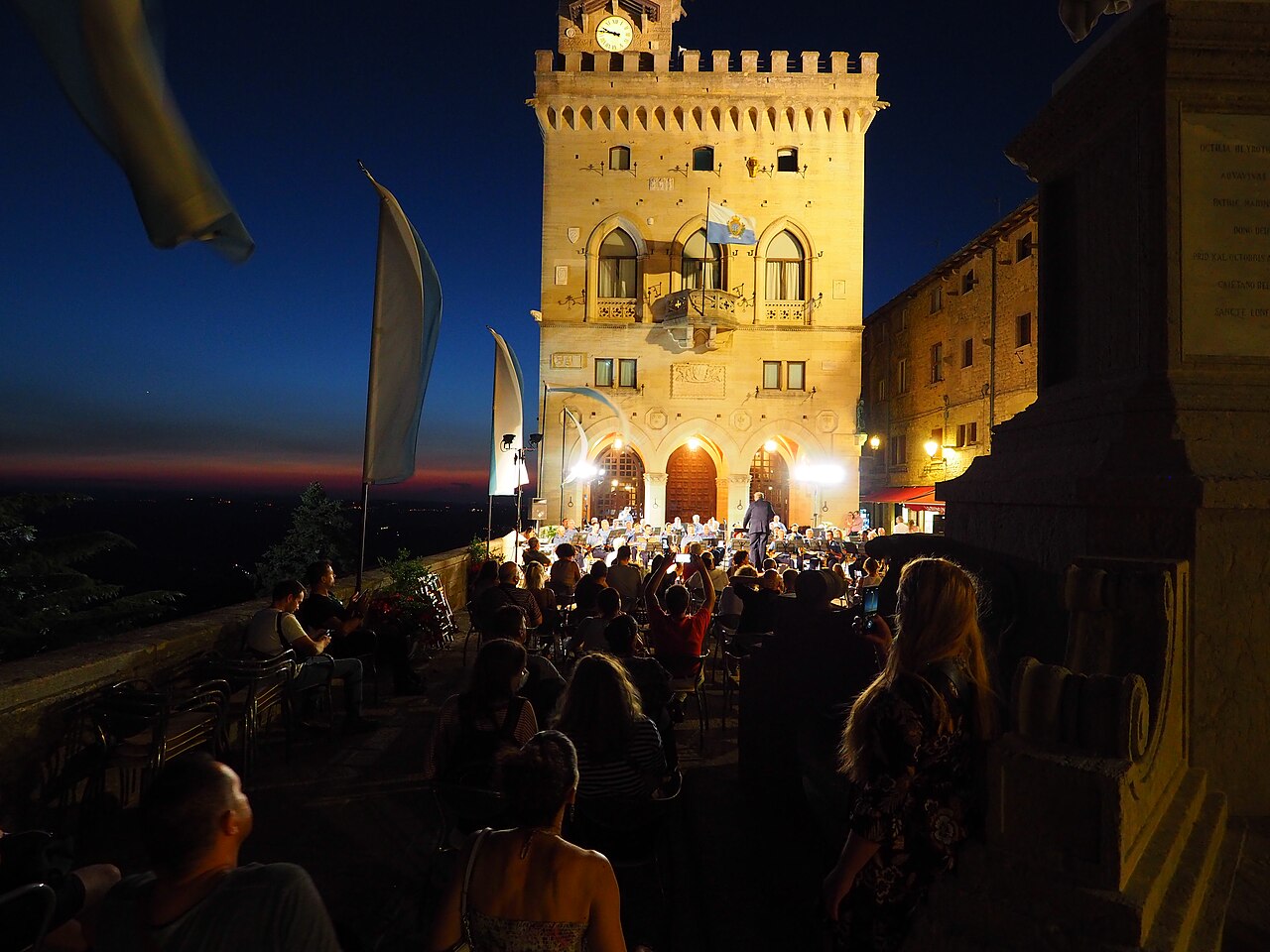
The strangest sight is a railway that no longer runs. The Rimini–San Marino electric line opened in 1932 — 32 km of track, viaducts and 17 tunnels climbing from the coast into the City's own station — and died in the Second World War, when Allied bombing hit the republic on June 26, 1944, despite its neutrality. Sections of the trackbed and the tunnel galleries under the old town now form a walking and cycling route, and the blue-and-white train association keeps the memory (and a restored carriage) alive: it is the republic's great what-if, and the quietest walk in the country. Add the Museum of the Emigrant (the republic exported people as well as stamps — its diaspora communities abroad are legion), the changing of the guard at the Palazzo Pubblico in season, and the crossbow quarry itself, and the day-tripper's 3 hours have become a resident's 3 days.
Picture the place
Thursday morning in Borgo Maggiore: market stalls under the porticoes, the cable car sliding down out of the cloud base above, and the Città's towers floating over the whole scene like a second, older town in the sky.
The easily missed detail
The Liberty statue's date is the trivia with a point: San Marino's Liberty was inaugurated in 1876, New York's in 1886, and the Sammarinese like the arithmetic. The deeper miss is the Domagnano treasure's address — the republic's most famous archaeological find is not in the republic; the Ostrogothic jewellery sits in London and Nuremberg, and the State Museum tells the story of a treasure its own soil produced and its own museum cannot show complete. Knowing that before you go sharpens the whole visit.
A practical rhythm
- 1 castello a day — Borgo Maggiore by cable car, then the valley municipalities by car in a slow loop
- Museums in the middle hours — State Museum and Pinacoteca taken when the ridge is in cloud or crowd
- The railway on foot — The old line's tunnels walked from the City toward Borgo as the descent route
What could complicate the plan
Scale cuts both ways: the sights beyond the highlights are small, and several (the Emigrant Museum, the Stamp and Coin Museum) keep state-office hours with midday closures and reduced winter schedules — the 10-day pass rhythm rewards checking the day's timetable at the tourist office each morning. The castelli need wheels: buses exist but are timed for residents, not sightseeing, and the lanes of Montegiardino were not built for the rental car's mirrors. The Palazzo Pubblico opens to visitors only when the Great and General Council is not sitting and no ceremony is scheduled, which the traveler learns on the day. And the private museums on the main lanes (curiosities, torture) are commercial attractions, not state institutions — budget and expectations should be set accordingly.
What to do next
Give the republic a second and third day: 1 for the Città's museums, 1 for Borgo Maggiore and the castelli, and ride the cable car at least twice.
Sources
- UNESCO World Heritage Centre — the San Marino Historic Centre and Mount Titano property (2008) and its components
- San Marino State Museums — the State Museum (collections since 1899), Pinacoteca San Francesco, and Stamp and Coin Museum
- San Marino Tourism Board — the 9 castelli, Borgo Maggiore's market and the funivia
- Treno Bianco Azzurro Association / railway histories — the 1932 Rimini–San Marino line, its 17 tunnels and its wartime destruction