Seychelles country guide When to visit
When is the best time to visit Seychelles for La Digue?
The short answer
April and October are especially good months for a La Digue-focused Seychelles holiday, when the prevailing winds are transitioning and sea conditions are often more favorable for inter-island excursions.
The answer, with local context
Seychelles is an Indian Ocean archipelago, and its weather follows alternating wind systems rather than the conventional four-season calendar. The Seychelles Meteorological Authority describes April as the transition away from the northwest monsoon toward the southeast trade winds. May through September generally brings stronger southeast winds, while October begins another transition.
The national meteorological authority identifies October as having an average of 16 dry days, although rain remains possible. In April, maximum temperatures can occasionally exceed 90°F (32°C). Both months can suit visits to Mahé, Praslin and La Digue, but individual beaches face different directions and therefore experience wind and swell differently.
How little the thermometer moves here is partly a function of sea level. NOAA's engineering weather archive lists the archipelago's long-term reference station under WMO number 639800, sited just 10 feet above the sea, so there is no inland elevation to pull daytime figures down the way there is on a continental coast.
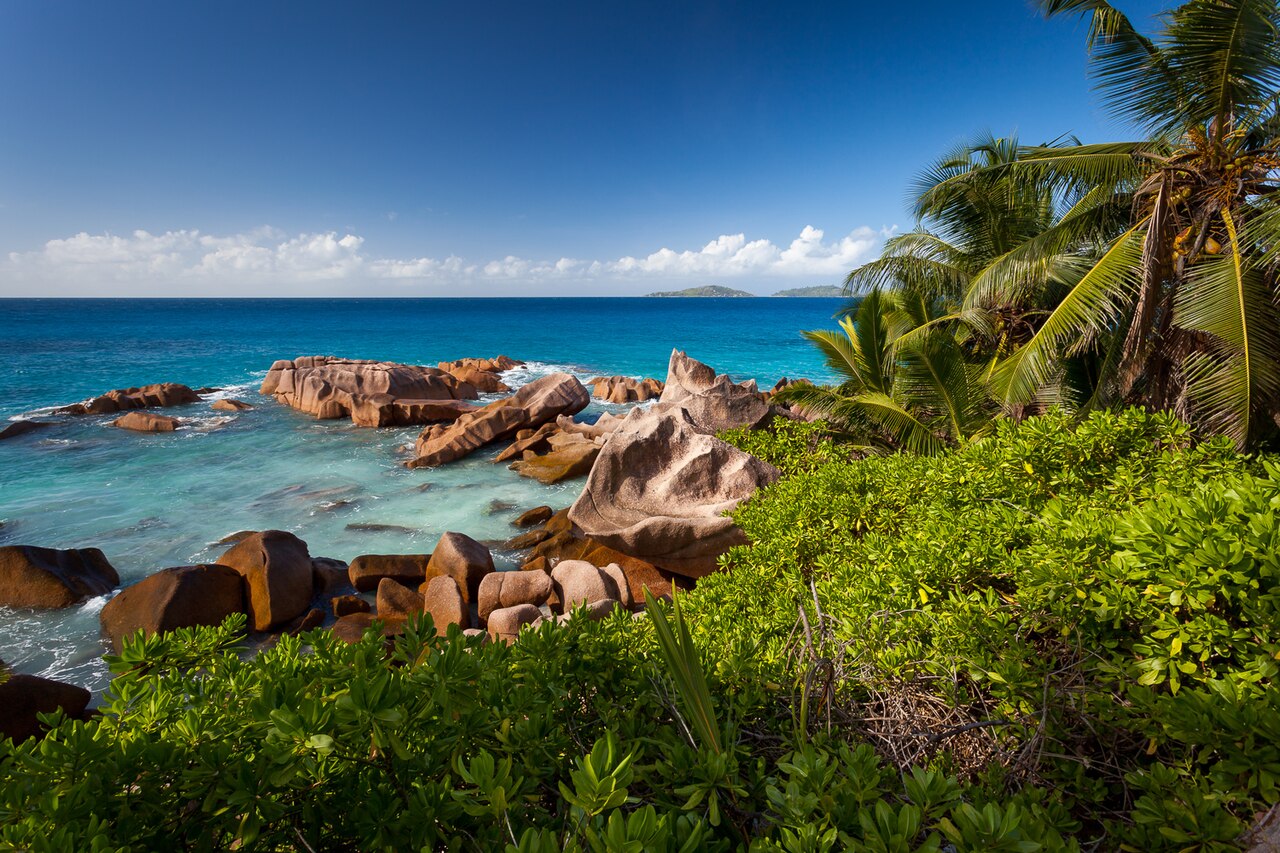
For La Digue specifically, Anse Source d'Argent is known for its enormous granite boulders and shallow coastal setting. Grande Anse, on a more exposed side of the island, can experience powerful surf and should not be treated as equivalent swimming water.
A visit can also include the Veuve Special Reserve at Anse Réunion. The Seychelles Parks and Gardens Authority lists weekday opening hours of 8 a.m.–4 p.m., Saturday hours of 9 a.m.–3 p.m., and an unguided non-citizen entry fee of SCR 150. These are current published operational details, not permanent entitlements.
Picture the place
La Digue's granite formations divide sandy coves, while low coastal roads connect settlements, beaches and small guesthouses. The island's character is noticeably different from the mountainous interior of Mahé.
The easily missed detail
Rainfall averages alone do not determine whether a particular beach is comfortable for swimming. The direction of the monsoon matters, especially on exposed shores.
Distance is the other thing an archipelago map flattens. The outer islands hold a World Heritage property that no inner-islands itinerary reaches: Aldabra Atoll, inscribed by UNESCO under criteria (vii), (ix) and (x), carries about 152,000 giant tortoises, the largest population of the species anywhere. A La Digue holiday is an inner-islands holiday, and the atoll is not a day trip from it in any month.
A practical rhythm
Morning: Visit Anse Source d'Argent before the strongest daytime heat.
Midday: Explore La Digue's village roads and sheltered coastal areas.
Afternoon: Visit Veuve Special Reserve during its published opening hours.
What could complicate the plan
Wind-driven swell may affect ferry journeys and beach access. Seychelles requires a Travel Authorization even though visitors generally do not need an ordinary tourist visa.
What to do next
explains how to explore the wider Seychelles archipelago beyond La Digue.
Sources
- Seychelles Meteorological Authority — monsoon transitions and climate characteristics.
- Seychelles Parks and Gardens Authority — reserve hours, location and admission.
- Seychelles Ministry of Foreign Affairs — travel authorization requirements.
- NOAA National Centers for Environmental Information, Engineering Weather Data, Seychelles — station identifier and elevation.
- UNESCO World Heritage Centre, Aldabra Atoll — inscription criteria (vii), (ix) and (x) and the giant tortoise population of about 152,000.