Siracusa / Italy Things to do
What are the most worthwhile things to do in Siracusa on a first visit?
The short answer
Cross to Ortygia for the cathedral built inside a Greek temple, walk the Neapolis park (theater, sacrificial altar, the Ear of Dionysius), and take the spring of Arethusa and the Maniace castle at the island's tip — the Greek superpower's capital in two walkable halves.
The answer, with local context
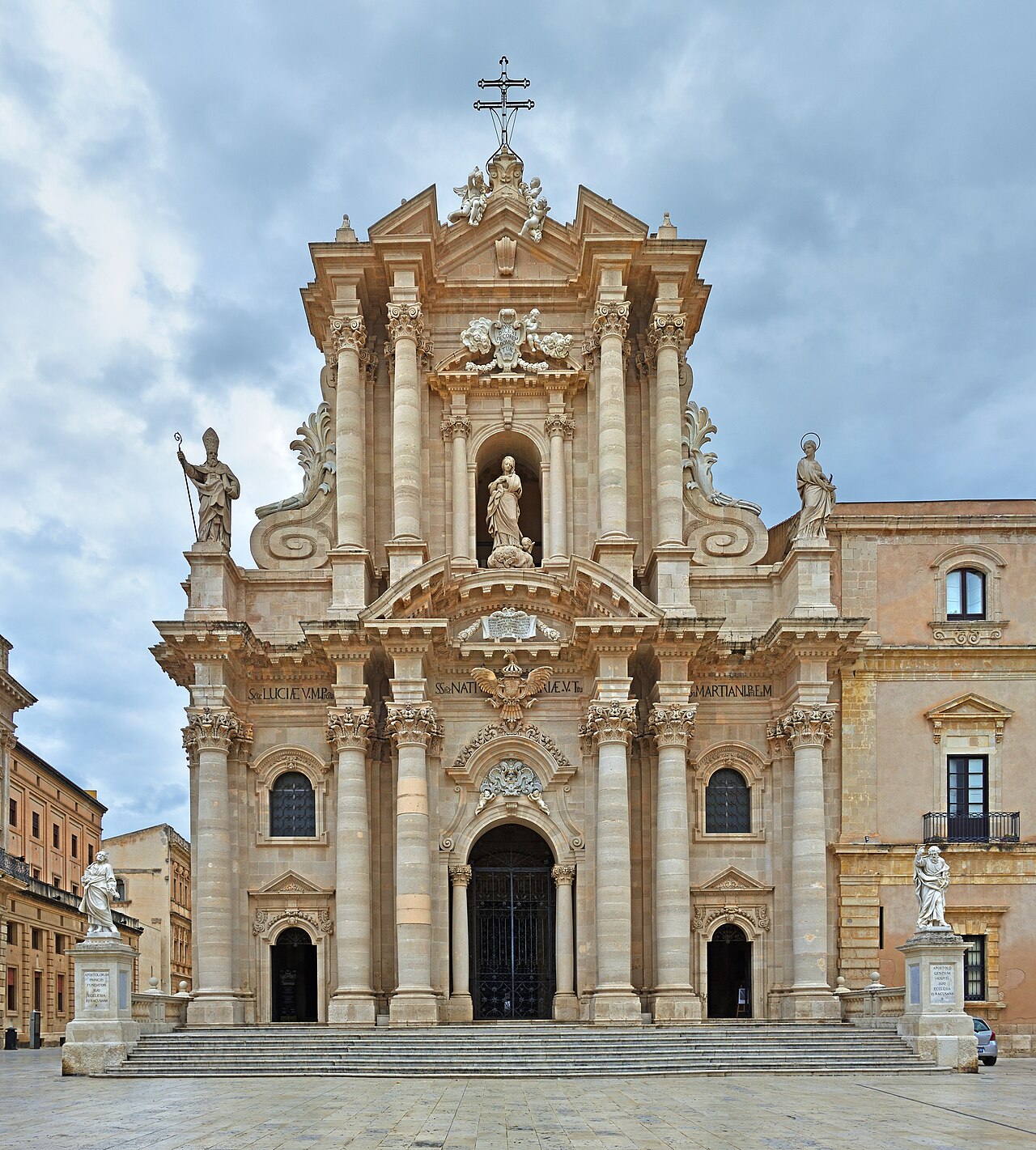
Siracusa was founded by Corinthian Greeks in 733 BC and grew into one of the largest cities of the ancient world — Cicero called it the greatest and most beautiful of Greek cities, and its native Archimedes (287–212 BC) died defending it from Rome. Its remains split between two stages. The first is Ortygia, the island citadel, where the cathedral performs the city's whole history in one wall: the Duomo is a fifth-century-BC Doric Temple of Athena whose columns stand embedded in the nave — walk inside and you pray between Greek pillars; walk the flank on Via Minerva and the temple's colonnade marches down the street. The baroque facade (Andrea Palma, 1728–53) fronts a perfect baroque square, Piazza Duomo. Around it the island layers on: the Temple of Apollo (c. 565 BC, the oldest Doric temple in Sicily) beside the market, the Fonte Aretusa — a freshwater spring at the very edge of the sea, thick with papyrus, where the nymph Arethusa's myth pools — and at the island's tip the Castello Maniace (1232–40), Frederick II's Swabian fortress guarding the Great Harbour where Athens' Sicilian Expedition died in 413 BC.
The second stage is the Neapolis archaeological park on the mainland hill. The Greek theater (see it even out of season: 5th c. BC, rock-cut, ~15,000 seats) anchors a circuit that rewards two unhurried hours: the Altar of Hieron II, a sacrificial altar 198 meters long built for processions of hundreds of oxen; the Roman amphitheatre (3rd century AD); and the Latomia del Paradiso, the ancient quarries where 7,000 Athenian prisoners were left after 413 BC — now a garden of citrus and magnolia inside the stone pits. Its star is the Ear of Dionysius, a 23-meter-high, 65-meter-deep S-curved cave whose acoustics carry a whisper the length of the vault (the name is tradition's, credited to Caravaggio's 1608 visit). The Paolo Orsi archaeological museum (one of Italy's great Greek collections — the Venus Landolina, the coin room) sits a short walk away.
The second day belongs to the city's quieter depths: the Jewish quarter's mikveh, a Byzantine-era ritual bath some 18 meters underground near Via Alagona (found by accident in 1988 during hotel works, among Europe's oldest surviving); the Ciane river, rowed or walked, where wild papyrus — Europe's only natural stand, with the Arethusa spring — grows along the banks (the Papyrus Museum on Ortygia tells the plant's Egyptian story); the Plemmirio marine reserve (protected since 2004) for the swim and the kayak among the headlands south of the harbor; and, with a car, the second half of the UNESCO listing: the Rocky Necropolis of Pantalica, some 5,000 rock-cut tombs (13th–7th century BC) honeycombing a gorge inland — the pre-Greek Sicels' city of the dead, empty of crowds in every month.
Picture the place
Via Minerva at noon: a cathedral wall on one side, and set into it, marching into the sun, the fluted Doric columns of Athena's temple, holding up the church that swallowed them.
The easily missed detail
The Duomo's columns tell their story best from inside the side aisles: the temple's pillars are not decoration but structure — the Christian church (7th century onward) walled between them, so the congregation worships literally inside the temple's bones. The complementary detail is underground: the mikveh's freshwater still flows. The ritual bath fills from a spring-fed aquifer at constant temperature, discovered only in 1988 — the Giudecca's whole hidden world (the quarter was emptied by the 1492 expulsion) preserved by being forgotten. Between the two, Siracusa's first visit is a lesson in how cities survive: by being reused, and by being buried.
A practical rhythm
- Neapolis first, at opening — The park's quarries are the day's oven; the theater-to-altar circuit before 11, museum at noon
- Ortygia is the evening — Cathedral, Aretusa and Maniace by day if you must, but the island's soul is 6 p.m. to midnight
- One boat or swim per trip — Plemmirio's clear water is the city's pressure valve; book the kayak or the bay in advance in season
What could complicate the plan
The two halves defeat lazy planning: the Neapolis is a mile and a half of modern city from Ortygia, and the walk between is the least lovely in Siracusa — take the bus or a taxi and spend your steps inside the fences. The park's one-ticket circuit still leaves the cathedral, Maniace and mikveh as separate tickets on separate hours (the mikveh runs small guided descents and sells out); Sunday mornings compress the cathedral into Mass hours. Heat is the standing editor: the Latomia at 1 p.m. in summer is a punishment detail. Keep the sunset hour sacred — in season for the theater, out of season for the Lungomare di Levante, where the whole island comes to watch the harbor turn gold.
What to do next
Do the Neapolis at tomorrow's opening, the Duomo's columns at noon, and save the Aretusa-to-Maniace waterfront for the golden hour.
Sources
- UNESCO World Heritage List — Syracuse and the Rocky Necropolis of Pantalica (2005): Ortygia, the Neapolis monuments and the 5,000-tomb necropolis
- Parco Archeologico della Neapolis — the Greek theatre, the Altar of Hieron II (198 m), the Latomie and the Ear of Dionysius (23 m high, 65 m deep)
- Diocese of Siracusa / Duomo di Siracusa — the cathedral built within the fifth-century-BC Temple of Athena; the baroque facade by Andrea Palma (1728–53)
- Area Marina Protetta del Plemmirio — the marine reserve established 2004 south of the harbour