South Africa country guide Places and experiences
What should a first-time traveler see in South Africa beyond the obvious highlights?
The short answer
South Africa has 12 UNESCO World Heritage properties and most first trips visit one or two — Vredefort Dome, the Richtersveld, Mapungubwe and the Barberton Makhonjwa Mountains are the ones that change what a traveler thinks the country is.
The answer, with local context
Start with the oldest things. The Barberton Makhonjwa Mountains, inscribed in 2018, preserve one of the oldest and best-preserved successions of volcanic and sedimentary rock on earth, laid down between roughly 3.6 and 3.25 billion years ago; the scenic road through them is drivable in a day from the Kruger lowveld. Vredefort Dome, inscribed in 2005, is the eroded center of the largest and oldest known meteorite impact structure on the planet, about two hours from Johannesburg and almost entirely unvisited by foreign travelers.
Then the landscapes that are also cultural listings. The Richtersveld Cultural and Botanical Landscape, inscribed in 2007, is a mountainous desert in the Northern Cape still grazed seasonally by Nama herders using portable rush-mat houses — a living pastoral system, not a wilderness. The ǂKhomani Cultural Landscape, inscribed in 2017 near the Kalahari border, recognizes San knowledge of that desert environment. Maloti-Drakensberg Park, inscribed in 2000 and extended in 2013, pairs basalt escarpment with one of the world's great concentrations of San rock art.
Mapungubwe Cultural Landscape, inscribed in 2003 where the Limpopo and Shashe rivers meet, was a trading kingdom connected to the Indian Ocean world by the thirteenth century. It sits beside a national park, which means SANParks fee rules apply there as everywhere: the tariff year runs 1 November 2026 to 31 October 2027, children aged 2 to 11 pay a reduced rate, adults are 12 and over, and WILD Card members pay no conservation fees at all on presentation of identity and card.
The famous properties are worth knowing in sequence too. Robben Island, the Fossil Hominid Sites of the Cradle of Humankind and iSimangaliso Wetland Park were all inscribed in 1999, and the Cape Floral Region Protected Areas in 2004.
Picture the place
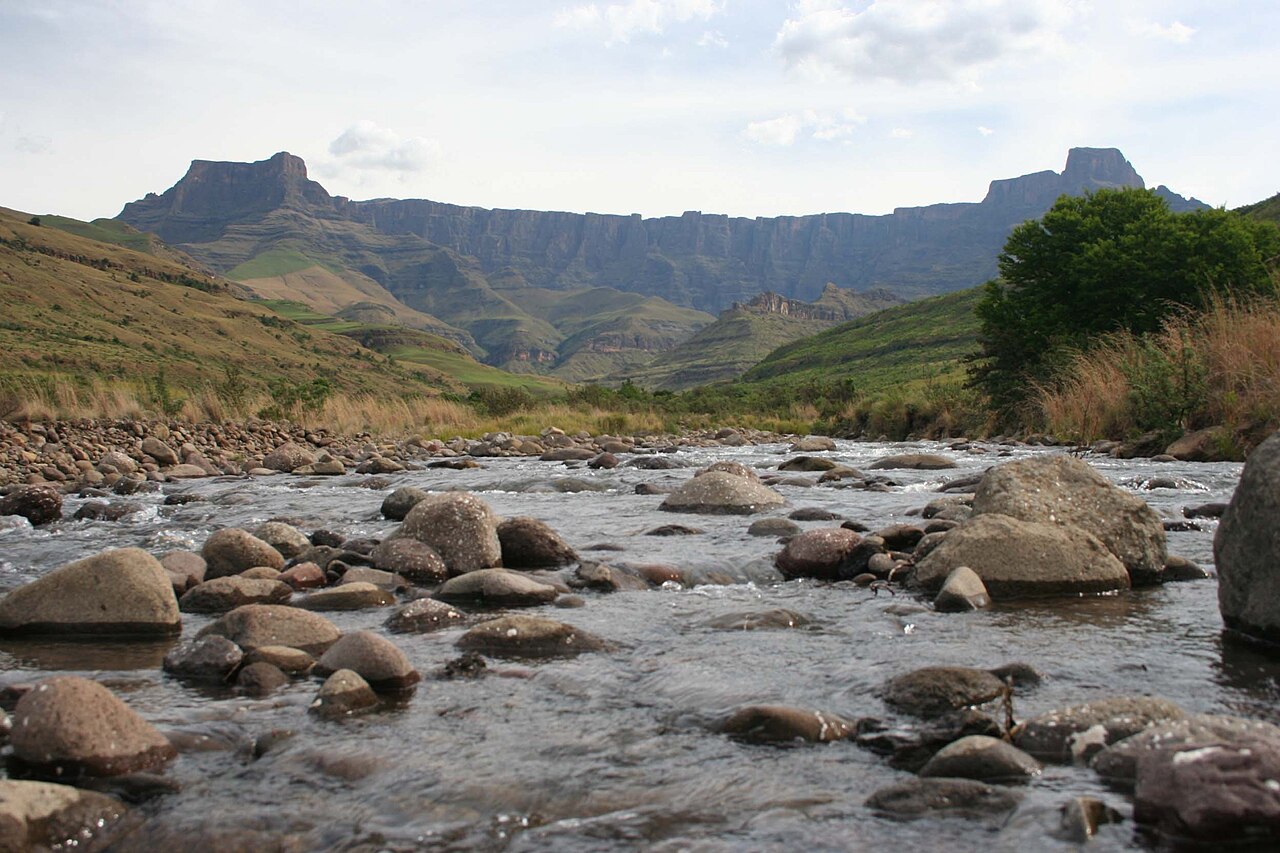
The Drakensberg amphitheatre, seen from the upper Tugela in KwaZulu-Natal, is a basalt wall several miles wide curving around a grassed bowl, with the escarpment edge so straight that the whole formation reads as architecture rather than geology. The rock-art shelters sit low on the slopes beneath it, in overhangs you would walk past without a guide.
The easily missed detail
Kruger is not priced like the Cape. For the 2026/27 tariff year, SANParks charges R692 per standard international adult per day at Kruger and R345 per child, against R296 and R147 for SADC nationals and R140 and R70 for South African citizens and residents — and SADC nationals from countries with a transfrontier agreement, such as Mozambique and Zimbabwe for Kruger, pay the citizen rate. On a week in the park that spread is the difference between a daily rounding error and a significant line item, which is what makes the WILD Card worth costing out before you book.
A practical rhythm
- Northeast — Barberton Makhonjwa on the way to or from Kruger, which turns a transfer day into a World Heritage day.
- Centre — Vredefort Dome from Johannesburg, and Mapungubwe at the Limpopo confluence further north.
- Northwest and west — The Richtersveld and the ǂKhomani landscape, both requiring real distance and both unlike anything else in the country.
What could complicate the plan
These places are far apart and several are remote: the Richtersveld in particular needs high-clearance vehicles and planning for fuel and water. South Africa's advisory from the US Department of State, issued 27 May 2025, is set at Level 2, Exercise Increased Caution. Entry requirements do not bend for domestic itineraries — US citizens need two consecutive completely blank visa pages on arrival, and passports valid 30 days beyond exit. Rock-art sites in the Maloti-Drakensberg are access-controlled and frequently require a guide.
What to do next
The trip-planning question in this group shows how to fit two or three of these into a route without a punishing drive every day. The when-to-visit question explains why the Cape and the interior want different months.
Sources
- UNESCO World Heritage Centre, States Parties statistics — South Africa's 12 inscribed World Heritage properties
- UNESCO World Heritage Centre, South Africa property listings — inscription years and the designated values of Vredefort Dome, Barberton Makhonjwa, Richtersveld, ǂKhomani, Maloti-Drakensberg and Mapungubwe
- South African National Parks, daily conservation fees 2026/27 — Kruger fees by category, tariff validity, child age band, transfrontier rule, WILD Card exemption
- US Department of State, South Africa travel advisory — advisory level and date
- US Department of State, South Africa country information — passport validity and blank page requirements