South Sudan country guide When to visit
When is the best time to visit South Sudan for Juba?
The short answer
The FCDO advises against all travel to South Sudan, and within that constraint the dry months of December to February fall outside the April-to-November rainy season FAO records for the southern areas where Juba sits.
The answer, with local context
The advice is blanket, not regional. The FCDO's South Sudan page states that it advises against all travel to the country because of the risk of armed violence and criminality, and warns that consular assistance to British nationals is severely limited, with in-person consular assistance not available. It cautions that it may not be able to help people leave during serious unrest or a crisis. For anyone looking at flights specifically, it notes that Juba airport may close or be inaccessible, that flights may be cancelled at short notice, that routes into and out of the country may be blocked, and that airspace has closed temporarily in the past because of events in Sudan, in both 2019 and 2023.
The seasonal picture is published and regionally split. FAO's South Sudan country brief of 7 September 2026 puts the southern rainy season at April to November — a season that in 2026 began in early March — with the first-season maize and sorghum harvest concluding in August 2026 and second-season planting expected to finish that September for a harvest in late 2026 or early 2027. Northern and central areas run on a shorter May-to-October season, with short-cycle sorghum and maize harvested to October and long-cycle sorghum from November 2026 through January 2027. Juba, in Central Equatoria, sits in the southern pattern, which means its wet season is the longer of the 2.
There is one genuinely world-scale seasonal event in the country, and it is the reason the question of timing is not academic. An aerial survey whose results were announced in Juba on 25 June 2024, conducted by African Parks with South Sudan's Ministry of Wildlife Conservation and Tourism, estimated 5,896,373 animals across 4 migratory species in the Boma Badingilo Jonglei Landscape. That migration moves with the rains, and the parks that hold it lie east of Juba.
Picture the place
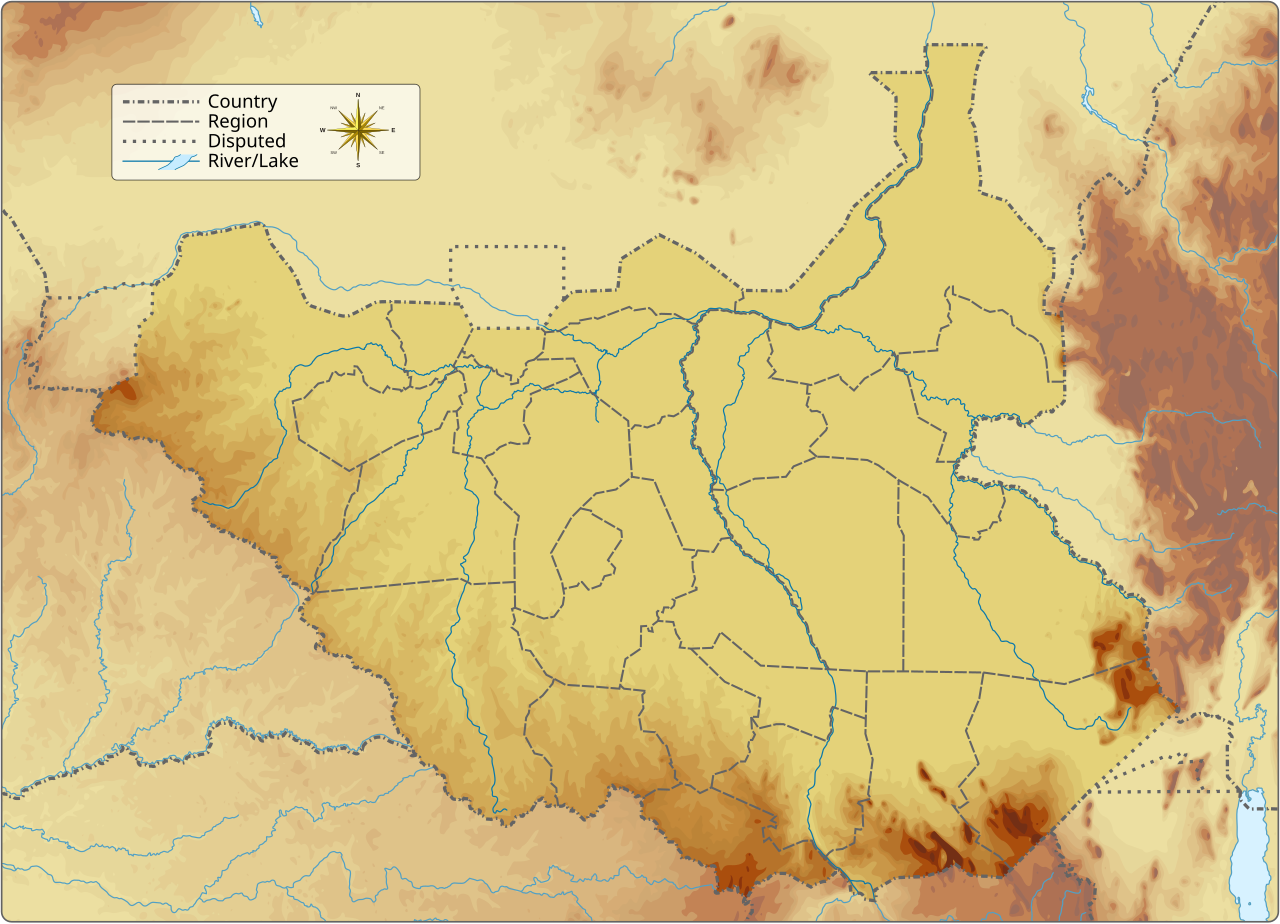
Juba sits on the White Nile at the southern end of a country whose defining feature is water. The Boma-Badingilo landscape immediately east covers a contiguous surveyed block of 122,774 km², inside a wider ecosystem of about 200,000 km² east of the Nile spanning Central Equatoria, Eastern Equatoria, Jonglei State and the Greater Pibor Administrative Area — and it connects northward to the Sudd, the wetland the survey report describes as the largest in Africa.
The easily missed detail
Arrival paperwork in South Sudan has a 5-day trigger that catches people out. The FCDO states that anyone in the country for 5 days or more must register at a local police station. A visa is required to enter or even transit South Sudan, obtainable through the national e-visa portal or the embassy, and extending one requires attending the Ministry of the Interior in person on Airport Road in Juba. The passport must have an expiry date at least 6 months after arrival and carry at least 2 blank pages, and a yellow fever vaccination certificate is required. Travelers have occasionally been asked for proof of COVID-19 vaccination.
A practical rhythm
- December to February — Outside the southern April-to-November rains, and the only part of the year when ground movement around Juba is not rain-limited.
- Within 5 days of arrival — Police registration becomes mandatory, so it belongs in the first week's plan, not the last.
- Before departure — Build in slack for flight cancellation; the FCDO warns Juba airport may close or be inaccessible.
What could complicate the plan
The advisory is the first and largest complication, and the consular position behind it is the real risk: severely limited assistance, no in-person consular service, and no guarantee of help leaving in a crisis. The food-security situation compounds it. FAO assessed about 7.8 million people — 55% of the total population — in IPC Phase 3 or worse during the April-to-July 2026 lean season, with severe acute food insecurity reaching about 65% of the population in Unity, Jonglei and Upper Nile states, and about 73,000 people in IPC Phase 5, split 24,000 in Upper Nile and 49,000 in Jonglei. A risk of famine under plausible worst-case conditions was identified in Luakpiny/Nasir and Ulang counties in Upper Nile and Nyirol and Akobo counties in Jonglei. First-season output in 2026 was estimated below average. Entry may also be refused on an invalid travel document or a passport reported lost or stolen.
What to do next
The South Sudan places answer sets out the Sudd's Ramsar designation and the full survey figures for the Boma-Badingilo migration. For sorghum, maize and the river fishery, see the South Sudan food question.
Sources
- UK Foreign, Commonwealth and Development Office, South Sudan travel advice and entry requirements — the against-all-travel advice, consular limits, Juba airport and airspace warnings, visa and e-visa rules, the 5-day police registration, passport validity and blank pages, and the yellow fever certificate
- FAO GIEWS Country Brief, South Sudan, 7 September 2026 — the April-to-November southern and May-to-October northern rainy seasons, harvest timings, and the IPC Phase 3, Phase 5 and famine-risk findings
- African Parks with the Ministry of Wildlife Conservation and Tourism of South Sudan, Boma Badingilo Jonglei Landscape aerial survey, announced 25 June 2024 — the 5,896,373 total, the 122,774 km² surveyed block and the roughly 200,000 km² ecosystem