Ukraine country guide Trip planning
How can I plan a memorable first trip to Ukraine without rushing?
The short answer
You cannot take it yet — so plan it the way this guide is written: a 10–12-day west-and-center arc (Lviv, the Carpathians, Kamianets-Podilskyi, Kyiv), entered by land and traveled by Ukraine's excellent trains, held ready for the day the Level 4 advisory falls.
The answer, with local context
The geography first, because it survives the war. Ukraine is Europe's largest country wholly within the continent (603,628 km²), and its classic first trip runs on the Kyiv–Lviv axis: Kyiv to Lviv is about 540 km, covered before the war by Intercity+ trains in about 5 hours; Kyiv to Odesa about 475 km; Lviv to the Carpathians (Ivano-Frankivsk) about 130 km; Kamianets-Podilskyi sits about 100 km south of Khmelnytskyi on the Podillia routes. The unhurried shape for the trip, when it becomes a trip: enter overland from Poland (Przemyśl is the gateway station, with through trains to Lviv and Kyiv; Warsaw and Kraków feed it) and give Lviv 3 nights (the UNESCO old town, the coffee houses, a Golden Horseshoe castle day), the Carpathians 2–3 (Yaremche and the tserkva valleys, a Hoverla-foothills walk, a kolyba evening), Kamianets-Podilskyi and Khotyn 2, and Kyiv 3–4 (St. Sophia and the Lavra — both UNESCO, both on the danger list since 2023 — Podil, the Dnipro hills, the great museums as they reopen their halls). Odesa joins the itinerary in the form it deserves only when its port is no longer a target list.
Entry, as the rules presently stand, is land-only and papered: Ukrainian airspace has been closed since February 24, 2022 (no commercial flights; Kyiv's Boryspil airport silent); U.S. citizens are visa-free for 90 days in any 180-day period with a passport and proof of health insurance and sufficient funds (U.S. Department of State), crossing from Poland, Slovakia, Hungary, Romania or Moldova — the crossings with Russia and Belarus are closed. Martial law (extended in 90-day parliamentary steps) brings curfews in every city, document checks at internal roadblocks, and the ban on photographing military subjects; the population the traveler meets is a country displaced and mobilised (the UN counts millions of Ukrainians abroad and internally displaced), which any honest itinerary note should hold in view.
Why plan it now, then? Because the trip's bones are checkable in advance (trains, distances, seasons, sights), because Ukraine's own tourism authorities ask future visitors to keep the country on their lists, and because the first travelers back will meet a country that has thought hard about what it wants to show: memorials alongside cathedrals, a Lviv that sheltered a nation's displaced, a Kyiv whose chestnuts have flowered through every spring of the war. The unhurried trip, planned in pencil at 10–12 days, is the correct size for it.
Picture the place
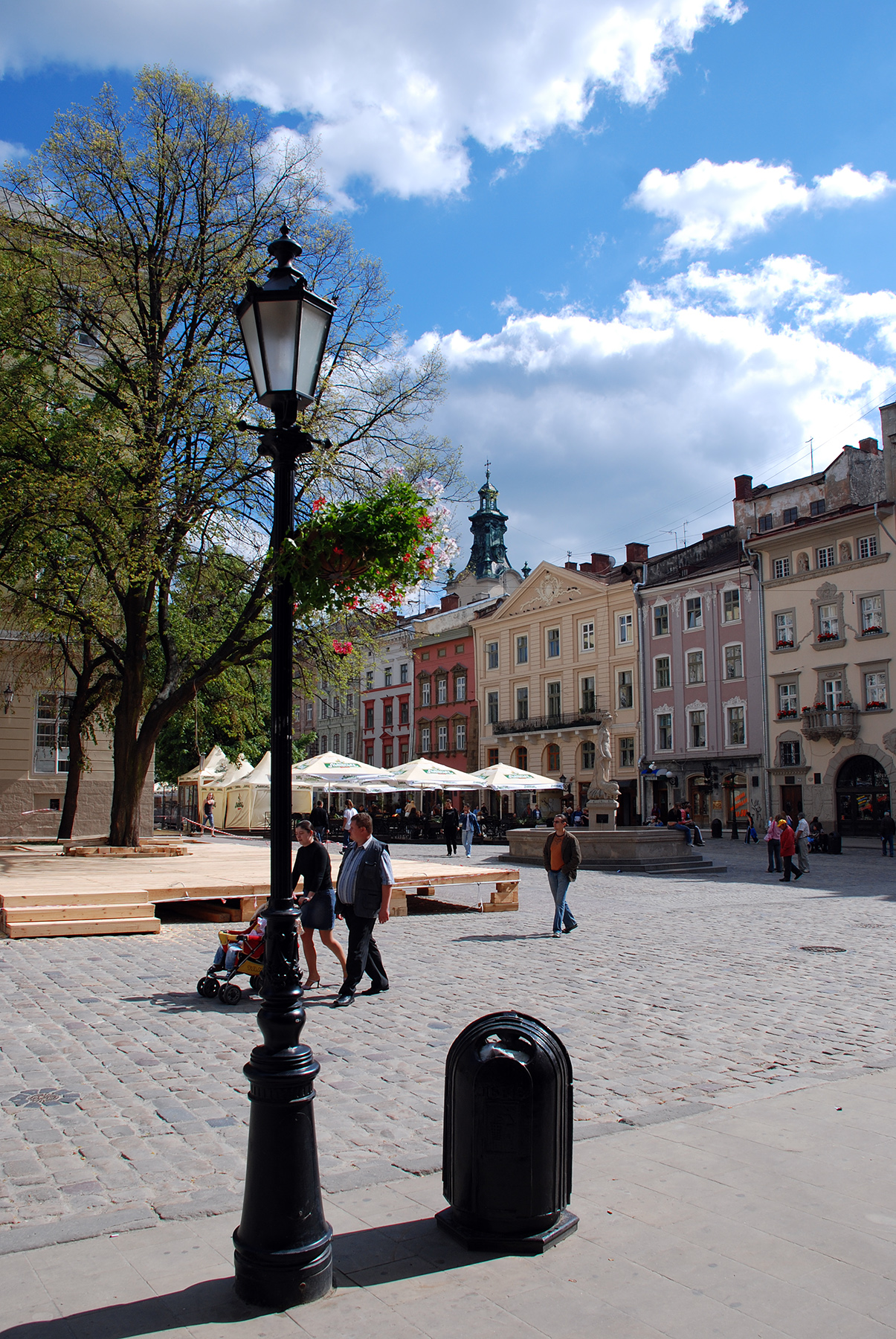
Rynok Square, Lviv, at first light: 44 burgher houses in 4 nations' styles around the tower, pigeons on the Neptune fountain, and a coffee window steaming on the corner — the west's gentle front door.
The easily missed detail
Przemyśl is the hinge of the whole journey: the Polish border station where the broad-gauge Ukrainian trains begin, a 10-minute hop from the EU platforms across a bridge of 2 rail gauges — in wartime it became one of Europe's most storied stations, and in the future itinerary it is where the trip's tempo changes from European to Ukrainian. The second detail is the overnight train: Ukraine's sleeper network (Kyiv–Lviv, Kyiv–Odesa in peacetime) turns the country's size from cost into comfort, the kupe 4-berth being the classic unit of Ukrainian travel — book the lower berths, bring the picnic, and let the distances happen while you sleep.
A practical rhythm
- West to center — Lviv → Carpathians → Kamianets → Kyiv: against the crowd flow, ending in the capital
- Trains over roads — Intercity+ by day, sleepers by night: the network is the itinerary's spine
- Kyiv kept for last — The capital given the trip's freshest eyes and its longest stay, 3–4 nights
What could complicate the plan
Begin with the disqualifier: the U.S. Department of State's Level 4 advisory ("Do not travel... for any reason," reissued August 28, 2026) and the UK's parallel advice stand over every paragraph of this plan; ordinary travel insurance excludes war; and no responsible version of this trip exists until the advisory falls and scheduled aviation resumes. Even then, expect a long normalisation: sites on UNESCO's danger list (Kyiv, Lviv, Odesa) will reopen in stages, Chornobyl stays closed, demining will fence parts of the countryside for years, and the east and south — Kharkiv, the Donetsk and Luhansk oblasts, occupied Crimea — are excluded from any first itinerary for the foreseeable future. Dual U.S.–Ukrainian men aged 18–60 face exit bars under mobilisation law, as the State Department warns. The plan above is a draft with a trigger condition, and the trigger is not a date anyone can publish today.
What to do next
Keep the draft, watch the advisory and the airspace bulletins, and when both clear, book the Przemyśl–Lviv train first — everything else hangs off that arrival.
Sources
- U.S. Department of State — Ukraine Travel Advisory Level 4 (reissued August 28, 2026); country information on visa-free entry, insurance and funds; dual-national warning
- Ukrainian Railways (Ukrzaliznytsia) / gateway stations — the Przemyśl connection and the Intercity+ network
- State Statistics Service of Ukraine / UNHCR — the country's area (603,628 km²) and the displacement counts of the war years
- UNESCO World Heritage Centre — Kyiv and Lviv on the List of World Heritage in Danger (2023)