Ukraine country guide Food and drink
What local dishes should I try in Ukraine, and where should I look for them?
The short answer
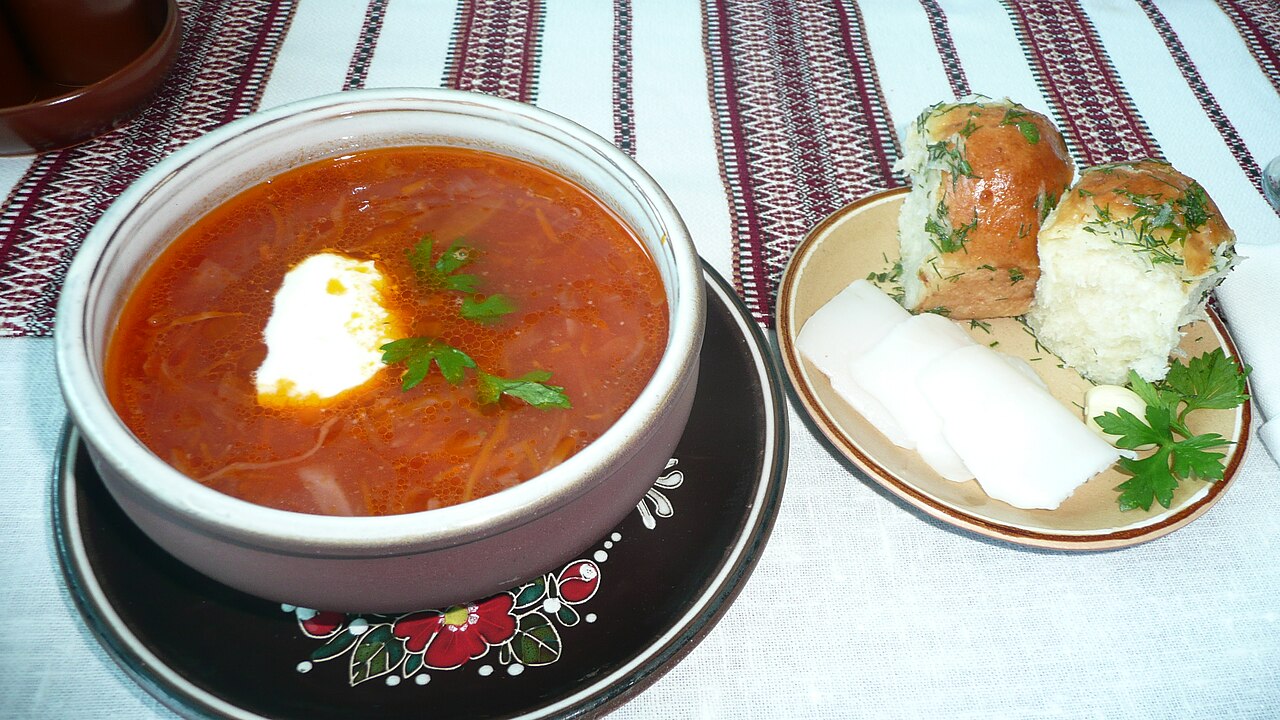
Borsch with pampushky and a dollop of smetana at the center, varenyky and holubtsi beside it, deruny in Polissia, banosh in the Hutsul mountains, salo and horilka as ritual, and Kyiv cake and a perepichka to go — a beetroot-red, dill-green cuisine that UNESCO now lists and wartime kitchens still serve.
The answer, with local context
Borsch is the flag. In July 2022 UNESCO placed "the culture of cooking Ukrainian borsch" on its List of Intangible Cultural Heritage in Need of Urgent Safeguarding — a wartime inscription for a soup that is really a genre: beetroot at its base in most of the country, but green borsch with sorrel in spring, a white Poltava style, beans in Podillia, dried pears in some southern pots, and always the liturgy around it — pampushky (yeast buns slicked with garlic oil) for dunking, smetana stirred in, a shot of horilka beside. Varenyky, the crescent dumplings, run savoury (potato, cabbage, curd cheese, meat) into sweet (sour cherry is the summer order), and holubtsi (cabbage rolls) anchor festive tables. Deruny, crisp potato pancakes, belong to Polissia in the north — the town of Korosten holds a deruny festival — and salo, cured pork fat eaten on black bread with garlic and horseradish, is the national emblem that Ukrainians joke about precisely because it is true. Chicken Kyiv, the butter-centred cutlet, carries the capital's name around the world; the capital's own cake, Kyiv cake (hazelnut meringue layers, created in 1956 at the city's Karl Marx confectionery factory), is the boxed souvenir of record, and the Kyivska perepichka — a sausage fried inside yeasted dough at a Khreshchatyk-side kiosk trading since 1981 — is the beloved street original.
The regions cook their own chapters. In the Carpathians, Hutsul kitchens make banosh: cornmeal cooked in sour cream and sheep's cheese (brynza), crowned with cracklings and mushrooms, eaten from wooden bowls in the kolyba huts; yushka, the clear fish soup, belongs to the Dnipro and Danube fisheries; uzvar (smoked-fruit compote) is the Christmas drink; the south pours wine from Shabo, founded by Swiss settlers in 1822 near Odesa, and from Koblevo and the Beykush vineyards on the Black Sea limans — a wine culture rebuilding through the war years. Lviv is the west's sweet capital (a coffee obsession since the 17th century's Viennese connections, and a chocolate house tradition), and the zakusky table — pickles, smoked fish, buckwheat blini... — belongs to every region's celebration.
Where to eat it, on the ground as it stands: Kyiv's restaurants operate around the curfew (kitchens close early; lunch is the grand meal of the war years), Lviv's café and restaurant scene functions most fully of any big city, and the Carpathian kolyby and small-town varenyky counters serve their regions without interruption. The dish list above is also a heritage record — borsch's UNESCO status was sought precisely because the culture that cooks it is under attack — so the future traveler's table manners include eating in family-run rooms and village kitchens, where this food actually lives, rather than only in the capital's flagships.
Picture the place
A kolyba above Yaremche: banosh steaming in a wooden bowl, brynza crumbled over it like snow, the Prut river audible below the terrace, and carved Hutsul plates on the wall.
The easily missed detail
Borsch has no single recipe, and ordering "borsch" twice in 2 oblasts is a field method, not a repetition: the Podillian pot carries beans, the Poltavan one is built on goose or duck in its festive form, the southern versions may skip beetroot's dominance for tomato, and every family's is defended as the standard. The second detail is the pampushka protocol: the buns arrive hot under their garlic oil, and the correct sequence — tear, dunk, soup, smetana — is demonstrated by any Ukrainian table companion within the first 3 minutes, whether you asked or not.
A practical rhythm
- Borsch by region — A different oblast, a different pot: the soup treated as the itinerary's tasting thread
- Lunch is the feast — The grand meal taken at midday, as curfew-era kitchens (and peacetime village rooms) prefer
- 1 street original — A perepichka at the Khreshchatyk kiosk for the Kyiv chapter, eaten standing like a local
What could complicate the plan
The war sets the service hours: curfews (Kyiv midnight–5 a.m.) compress dinner into early evening, air alerts pause service mid-course, and blackouts send kitchens to generators and candles — restaurants in Kyiv and Lviv have adapted with a resilience visitors describe with awe, but the 10 p.m. tasting menu is a peacetime artifact. The southern table is the war's culinary casualty: Odesa's restaurant row and the Shabo winery sit in a strike zone, Kherson's and Zaporizhzhia's kitchens are not traveler territory, and some Black Sea fisheries are mined or closed, so fish courses inland come from river and pond. Markets (Kyiv's Besarabsky, Lviv's Halytskyi) run but reflect wartime logistics in their stalls. None of this dims the cuisine; all of it changes the reservation.
What to do next
Learn 5 dishes by name (borsch, varenyky, deruny, banosh, Kyiv cake) and plan to eat them where they were born — when the table is open to you.
Sources
- UNESCO Intangible Cultural Heritage — the culture of cooking Ukrainian borsch, inscribed on the Urgent Safeguarding list (July 2022)
- Ukrainian cuisine institutions — Kyiv cake's creation (1956) and the perepichka kiosk (since 1981), Kyiv city tradition
- Shabo Wine Cultural Center / Ukrainian wine authorities — the 1822 Swiss-founded winery and the Odesa-region wine country
- Korosten deruny festival / Hutsul regional kitchens — the Polissia and Carpathian specialities