Vanuatu country guide Trip planning
How can I plan a memorable first trip to Vanuatu without rushing?
The short answer
Give Vanuatu 2 weeks in the dry season: Port Vila and Efate to arrive and recover (3–4 days), 1 southern anchor (Tanna, 3 nights), 1 northern anchor (Santo, 4 nights — or Pentecost in land-diving season), domestic flights padded with buffer days, and vatu cash beyond the capital.
The answer, with local context
The planning constants have sharpened since 2024. Gateways: Bauerfield International (VLI), Port Vila, now served entirely by foreign carriers — Qantas and Jetstar from Sydney/Brisbane, Virgin Australia from Brisbane, Air New Zealand from Auckland, Fiji Airways via Nadi, Aircalin from Nouméa, Solomon Airlines (including its Brisbane–Santo services when scheduled) — because Air Vanuatu entered liquidation on May 9, 2024 and returned as a domestic-only airline (ATR 72 and Twin Otters), its international routes redistributed. Domestic hops (Port Vila–Tanna about 45 minutes; Port Vila–Santo about 1 hour) ride that rebuilt domestic operation plus Unity Airlines charters — functional, thinner than before, and cancellation-prone enough that the itinerary must be built with slack as a structural material. Entry is easy (this guide's first answer): 30-day visitor permit on arrival, free; passport 6 months beyond arrival; extensions to 120 days at the Vila immigration office. Money is the vatu (VUV); cards ride in Vila's hotels and Australia-linked ATMs, cash rules the islands. The capital itself is mid-recovery from the December 2024 earthquake — services and hotels operating, reconstruction visible — so Vila is the trip's logistics base and market town rather than a destination to linger in beyond its days below.
Build the fortnight as a triangle. Days 1–4, Efate: the Market House and waterfront, Mele Cascades and Hideaway Island, a round-island day (Havannah Harbour's WWII traces, village visits by arrangement), and the recovery sleep that makes the rest possible — this block also absorbs any arrival chaos from the post-collapse flight map. Days 5–7, Tanna: fly to Whitegrass, cross the island, the dusk volcano, a kastom village morning (Yakel or a cultural tour), coffee country, fly back with a spare morning for the weather's opinion. Days 8–12, Santo: the Coolidge across 2 dive days, blue holes and Champagne Beach, a Millennium Cave day if the rains allow (the cave trek closes swollen), Million Dollar Point to finish — or, in April–June, swap Santo for Pentecost's Saturday naghol plus a shorter Santo stay. Days 13–14: back in Vila for the buffer, the beef dinner, and out. Health in the plan's spine: malaria prophylaxis for Tanna/Santo/Malekula legs (a live conversation — Vanuatu's elimination programme has cleared some southern islands at times while the northern group remains malarious), dengue discipline, and evacuation cover that reaches Brisbane or Nouméa (the U.S. presence runs through Port Moresby's embassy; Vila's hospital is the country's ceiling).
Picture the place
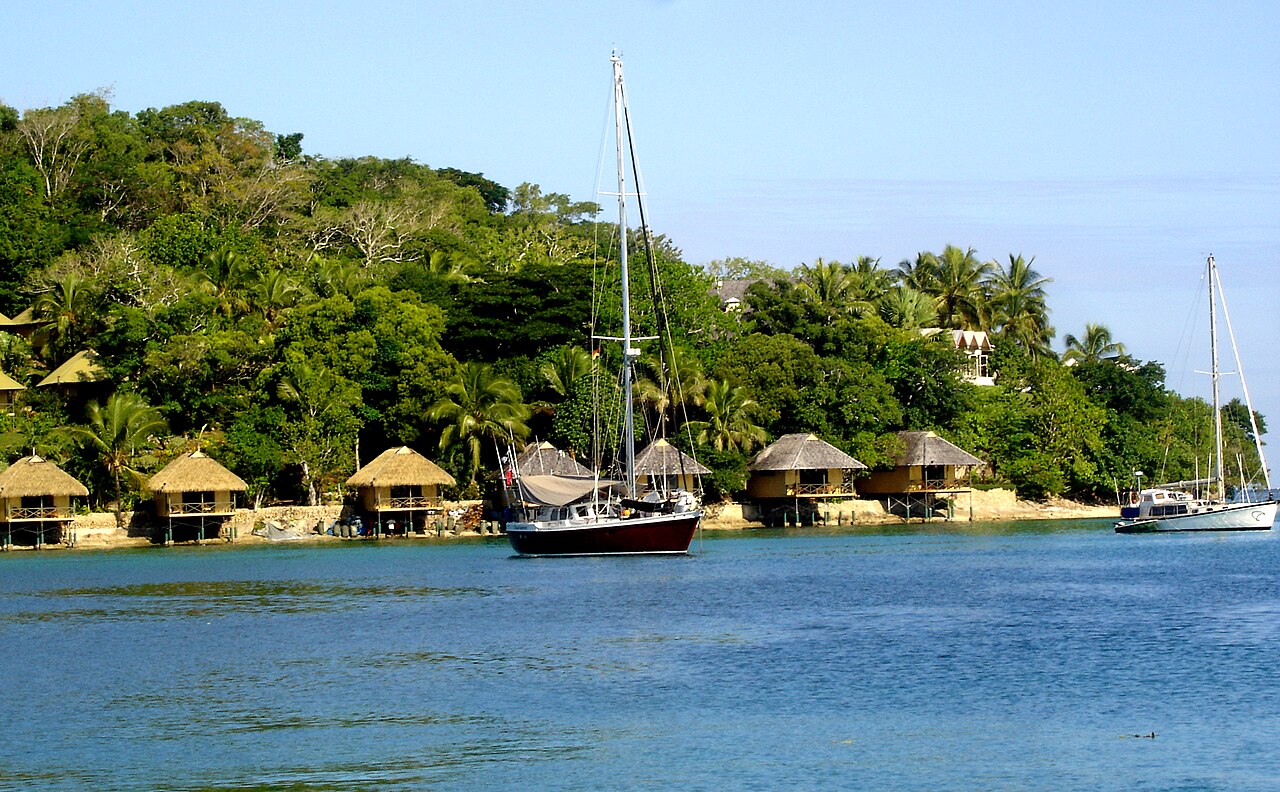
The triangle drawn on 1 page: Vila's harbor lights, Tanna's crater glowing in your camera roll, the Coolidge's statue still smiling in yours — and 2 spare days that turned out to be the smartest bookings of the trip.
The easily missed detail
Inter-island Vanuatu runs on relationships: lodges hold seats, operators rebook each other, and the traveler who books island stays through Vila-based agents (or the lodges directly) gets re-protected when a flight cancels, while the pure-independent traveler re-queues alone. The second detail is peso-of-the-pocket practical: vatu cash in small notes is the outer islands' fuel (fuel itself included — Tanna and Santo tours include it in the tour price; the independent driver negotiates in cash), and Australian dollars in an envelope are your emergency reserve, accepted gratefully in extremity from Vila to the Banks.
A practical rhythm
- Triangle, 14 days — Efate 4, Tanna 3, Santo 4, Vila buffer 2–3 spread as insurance
- Season chooses the north — Pentecost's Saturdays (April–June) versus Santo's any-dry-month diving
- Prophylaxis and slack — The 2 currencies Vanuatu never devalues
What could complicate the plan
The aviation rebuild remains the plan's soft underbelly: international carriers have stabilised the trunk routes, but domestic legs still cancel for weather, maintenance and load — never chain a Tanna return into a same-day international departure, and treat the buffer days as cargo, not leisure. Earthquakes are the country's geology, not its anomaly (the December 2024 shock, a further significant quake shaking the islands in March 2026 by some reports) — flexible bookings and insurance that names seismic disruption are the adult response. Volcano governance can re-draw the Tanna block overnight (Yasur's alert level) and the Ambrym/Maritime exclusions shift with theirs; the Pentecost season cannot be improvised outside April–June. Malaria geography is uneven and official elimination status by island changes — take the clinician's map of the current year, not the guidebook's. And the country's warmth has a protocol: villages are customary ground (fees, permissions, modest dress, no photography without asking), Sunday quiets everything, and kava evenings end plans for the night — the itinerary that respects kastom gets invited deeper; the one that doesn't gets politely stranded at the nakamal door.
What to do next
Book the international flights and the Santo/Tanna domestic legs in 1 session for a dry-season window, then book lodges that will re-protect you when the domestic board changes.
Sources
- Aviation record — Air Vanuatu's liquidation (May 9, 2024) and domestic-only return; international carriers at Bauerfield (Qantas, Jetstar, Virgin Australia, Air New Zealand, Fiji Airways, Aircalin, Solomon Airlines)
- U.S. Department of State, Vanuatu — 30-day free visitor permit; extensions up to 120 days; passport valid 6 months beyond arrival
- Vanuatu Tourism Office — Tanna and Santo flight times; naghol season (April–June); Millennium Cave conditions
- Health authorities — malaria risk concentrated in the northern islands; elimination progress in the south (verify current island status)