Victoria Falls / Zimbabwe Food and drink
Where should I eat in Victoria Falls, and which local food or drink is worth trying?
The short answer
Eat in Victoria Falls town rather than inside the park — the national park is a 23.4-square-kilometer protected area with gated, fee-charged access, while the adjacent town of roughly 50,000 residents and about 4,000 beds holds the restaurants.
The answer, with local context
Zimbabwe's staple is sadza, a stiff maize-meal porridge eaten with relish — most often a stew of beef, chicken or greens such as covo or rape. Order it in town and you are eating the country's everyday meal rather than a tourist version of it. Game meats appear widely on menus here, and the Zambezi supplies the local fish, with bream the usual restaurant option and tigerfish the river's famous sport species.
Two things on a Victoria Falls menu are genuinely regional. Madora, the mopane caterpillar, is a dried protein eaten across Zimbabwe's dry woodland belt. Maheu, a lightly fermented maize drink, is sold cold and non-alcoholic, and is a far better reflection of local habit than anything poured for a sunset cruise.
The town's geography shapes dinner more than any guide suggests. It sits immediately against the park boundary with the A8 running in from Bulawayo and the international airport on the same road, which is why hotel dining clusters along the park side and independent restaurants and markets sit back toward the residential grid.
Peak tourist numbers in the town reach about 4,000 against roughly 4,000 beds, so during the March-to-May high-water months restaurant tables and rooms tighten at the same time.
Picture the place
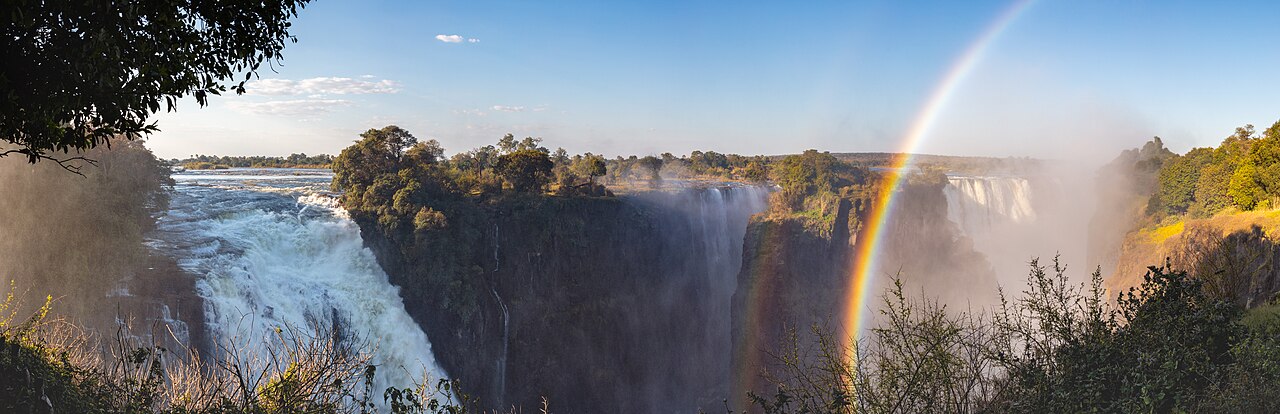
The town is a thin settlement in dry teak and mopane woodland, and the boundary is not symbolic — baboons, warthogs and monkeys move through the built-up edge, which is why food is not left out on open verandas.
The easily missed detail
Nothing you eat is produced where you are standing. The park's own economy is conservation, not agriculture: camping has been withdrawn from the Zambezi riverbank, the Rainforest is fenced and tightly controlled, and all supply arrives along the A8 from Bulawayo or through Victoria Falls International Airport. That single road explains both the price of imported wine and the reliability of beef and maize.
A practical rhythm
- Breakfast — Eat before the park opens, since the daily conservation fee makes a mid-morning return trip expensive.
- Lunch — Keep it in town between park sessions; the Falls and Rain Forest zone is only 0.45 square kilometers and does not need a full day.
- Dinner — Pair a river fish or a sadza plate with maheu, and save game-meat menus for a single evening rather than every night.
What could complicate the plan
The CDC lists Zimbabwe among destinations affected by East African Sleeping Sickness at Level 1 and by Global Measles at Level 1, both Practice Usual Precautions. Supply-driven menus change by season and by what the A8 delivered that week. Evenings in the April-to-August period can be genuinely cold, with mean minimums capable of dropping below 43°F (6°C), so open-air dining is not a year-round proposition.
What to do next
The things-to-do answer in this group sets out how the gorge, river and Rainforest zones divide a day, which is what fixes when you will actually be free to eat.
Sources
- Zimbabwe Parks and Wildlife Management Authority, Zambezi and Victoria Falls General Management Plan — town population and bed numbers, peak visitor figures, camping rule, zone area, temperatures
- Zimbabwe Parks and Wildlife Management Authority, Victoria Falls National Park — road and air access, wildlife present around the park edge
- UNESCO World Heritage Centre, Mosi-oa-Tunya / Victoria Falls — protected property status
- US Centers for Disease Control and Prevention, travel health notices — Zimbabwe notice levels