Yosemite / United States Things to do
What are the most worthwhile things to do in Yosemite on a first visit?
The short answer
Take the Tunnel View reveal, walk to the base of Yosemite Falls, and — if the lottery allows — climb Half Dome's cables; fill the rest with Glacier Point and the Mariposa Grove, the two corners of the park the 1864 grant was written to protect.
The answer, with local context
Yosemite exists in law because of two places. On June 30, 1864, in the middle of the Civil War, President Abraham Lincoln signed the Yosemite Grant, setting aside Yosemite Valley and the Mariposa Grove of giant sequoias "for public use, resort, and recreation… inalienable for all time" — the first time any government had preserved land purely for its scenery. Congress made the surrounding high country a national park on October 1, 1890, the third in the nation, and California handed the Valley and the Grove back to federal care in 1906. The park now covers 747,956 acres, about 95 percent of it designated wilderness, and UNESCO inscribed it as a World Heritage Site in 1984.
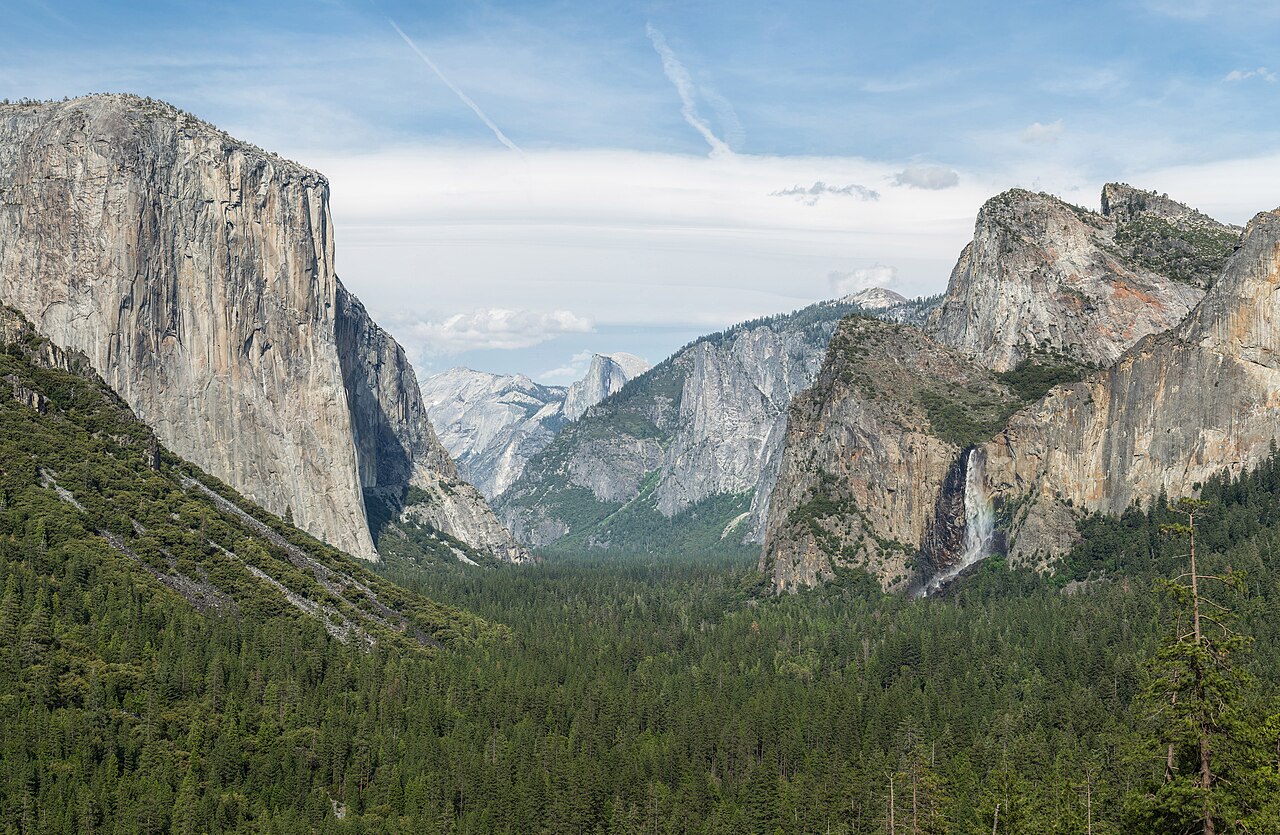
The Valley, famously, is only about one percent of that area. Its set piece is the view from Tunnel View, where the Wawona Tunnel's east portal frames El Capitan's 3,000-foot granite face on the left, Bridalveil Fall on the right and Half Dome closing the distance. From the Valley floor, the one-mile loop to Lower Yosemite Fall puts you at the base of a 2,425-foot, three-tier drop; the full Upper Yosemite Fall trail climbs 7.2 miles round trip and some 2,700 feet to the brink. Across the Valley, binoculars from El Capitan Meadow resolve the climbers on the great wall into slow-moving colored dots.
Half Dome is the park's summit ambition and its bureaucracy in one. The dome rises about 4,800 feet above the Valley floor; the final 400 feet climb its bare shoulder on steel cables that the park installs each spring — usually the Friday before Memorial Day, May 15 in 2026 — and removes the day after the second Monday in October. A permit is required whenever the cables are up, issued by lottery on recreation.gov: a preseason lottery each March, and a second lottery two days before each hiking date. The park caps the route at 300 people a day — 225 day hikers and 75 backpackers — for a hike of 10 to 14 hours. Glacier Point, 3,200 feet above the Valley at the end of its seasonal road, is the same view with none of the paperwork. The Mariposa Grove, an hour south, holds about 500 mature giant sequoias, among them the Grizzly Giant, estimated at some 3,000 years old.
Picture the place
At Tunnel View in the late afternoon the whole composition is lit in sequence — El Capitan catching the sun full-face, Bridalveil Fall's plume blowing sideways in the updraft, and Half Dome standing pale and bare at the head of the valley.
The easily missed detail
Ninety-five percent of this park is wilderness that most visitors never enter. The Valley's crowds are a one-percent problem: a single trailhead on Tioga Road or at Glacier Point leaves them behind within a mile.
A practical rhythm
- Morning — Tunnel View first, then the Lower Yosemite Fall loop before the Valley's lots fill, which in 2026 happened by about 8 a.m. on peak days.
- Midday — Ride or drive to Glacier Point for the high view while the Valley floor is at its busiest and hottest.
- Afternoon — The Mariposa Grove in the quieter late light, or the first miles of the Mist Trail toward Vernal Fall.
What could complicate the plan
Half Dome is won in March, not on the trail: miss the preseason lottery and the remaining route is the two-days-ahead lottery for a capped pool. Trail work also bites in 2026 — scheduled repairs close the Mist Trail on weekday mornings and early afternoons, 7:00 a.m. to 3:30 p.m., from the end of June into October, pushing Vernal and Nevada Fall hikers to weekends or the John Muir Trail. Rockfall, meanwhile, is the Valley's background process rather than a freak event: a USGS study that combined 1976 aerial photographs with repeat laser scanning counted 235 rockfalls from El Capitan and Middle Brother alone over a 40-year period, eroding those two cliffs at 0.9 to 1.7 millimetres a year.
What to do next
Enter the March lottery if Half Dome is the ambition; if it is not, build the trip on the Valley and Glacier Point and let the dome be the view. The food question in this group covers the park's one great dining room.
Sources
- National Park Service — Yosemite history and foundation documents: the 1864 Yosemite Grant, national park designation on October 1, 1890, 747,956 acres and 95 percent designated wilderness
- National Park Service — Half Dome permits: cables season, the 300-per-day cap and the March preseason and two-days-ahead lotteries on recreation.gov
- UNESCO — Yosemite National Park World Heritage inscription, 1984
- National Park Service — Yosemite Falls trails and Glacier Point: 2,425-foot falls, the 7.2-mile Upper Fall trail and Glacier Point's 3,200-foot elevation above the Valley
- U.S. Geological Survey — 235 rockfalls documented from El Capitan and Middle Brother over a 40-year period, with cliff erosion at 0.9 to 1.7 mm per year