Zanzibar / Tanzania Things to do
What are the most worthwhile things to do in Zanzibar on a first visit?
The short answer
Walk Stone Town's World Heritage core and spend a half day in Jozani — UNESCO inscribed Stone Town under criteria (ii), (iii) and (vi), and Jozani-Chwaka Bay holds the main population of the Zanzibar red colobus, a monkey the IUCN Red List classes as Endangered with fewer than 2,000 individuals left.
The answer, with local context
Stone Town is not a monument but a street plan, and the buildings worth finding are specific. The Old Fort stands on the site of an earlier Portuguese church. The House of Wonders is the large ceremonial palace built by Sultan Barghash. Christ Church Anglican Cathedral was raised on the site of the last slave market and commemorates David Livingstone's work against the slave trade. The Old Dispensary, St. Joseph's Roman Catholic Cathedral, the residence of the slave trader Tippu Tip, the Malindi Bamnara Mosque, the Jamat Khan built for the Ismaili community, the Royal Cemetery and the Hamamni Persian baths complete a walk you can do in a long morning.
Criterion (vi) is the one most visitors never read. UNESCO lists Zanzibar as being of great symbolic importance in the suppression of slavery, as both a major East African slave-trading port and a base for abolitionists. The cathedral and the former market site are therefore part of the inscription's reasoning, not a side trip.
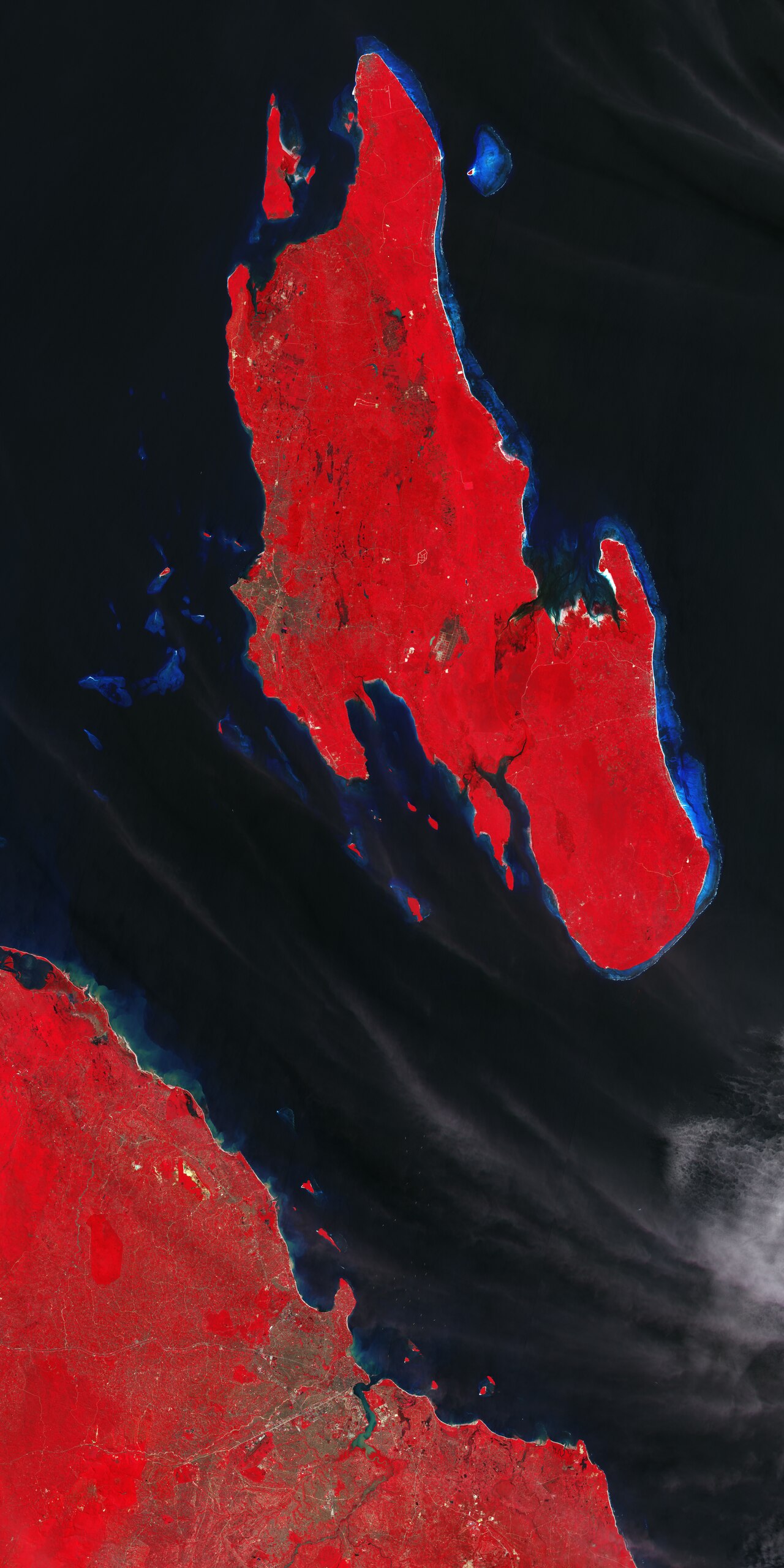
Jozani is the island's wildlife anchor. Piliocolobus kirkii is endemic to Zanzibar Island, lives between sea level and 110 meters, and is concentrated in the southeast around Jozani-Chwaka Bay National Park, adjacent farmland and Uzi Island; the Jozani subpopulation alone has been put at about 500 animals. A translocated group survives in Masingini Forest Reserve, and roughly 14 animals were introduced to Ngezi Forest Reserve on Pemba around 1974.
Picture the place
Jozani's groundwater forest sits low and close, with mahogany and palm canopy and a boardwalk across mangrove on the Chwaka Bay side. The colobus troops feed within a few yards of the path, which is precisely the pressure the park manages.
The easily missed detail
The red colobus is Endangered on range size rather than persecution alone: the assessment rests on criteria B1ab(ii,iii,v), the signature of a species whose entire world is one small island. That is also why Zanzibar's forest reserves and the farmland next to them matter as much as the national park itself, and why guided-only access to the monkey groups exists.
A practical rhythm
- Morning — Stone Town on foot, starting at the Old Fort and the seafront while shade still falls into the lanes.
- Midday — The Hamamni baths, the cathedral and the covered market area, all within the historic core.
- Afternoon — Drive southeast to Jozani, where the forest and mangrove boardwalk take about two hours.
What could complicate the plan
Tanzania sits at Level 3, Reconsider Travel, as of October 31, 2025, for unrest, crime, terrorism and the targeting of gay and lesbian individuals. Stone Town's historic fabric is under active conservation management, and individual monuments close for structural work — the property's record at UNESCO includes joint advisory and reactive monitoring missions. The lanes are uneven coral stone with no vehicle access in much of the core, which rules out wheeled luggage and makes step-free routes hard to plan.
What to do next
The food-and-drink answer in this group picks up the spice trade that built these houses, and the when-to-visit answer explains the island's two rainy seasons.
Sources
- UNESCO World Heritage Centre, Stone Town of Zanzibar — criteria, named buildings, slavery-suppression significance
- IUCN Red List, Piliocolobus kirkii — Endangered status, criteria, population and range
- US Department of State, Tanzania Travel Advisory — advisory level and reasons