Antigua Guatemala / Guatemala Things to do
What are the most worthwhile things to do in Antigua Guatemala on a first visit?
The short answer
Walk the UNESCO-listed colonial grid from Parque Central to the Santa Catalina Arch and the great ruined convents, climb Cerro de la Cruz for the postcard view, and give one night to the Acatenango trek to watch Volcán de Fuego erupt.
The answer, with local context
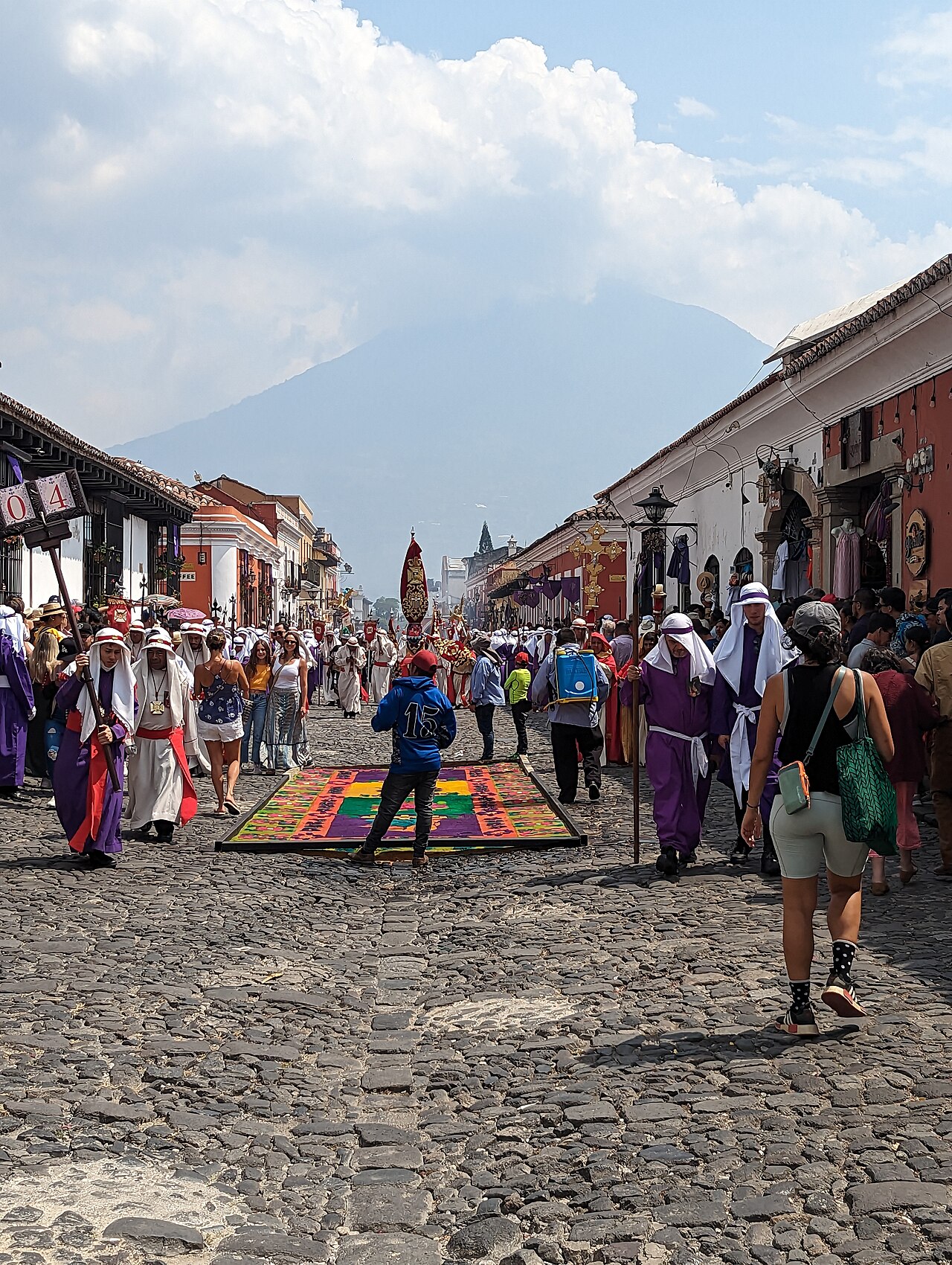
Antigua was founded on March 10, 1543, as Santiago de los Caballeros and governed Spanish Central America — a captaincy stretching from Chiapas to Costa Rica — for 230 years, until the Santa Marta earthquakes of July 29, 1773 destroyed it and the Crown ordered the capital moved to what is now Guatemala City. Because the city was abandoned rather than rebuilt, its grid survives whole, and UNESCO inscribed it in 1979 under cultural criteria (ii), (iii) and (iv). A first visit is best spent walking it: Parque Central with its 1737 Sirens fountain, the San José Cathedral (begun in 1545, its grand nave still a roofless ruin behind the working church), and the Santa Catalina Arch on 5a Avenida Norte — built in 1693 as an enclosed bridge so the cloistered nuns of the Santa Catalina convent, founded in 1609, could cross the street unseen; its French clock was added in the 19th century.
The ruins are the second act. Las Capuchinas, consecrated in 1736 and the last convent built in the city, holds the Tower of Retreat: a circular courtyard ringed by 18 tiny cells, each with its own bathroom, an arrangement unique in colonial America. La Merced, dedicated only in 1767, survived 1773 almost intact and is still a working church; San Francisco el Grande keeps the tomb of Saint Pedro de San José Betancur, canonized in 2002 as Central America's first saint. Climb the steps to Cerro de la Cruz, the cross-topped hill north of the grid, for the view that organizes everything — the checkerboard of streets running straight at the cone of Agua.
Save the biggest effort for the volcano overnight. Guided groups climb Acatenango (13,045 feet / 3,976 m) in 4 to 6 hours to camps pitched across a roughly 2-mile saddle from Fuego (12,346 feet / 3,763 m), which INSIVUMEH logs erupting several times an hour — up to 13 explosions an hour in active spells — throwing glowing bombs visible all night. Climbing Fuego itself is prohibited, a certified guide is mandatory on Acatenango, and the gentler alternative is Pacaya (8,373 feet / 2,552 m), a half-day hike to steaming vents. Round out the days at ground level with a working coffee finca tour — Antigua is one of Anacafé's eight named coffee regions — and the textile stalls of the Mercado de Artesanías and Nim Po't, where each woven huipil pattern identifies the town its weaver comes from.
Picture the place
From a tent door on Acatenango at midnight the whole show is silent for a beat after each flash — Fuego's cone lights orange from inside, lava fountains up and rattles down its flanks, and only then does the concussion roll across the saddle and shake the tent fabric.
The easily missed detail
The Arch's enclosed bridge exists because of a bureaucratic refusal, not devotion alone: when the Santa Catalina nuns outgrew their convent and were granted the building across the street, the city council denied them permission to close the road between the two — so they bridged it instead, and the cloister rule that nuns could not be seen in public was preserved by architecture.
A practical rhythm
- Grid first, on foot — Walk Parque Central, the cathedral ruins and the Arch in the morning, then Capuchinas and La Merced in the afternoon
- One summit viewpoint — Climb Cerro de la Cruz at breakfast time, when Agua is clearest and the light is on the grid
- One night out — Spend the middle night of the trip on Acatenango, keeping the following day unscheduled for the descent and a nap
What could complicate the plan
Acatenango is a genuine high-altitude climb: camps sit between about 11,150 and 12,300 feet, night temperatures fall below freezing in every month, and access closes entirely during Fuego's eruptive episodes — in August 2026 the municipal park shut during a paroxysm and reopened on August 7 with approved routes only. Antigua's flat grid hides how uneven its cobblestones are, the ruin sites charge separate small entry fees, and several close by late afternoon.
What to do next
Book the Acatenango trek with a certified operator for the middle of the trip, then walk the grid sights in the order listed on your first full day.
Sources
- UNESCO World Heritage Centre — Antigua Guatemala, inscribed 1979 under criteria (ii), (iii) and (iv), founded 1543 and capital of the Captaincy General until 1773
- Council for the Protection of Antigua Guatemala records — Santa Catalina Arch built 1693 for the cloistered Santa Catalina nuns; Las Capuchinas consecrated 1736 with its circular 18-cell Tower of Retreat
- INSIVUMEH — Fuego at 3,763 m in continuous eruption, logging up to 13 explosions per hour; Acatenango at 3,976 m, access regulated with INGUAT and CONRED
- Anacafé — Antigua as one of Guatemala's eight coffee regions, grown at 5,000 to 5,600 feet