Antigua Guatemala / Guatemala When to visit
When should I visit Antigua Guatemala, Guatemala, for the best experience?
The short answer
Visit in February, deep in the dry season, when the volcano views are at their clearest, the jacarandas are about to bloom, and Lent's processions have begun without yet reaching Holy Week's crush.
The answer, with local context
Antigua sits at 5,029 feet (1,533 m) in the Panchoy Valley, and altitude flattens its temperature calendar almost to nothing: daytime highs sit near 77°F (25°C) in every month of the year, which is why Guatemala calls itself the land of eternal spring. What actually changes is rain. The dry season runs from November to April, and February is its driest full month, averaging about 0.4 inches (10 mm) of rain against roughly 12 inches (304 mm) in June. For a city whose whole appeal is outdoors — cobblestone streets, ruined churches open to the sky, and three volcanoes standing over the grid — that dryness is the experience.
February also has the clearest volcano weather of the year. Volcán de Fuego, 10 miles west, is in near-continuous eruption, and in January and February the cloud bank that parks on the Acatenango saddle in wetter months rarely forms, so the overnight hike to watch Fuego fire lava into the night sky runs at its most reliable. Nights in December and January can drop to about 50°F (10°C); by February the evenings have softened while the skies stay hard and blue, and the coffee harvest on the fincas around the valley, which runs through the dry months, is still under way.
If you want the city's defining spectacle instead, aim one month later. Holy Week in Guatemala was inscribed on UNESCO's Representative List of the Intangible Cultural Heritage of Humanity in 2022, and Antigua's version — block-long sawdust carpets and processions that run 10 to 15 hours — is the country's largest. Lent's smaller Sunday processions begin weeks earlier, so a late-February trip catches the carpets and the purple-robed cucuruchos at neighborhood scale, while the jacaranda trees start dropping violet blossom onto the streets in March.
Picture the place
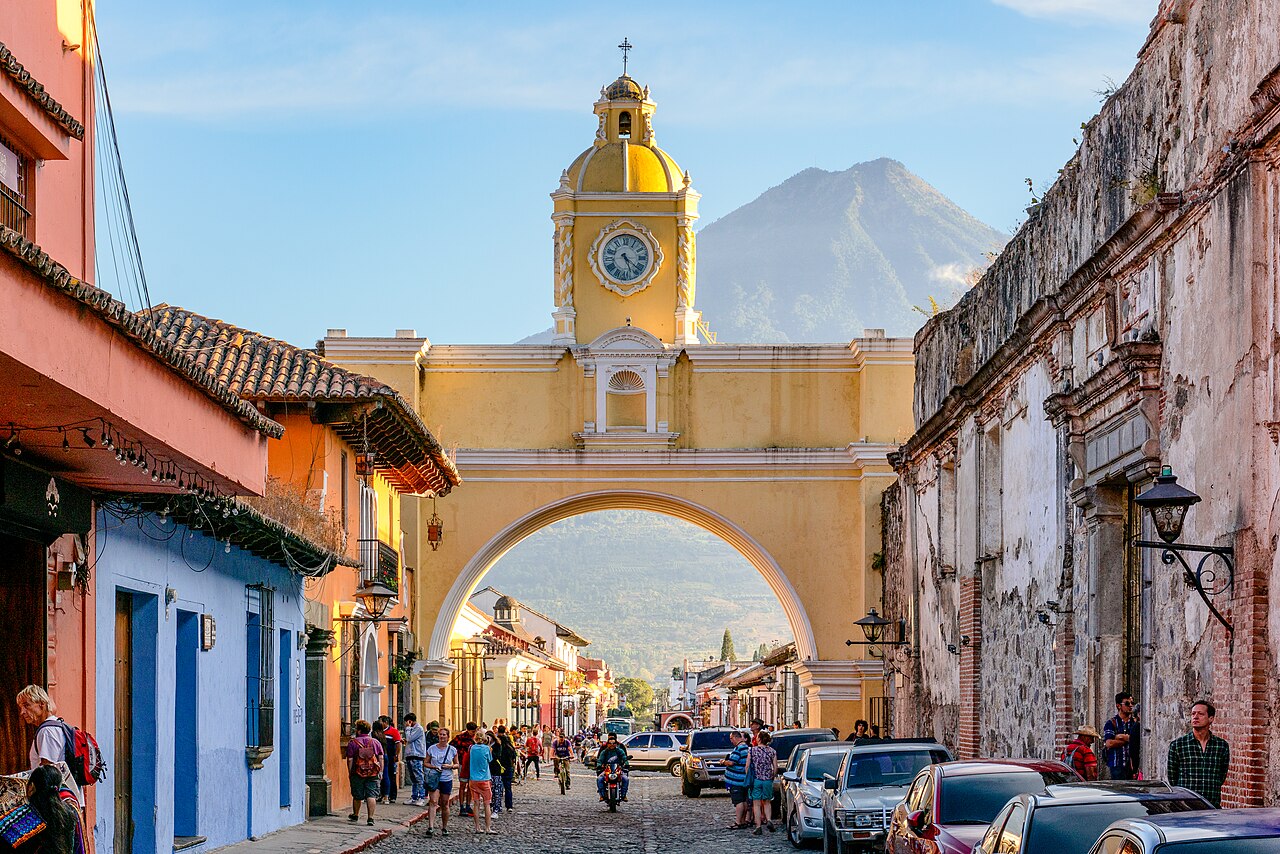
At dawn the whole grid points south: the Santa Catalina Arch frames Volcán de Agua's perfect cone dead-center, woodsmoke from breakfast fires hangs over the red tile roofs, and the volcanoes are sharp enough to show their gullies before the afternoon haze takes the edge off.
The easily missed detail
Antigua's two seasons are named backwards for visitors from the north: locals call the dry months verano (summer) and the rainy months invierno (winter), even though invierno, May to October, is when the valley is greenest and warmest-feeling. The trap inside the rainy season is September and October, when rain stops being a predictable afternoon shower and can close roads and cloud out the volcanoes for days at a stretch.
A practical rhythm
- Book the volcano hike early in the stay — Take the Acatenango overnight on your second or third night, leaving dry backup nights if cloud moves in
- Walk the grid in the morning — See the ruins and the arch in the clear early light, and save museums and cafés for the hotter afternoon
- Layer for the altitude — Carry a warm layer from the start: at 5,029 feet the temperature falls fast after sunset in every month
What could complicate the plan
Holy Week fills Antigua to capacity months ahead — rooms are booked a year out by some pilgrims, and prices spike. December and January bring the year's coldest nights and a persistent dry-season wind. And Fuego's activity is monitored daily by INSIVUMEH; during eruptive episodes the authorities restrict access to the Acatenango trails entirely, as they did in early August 2026, so no month guarantees the hike.
What to do next
Set February dates, stay inside the historic grid, and reserve the Acatenango overnight trek and any finca tour before you arrive.
Sources
- INSIVUMEH-based climate normals for Antigua — elevation 1,533 m, year-round highs near 25°C, February rainfall around 10 mm versus about 304 mm in June
- UNESCO Intangible Cultural Heritage — Holy Week in Guatemala inscribed on the Representative List in 2022, with Antigua's processions and carpets as its centerpiece
- UNESCO World Heritage Centre — Antigua Guatemala inscribed 1979, which protects the whole colonial grid visitors walk
- INSIVUMEH volcano bulletins — Fuego's continuous activity and the seasonal pattern of clear viewing in January and February