Bali / Indonesia When to visit
When should I visit Bali, Indonesia, for the best experience?
The short answer
May to October, Indonesia's dry season, with June through September the driest stretch at roughly 160 to 180 mm of rain a month nationally against about 300 mm in May and November.
The answer, with local context
Indonesia's monsoon year is simple in outline: wet from November to April, dry from May to October, on the 1991 to 2020 climatology. The useful detail is the gradient inside the dry season. June and July are the lowest-rainfall months at about 160 to 180 mm, roughly 6.3 to 7.1 inches each, while May and November average near 300 mm, about 11.8 inches — close to double. May and October are therefore shoulder months rather than dry ones.
Temperature barely moves across the year, which is why rainfall decides your timing. Monthly averages hold at about 77 to 79°F (25 to 26°C) nationally, with coastal areas near 82°F (28°C) and mountainous areas near 73°F (23°C). On Bali that spread is vertical, not seasonal: the coast is consistently warm while the Batukaru and Batur uplands are cooler at any time of year.
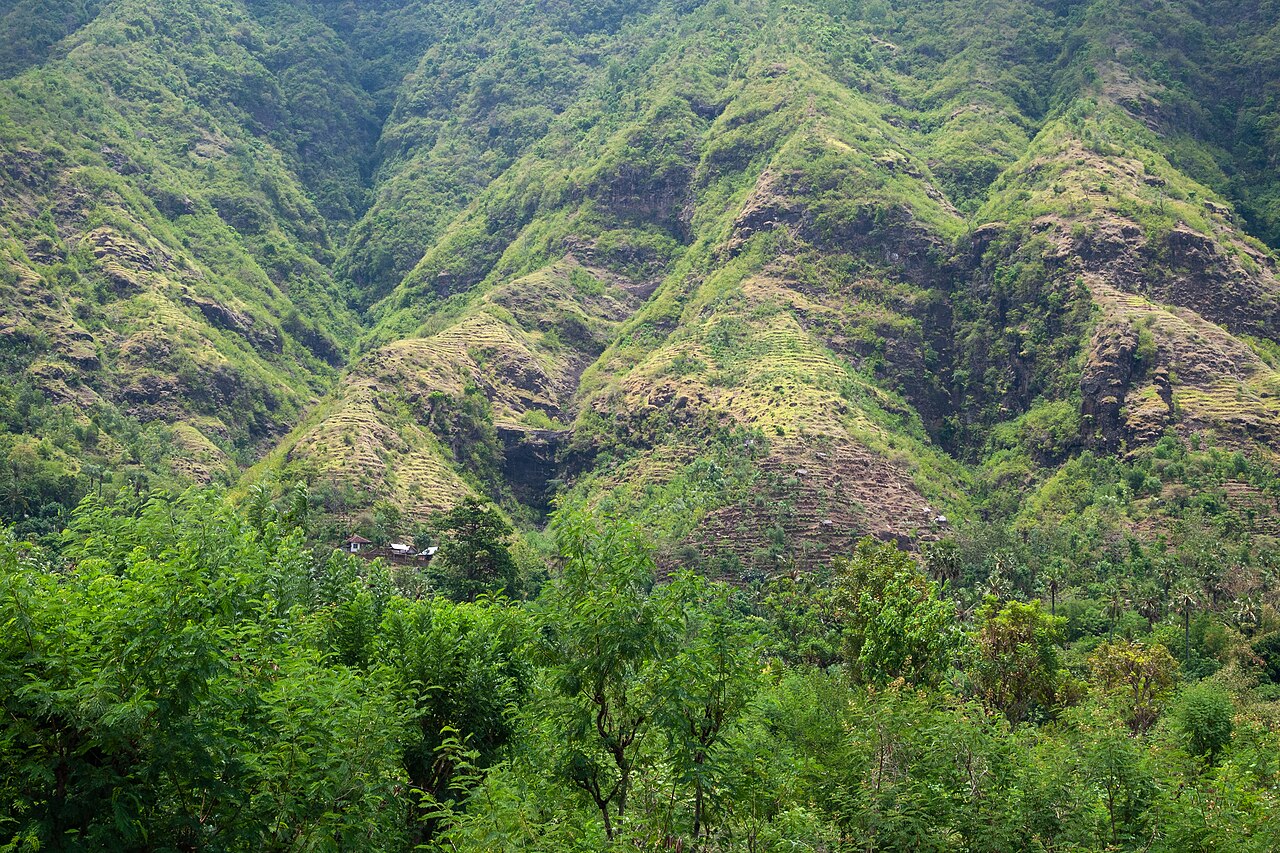
Altitude also explains why the island's cultural landscape looks greenest when the coast looks driest. The subak irrigation system that UNESCO inscribed in 2012 moves water from crater lakes and upland watersheds down through terraces, so the rice fields are not simply rain-fed.
One fixed date overrides all of this. For Nyepi, the Balinese day of silence, Bali's I Gusti Ngurah Rai International Airport closes completely for 24 hours; in 2026 that ran from 6:00 a.m. on Thursday 19 March to 6:00 a.m. on Friday 20 March under NOTAM A0096, cancelling 440 scheduled flights — 231 domestic and 209 international.
Picture the place
In the dry months the terraces at Jatiluwih sit in hard sunlight with the Batukaru ridge behind them, and the water in the channels is audible from the path. Under the November to April rains the same slopes carry low cloud for much of the afternoon.
The easily missed detail
Nyepi does not just stop flights. It is a full day of silence across the island: no travel on the roads, lights kept low, businesses closed, and that includes hotels serving guests under restrictions. Arriving the day before or leaving the day after both run into a hard closure — the last 2026 departures were 11:10 p.m. domestic on 18 March and 1:30 a.m. international on 19 March, with the first flights back at 7:00 a.m. on 20 March. The Saka calendar sets the date, so it moves each year.
A practical rhythm
- June to September — The driest months; the window for upland walking, terraces and dive conditions.
- May and October — Shoulder months at around 300 mm of rain, with fewer visitors than midsummer.
- November to April — Wet season; afternoons go to rain, and Nyepi falls inside this stretch.
What could complicate the plan
Every international tourist traveling to Bali owes the foreign tourist levy, Pungutan Wisatawan Asing, at Rp 150,000 per person, payable once per trip. The US Department of State has Indonesia at Level 2, Exercise Increased Caution, citing risk of natural disasters, unrest and terrorism, with some areas carrying increased risk. The CDC lists Indonesia among destinations affected by its Level 1 Global Measles notice dated May 28, 2025. Volcanic activity can disrupt flights independently of the monsoon.
What to do next
The responsible-travel answer in this group covers the upland and World Heritage parts of the island that suit the dry season best.
Sources
- World Bank Climate Change Knowledge Portal, Indonesia Climate Risk Country Profile — wet and dry season months, monthly rainfall, temperature by elevation
- Bali Provincial Government, Love Bali — foreign tourist levy amount and rule
- ANTARA, Bali airport 24-hour operational suspension for Nyepi — closure hours, NOTAM reference, flight numbers
- UNESCO World Heritage Centre, Decision on the Cultural Landscape of Bali Province — inscription year and subak water management
- US Department of State, Indonesia Travel Advisory — advisory level and reasons