Bali / Indonesia Food and drink
Where should I eat in Bali, and which local food or drink is worth trying?
The short answer
Eat in the inland villages and market warungs, and order the pork dishes — Bali is a Hindu-majority island inside the world's largest Muslim-majority country, which is why babi guling and lawar exist here and almost nowhere else in Indonesia.
The answer, with local context
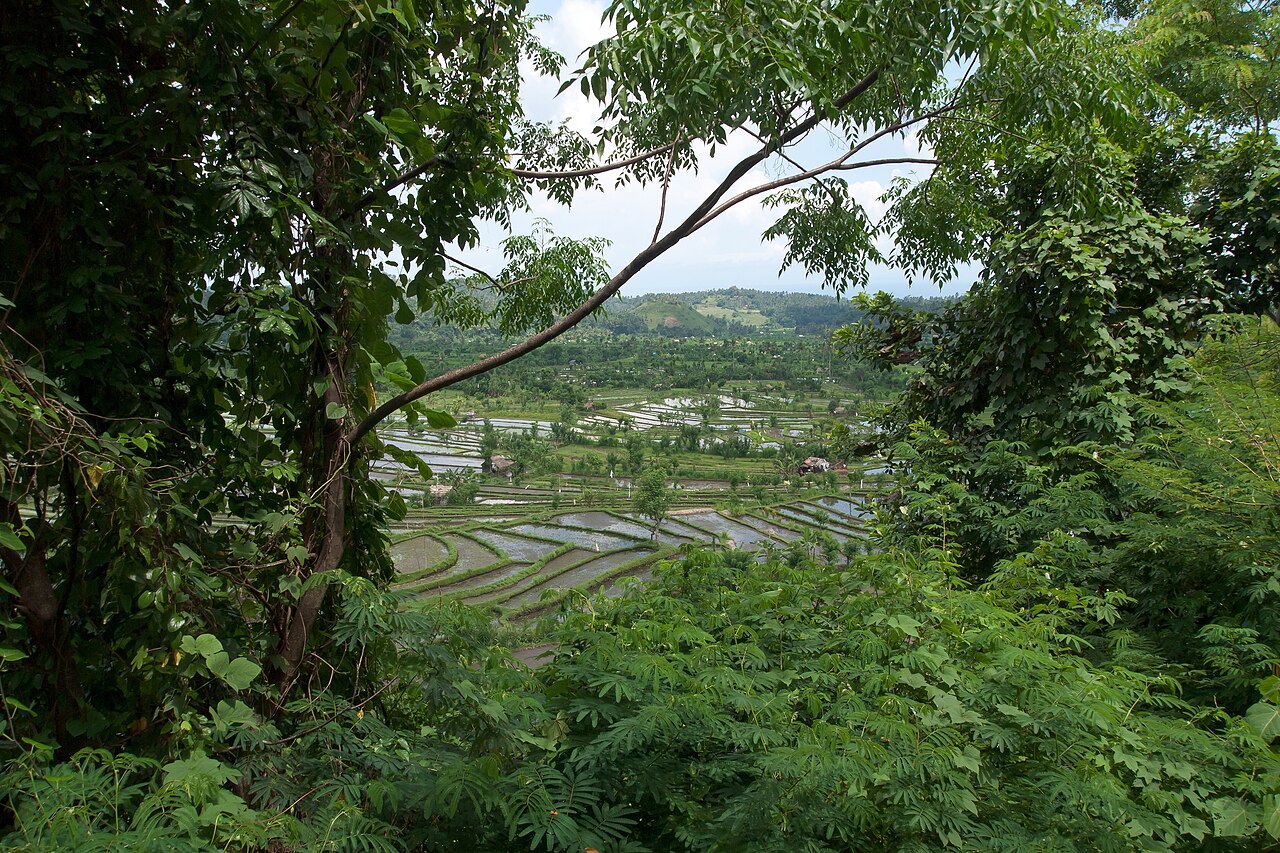
Balinese cooking is built on its own rice. UNESCO's inscription of the island's cultural landscape rests on the subak, a cooperative water-management system with about 1,200 collectives sharing sources among 50 to 400 farmers, coordinated through water temples since the 11th century. Rice from those terraces is the base of nasi campur, the mixed plate that remains the island's everyday meal.
Four dishes carry the island's name properly. Babi guling is spit-roasted suckling pig rubbed with turmeric, coriander and lemongrass. Lawar mixes minced meat with grated coconut, beans and spice. Sate lilit wraps minced fish or chicken around lemongrass stalks. Bebek betutu is duck packed with spice paste and slow-cooked, traditionally ordered ahead. Base genep, the island's standard spice paste, sits under most of them.
Geography and climate tell you where to eat what. Coastal areas average about 82°F (28°C) and the uplands about 73°F (23°C), which is why the volcanic slopes grow the coffee and citrus and the coast delivers the seafood. Kintamani, on the flank of the same volcano as the inscribed Lake Batur temple, is Bali's coffee district.
Market timing matters as much as location: traditional markets run early and clear out by mid-morning, so a market breakfast is a different experience from a market lunch.
Picture the place
A roadside warung inland is a single open room with the day's dishes set out in covered bowls, rice in a basket, and the smell of coconut and burnt chili. By ten in the morning the best of it is gone.
The easily missed detail
Arak is the island's distilled palm spirit, and quality varies enormously between licensed producers and informal ones; methanol contamination has caused deaths in Indonesia, which is a reason to drink it only where provenance is clear. Separately, on Nyepi the entire island stops — in 2026 the airport closed for 24 hours from 6:00 a.m. on 19 March — and restaurants close with it, so hotels become the only food source for a full day.
A practical rhythm
- Early morning — A market plate of nasi campur, before the stalls pack up.
- Lunch — Babi guling at an inland specialist, where it is cooked for the day and sold until it runs out.
- Evening — Grilled seafood on the coast, or bebek betutu ordered hours ahead.
What could complicate the plan
The Rp 150,000 foreign tourist levy applies once per trip to every international tourist traveling to Bali. The CDC includes Indonesia in its Level 1 Global Measles notice of May 28, 2025, and the State Department advisory for Indonesia is Level 2, Exercise Increased Caution. The wet season from November to April — about 300 mm of rain in November alone — limits open-air dining, and tap water is not drinkable anywhere on the island.
What to do next
The things-to-do answer in this group maps the inscribed subak landscapes that produce the rice; the when-to-visit answer sets out the monsoon months.
Sources
- UNESCO World Heritage Centre, Decision on the Cultural Landscape of Bali Province — subak collectives, water temples, 11th-century coordination
- World Bank Climate Change Knowledge Portal, Indonesia Climate Risk Country Profile — coastal and upland temperatures, wet season rainfall
- Bali Provincial Government, Love Bali — foreign tourist levy
- ANTARA, Bali airport 24-hour operational suspension for Nyepi — Nyepi closure hours
- US Centers for Disease Control and Prevention, travel health notices — Indonesia notice level