Bora Bora / French Polynesia When to visit
When should I visit Bora Bora, French Polynesia, for the best experience?
The short answer
September — deep in the dry season, when the lagoon sits at a steady 81°F (27°C), the August holiday crowds have flown home, the trade winds still polish the sky, and the humpback whales are in French Polynesian waters.
The answer, with local context
Bora Bora's year divides in two, and Météo-France's 1991–2020 normals for the airport station on Motu Mute draw the line precisely. The dry season runs from May to October: highs settle at 84–86°F (29–30°C), lows at 73–77°F (23–25°C), and rainfall falls to roughly 4.4 inches (109–112 mm) in the shoulder months and less in August, the driest. The wet season, November to April, pushes January's rain to 9.6 inches (245 mm) across 17 rain days, with December close behind at 9.9 inches (251 mm) — about 65 inches (1,654 mm) falls across the year, on some 147 days with rain. What barely moves is the temperature: barely ten degrees separate the warmest and coolest months, and the lagoon holds between 81 and 84°F (27–29°C) in every month of the year.
September collects the dry season's advantages after its peak has passed. July and August are the premium weeks — French school holidays fill the motu resorts and price them accordingly — while September keeps August's weather, adds the returning quiet, and overlaps the humpback season: whales migrate into French Polynesia's sanctuary waters roughly from July to November, and lagoon tours out of Bora Bora watch for them beyond the pass. July has one counter-claim: Heiva, the great Tahitian dance and song festival, fills the territory's calendar in mid-year, and Bora Bora stages its own celebrations.
Geography assigns every visitor the same arrival: the airport stands on Motu Mute, a reef islet built up by American engineers in 1942, so every stay begins and ends with a boat ride across the lagoon — transfers to the motu resorts on the eastern ring in the teeth of the trade winds, or the shuttle to Vaitape on the sheltered main island. The seasons treat the two addresses differently: in the wet months the motu resorts take the weather full-face, while Vaitape and Matira Beach, under the main island's western lee, sit out the squalls in calmer air.
Picture the place
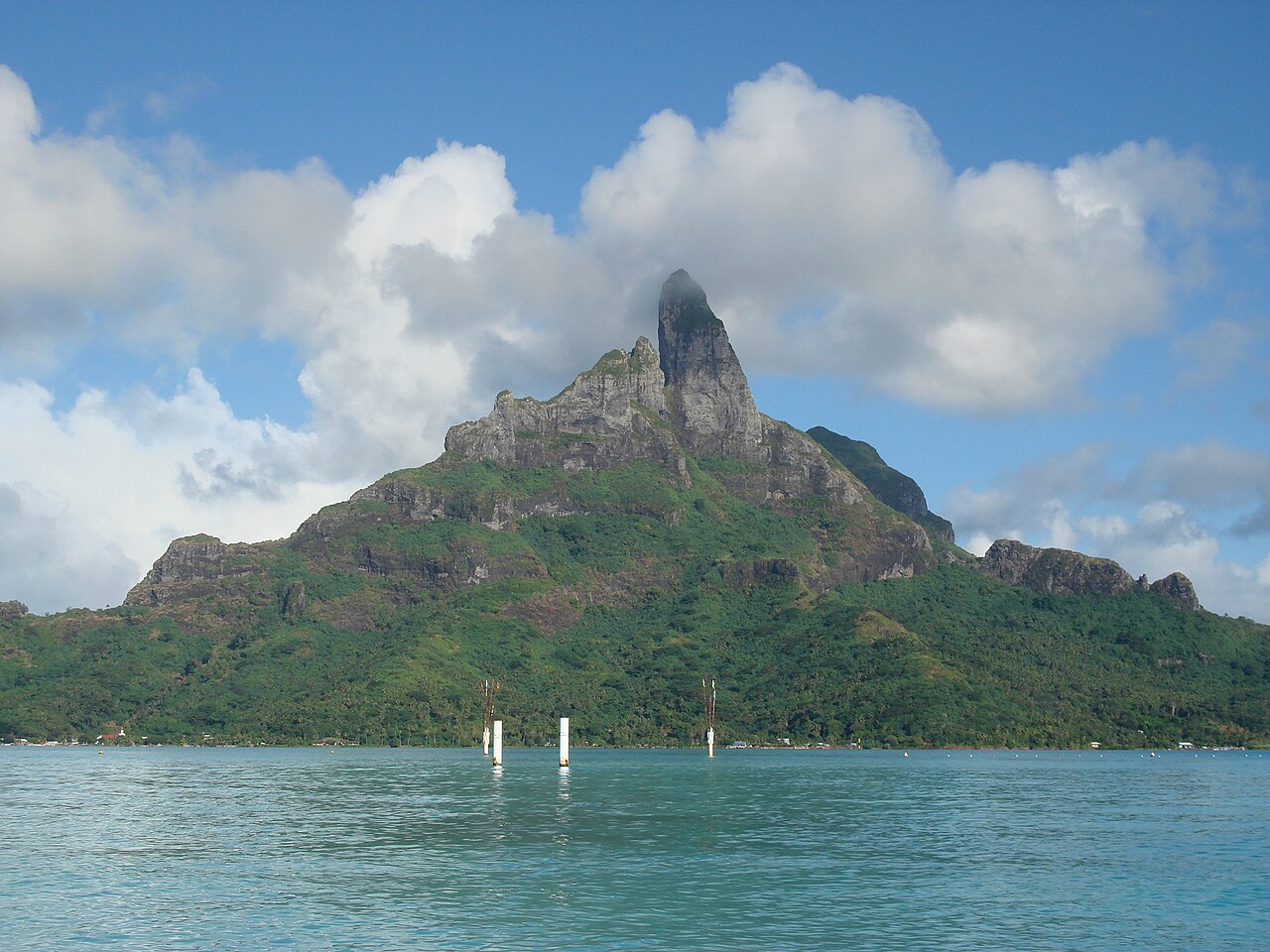
On a September morning the lagoon is doing its famous arithmetic of blues — indigo over the pass, sapphire over the deep water, milk-turquoise over the sand flats — and Otemanu stands so sharp against the sky that the cloud usually parked on its summit has not yet formed.
The easily missed detail
The cyclone calendar and the rain calendar are not the same thing, and neither should frighten a dry-season traveler: French Polynesia's cyclone season runs November to April, yet Bora Bora is struck rarely — Cyclone Osea in November 1997 and Oli, which brushed the island in February 2010, are the modern reference points. The wet season's real tax is not catastrophe but humidity, cloud on the mountain, and rain on half the days of the month.
A practical rhythm
- Morning — Lagoon tours before ten, when the water is glass, the snorkel sites are empty and Otemanu stands clear of its afternoon cloud.
- Midday — The main island's shade: lunch in Vaitape and the island's one road, when the trade wind makes even noon feel civilized.
- Evening — Sunset faces west over the pass from the main island and the western motus — the side of the lagoon to be on as the light goes.
What could complicate the plan
July and August sell out the famous overwater stock months ahead and price it at the year's ceiling; Christmas and New Year do the same inside the wet season's worst weather, the year's worst value combination. At the seasons' edges, a late cyclone in April or an early one in November can cancel inter-island flights and boat transfers for a day or two — build the Papeete connection with slack, because every Bora Bora journey passes through that single hub.
What to do next
Book the motu or the main island before the month, using the things-to-do question in this group: where you sleep on Bora Bora decides what the island is.
Sources
- Météo-France, French Polynesia — 1991–2020 climate normals for Bora Bora (Motu Mute station): seasonal rainfall, rain days, air and lagoon temperatures
- Direction de l'environnement, French Polynesia — the territory's marine mammal sanctuary and the humpback whale season, roughly July to November
- ISPF (Institut de la statistique de la Polynésie française) — cyclone season in French Polynesia, November to April