Bora Bora / French Polynesia Food and drink
Where should I eat in Bora Bora, and which local food or drink is worth trying?
The short answer
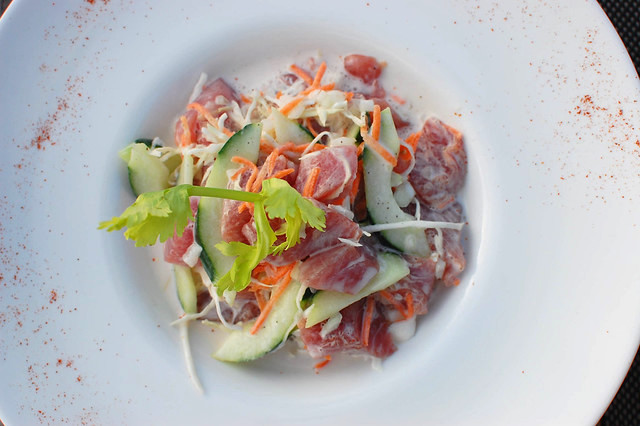
Poisson cru — raw tuna in lime and coconut milk, the national dish of French Polynesia — eaten twice: once from a roulotte food truck by Vaitape pier like a local, and once at Bloody Mary's on the main island, under the thatch, with your shoes off in the sand.
The answer, with local context
Bora Bora eats in two registers, and the honest map divides by address. On the main island, Vaitape has the roulottes — food trucks that set up near the pier from late afternoon — serving poisson cru, grilled mahi-mahi, steak frites, crêpes and the Chinese-Tahitian chao men for roughly the price of a generous plate, around US$10–20, while the motu resorts on the reef ring run French-Polynesian dining rooms their guests mostly cannot leave without a boat. The two worlds share one dish and one pantry.
Poisson cru — eia ota in Tahitian — is that dish: cubes of raw tuna, or mahi-mahi, or parrotfish, barely cured in lime juice until the edges turn opaque, then folded through freshly pressed coconut milk with cucumber, tomato and onion. It appears on every menu on the island, in half-coconut shells at the resorts and in plastic bowls at the roulottes, and the difference between versions is the freshness of the fish and the coconut milk, both measured in hours. Its companion plate is mahi-mahi in vanilla sauce, the signature of the resorts' kitchens: the vanilla is Vanilla tahitensis, grown chiefly on Taha'a, the island visible across the water, whose floral, raisin-dark beans season half the desserts and a good many cocktails in the territory.
Bloody Mary's, on Povai Bay on the main island, has been the island's famous middle ground since 1979: sand floor, thatched roof, and no printed menu — the day's catch is laid out on ice, tuna, mahi-mahi, parrotfish, shrimp and lobster, and you point at your dinner and say how you want it cooked. For the full traditional table, the ma'a Tahiti is a feast cooked in the ahima'a, an earth oven of hot stones: pork, fish, breadfruit, taro and fe'i bananas, steamed under banana leaves and earth, the Sunday celebration meal that resorts stage weekly and families still cook for occasions. Po'e — a soft baked pudding of banana, papaya or pumpkin under coconut milk — is the sweet ending, and Hinano, the territory's own lager, is the default glass beside all of it.
Picture the place
At the roulotte window by the pier the cook is working two pans and a grill at once, the poisson cru bowls are coming out sweating cold coconut milk, and the plastic chairs fill in the order of who is hungriest, locals and yacht crews and one or two resort wristbands all eating the same US$12 plate.
The easily missed detail
The coconut milk is the recipe's whole religion, and it cannot be canned without loss: Tahitian cooks press it fresh from grated coconut flesh, and in a good poisson cru you are tasting milk that was inside the nut that morning. It is also why the dish is made to order everywhere — lime-cured fish waits for no one, and yesterday's poisson cru is a thing no kitchen on the island would serve.
A practical rhythm
- Morning — Breakfast where you sleep; the island's French inheritance means a real baguette and coffee are never far, and the Vaitape shops sell vanilla and monoi oil best before the day boats leave.
- Midday — A snack or small restaurant lunch in Vaitape — poisson cru number one, in its plastic-bowl form, standing between the market stalls.
- Evening — Bloody Mary's for the catch on ice, or a roulotte dinner by the pier; motu guests should check their resort's boat times before the second Hinano.
What could complicate the plan
The motu resorts' geography is the standing complication: their restaurants vary enormously, their prices assume a captive audience, and off-resort dining costs a boat ride each way on the resort's schedule. Bloody Mary's has changed hands and passed through closures and reopenings in recent years, so its current season should be confirmed before an evening is built on it; and the roulottes keep island hours — a rolling roster, late-afternoon starts, and the best of them done by the time a resort dinner would begin.
What to do next
Split the trip's eating deliberately: roulottes and Vaitape for lunch and local nights, one resort or Bloody Mary's dinner for ceremony. The timing question in this group explains which months make those open-air dinners reliably dry.
Sources
- Tahiti Tourisme — poisson cru (eia ota) as French Polynesia's national dish, the roulotte dining culture and the ma'a Tahiti feast cooked in the ahima'a
- Bloody Mary's, Bora Bora — the restaurant on Povai Bay, established 1979, with the day's catch chosen from the ice display
- Service du développement rural, French Polynesia — Tahitian vanilla (Vanilla tahitensis) production centred on Taha'a