Brittany / France When to visit
When should I visit Brittany, France, for the best experience?
The short answer
Mid-September — the equinox brings Brittany's biggest tides of the year to Saint-Malo, the sea is at its warmest, and the August crowds have gone home to leave the GR34 coast path empty.
The answer, with local context
Brittany is France's Atlantic peninsula, and its weather is honest about it: oceanic, mild and changeable in every month, with summer highs near 75°F (24°C), winter near 50°F (10°C), and the driest, sunniest odds running from June to September. What decides a Breton trip is not rain but tide and crowd — and mid-September wins both arguments. Around the autumn equinox, the tidal range in the bay of Saint-Malo, already among the largest on earth (average about 26 feet / 8 m, maximum about 44 feet / 13.5 m at the Rance estuary), peaks: the sea vanishes far enough to walk to the offshore forts and returns fast enough to fill the moat of the corsair city twice a day, coefficients pushing past 110 on the year's best days. It is Brittany's essential natural spectacle, and it is a September (and March) phenomenon.
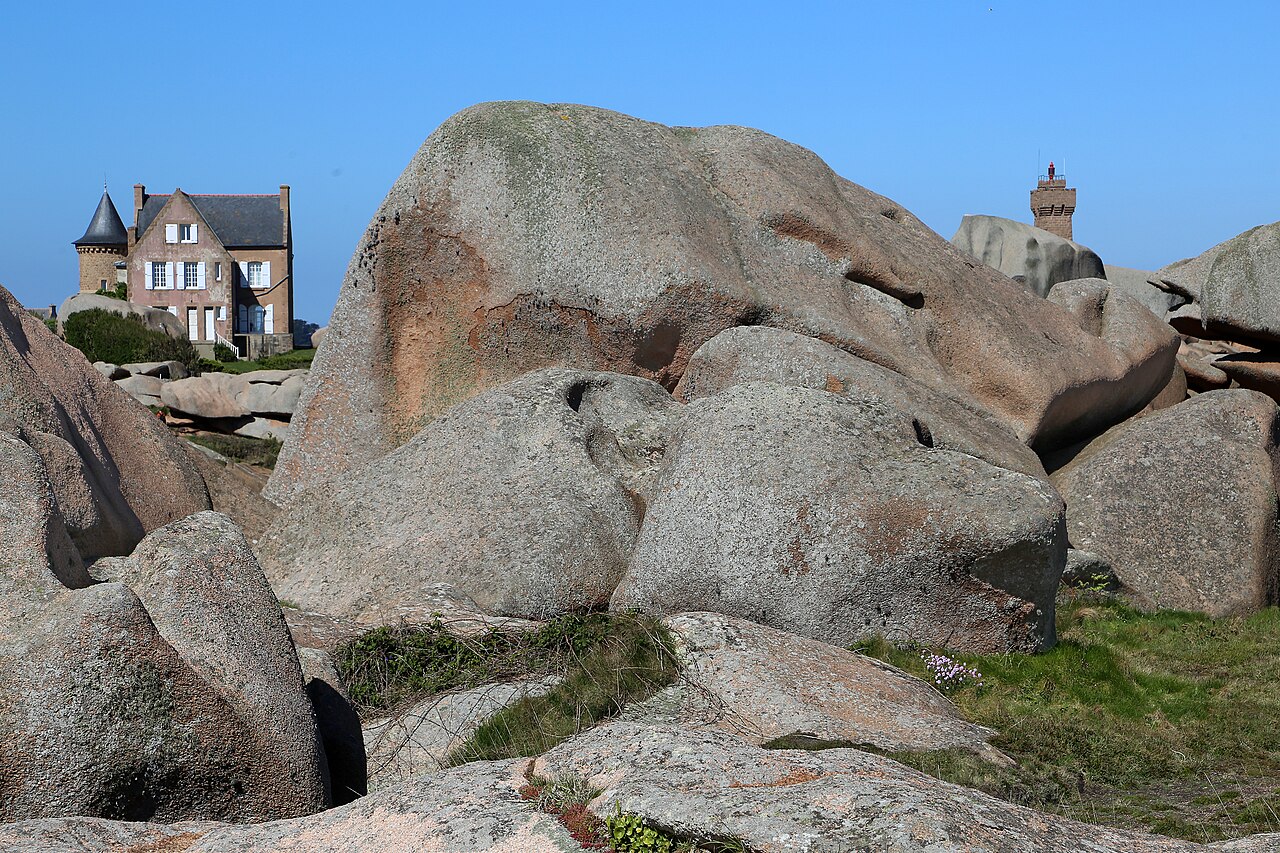
Geography splits the month. On the north coast — Saint-Malo, Cancale, the Pink Granite Coast around Ploumanac'h — September water reaches the year's warmest (≈64–66°F / 18–19°C, still bracing, honestly Breton), the summer families have left, and the cliff paths of the Sentier des Douaniers, the GR34 customs trail that runs the entire 1,240-mile (2,000 km) coastline, are quiet. In the south — the Morbihan, Carnac, the Quiberon peninsula, Belle-Île — September is the gentle season: sailing weather persists, the oyster season restarts with the "r" months at Cancale and in the Gulf of Morbihan, and the villages resume their local tempo. Inland Brittany — Rennes, Dinan, the Broceliande forest — is harvest-green and largely ignored even in summer.
The counter-season is the shoulder of June — the longest evenings in France (this far west at 48°N, daylight runs past 10 p.m. near the solstice) and the pre-peak lull — but June's sea is colder and its tides unremarkable. Early August holds the Festival Interceltique de Lorient, the Celtic world's great gathering (running since 1971), at the price of peak crowds. Mid-September is the insider's month.
Picture the place
At Saint-Malo on an equinox evening the Sillon beach empties to a mile of wet sand and gull prints, and two hours later the sea is slapping the ramparts' feet, the causeway to Fort National six fathoms under green water.
The easily missed detail
September is when Brittany's stone calendar aligns: the Journées du Patrimoine (European Heritage Days) in mid-September open normally closed lighthouses, manors and the Rance tidal power station — the world's first, inaugurated by de Gaulle in 1966, whose 24 turbines generate roughly the electricity of a city the size of Rennes on these very tides. Check the program; some of the region's best doors open exactly one weekend a year, and it is this one.
A practical rhythm
- Aim at the equinox tides — Check the year's grandes marées calendar (highest coefficients fall within days of the equinox, around September 21) and put Saint-Malo on those dates
- North first, south second — Saint-Malo, Cancale and the granite coast while the big tides run; the Morbihan and Carnac after, in settling weather
- Book the islands anyway — Belle-Île and Bréhat ferries run reduced autumn timetables; reserve crossings before you travel
What could complicate the plan
The first equinoctial storms can arrive with the big tides themselves — the spectacle of waves over the Saint-Malo digue is glorious and sometimes closes the rampart walk. Brittany's weather can always produce a grey week; the region's answer is layers and a coast that changes mood hourly. From late September, smaller resorts start seasonal closures, and the GR34's most exposed sections (Pointe du Raz, Crozon) demand real windproofing.
What to do next
Choose the September equinox window, stay two bases deep (Saint-Malo for the north, the Morbihan for the south), and let the tide tables, not the clock, schedule your coast days.
Sources
- SHOM (French Naval Hydrographic and Oceanographic Service) — the Rance estuary's tidal range, averaging 8 m and reaching 13.5 m, with peak coefficients at the equinoxes
- EDF — the Rance tidal power station, inaugurated 1966 as the world's first, 240 MW from 24 turbines
- Comité Régional du Tourisme de Bretagne — the GR34 Sentier des Douaniers, about 2,000 km along the Breton coast
- Festival Interceltique de Lorient — held since 1971 in early August