Brittany / France Food and drink
Where should I eat in Brittany, and which local food or drink is worth trying?
The short answer
Eat oysters standing at Cancale's shore market, learn the crêpe-galette distinction at a serious crêperie like Breizh Café, and drink farmhouse cider from a bowl — Brittany's table runs on buckwheat, butter and the sea.
The answer, with local context
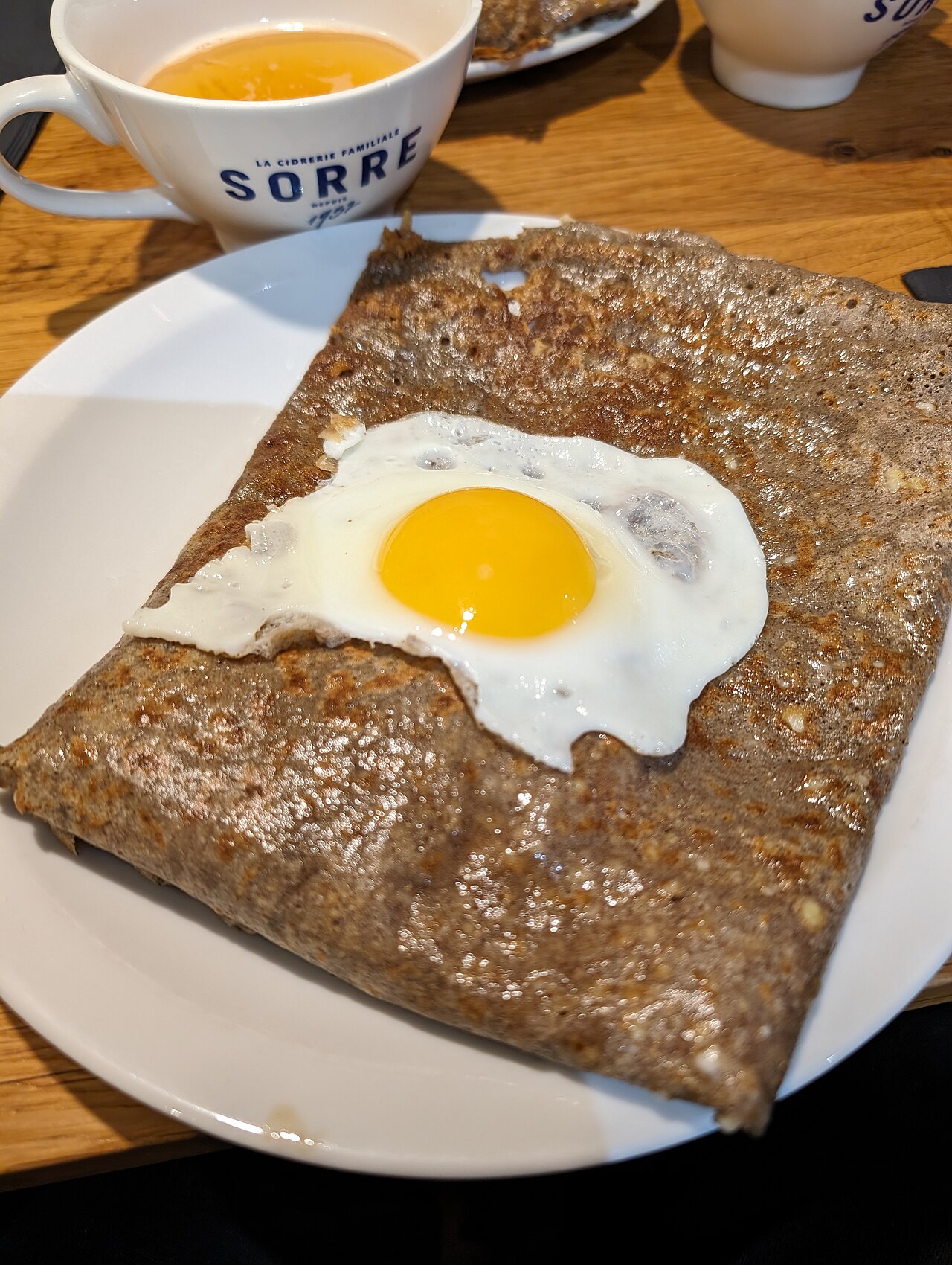
Brittany's first lesson is vocabulary. The savory buckwheat pancake is a galette (in Upper Brittany) — dark, lacy-edged, eggless in the classic dough — and the sweet wheat one is a crêpe; ordering them the wrong way round marks you instantly. The benchmark galette is the complète: ham, grated Emmental and an egg cracked in the center. The benchmark room is Breizh Café — Bertrand Larcher's crêperie in Cancale (with a Saint-Malo sibling) — where organic buckwheat, proper farm cider and a Japanese lightness of hand made it France's reference modern crêperie. Every port town has its own classic addresses; what matters is the crêpe cooked à la minute on a billig griddle and butter — always butter — as the medium: beurre demi-sel, salted butter flecked with sea-salt crystals, is Brittany's foundational flavor and its proudest export. The flour has papers of its own: Farine de blé noir de Bretagne — Gwinizh du Breizh — holds a protected geographical indication, homologated by the French arrêté of 10 November 2008 and registered across the EU by Regulation (EU) No 560/2010 of 25 June 2010, drawn from the five historic Breton départements and milled by roller or stone.
The coast eats raw where it can. At Cancale, on the bay's eastern shore, the oyster market at the Port de la Houle sells the town's famous flat oysters — the belons of the bay, farmed here since Roman enthusiasm made Cancale supplier to kings (Louis XIV had them carried to Versailles) — to eat on the sea wall with lemon, watching the beds emerge at low tide and Mont Saint-Michel across the water. Inland palates should hunt the scallop in season: the coquille Saint-Jacques of the bay of Saint-Brieuc is one of France's great regulated fisheries (the season runs roughly October to May, landings at Erquy and Saint-Quay-Portrieux), served seared with its coral. Olivier — now Hugo — Roellinger's Le Coquillage at Château Richeux outside Cancale, holder of two Michelin stars, is the coast's grand seafood table, built on spices as much as shellfish (the Roellinger spice cellar is a local institution).
The sweets and drinks complete the grammar. Kouign-amann — the name is Breton for "butter cake" — was invented in Douarnenez around 1860: laminated dough, salted butter and sugar baked to a caramelized slab, best eaten warm and not improved by sharing. Far breton, a dense prune flan, and the palet breton butter biscuit (Pont-Aven's Traou Mad bakery has made them since 1920) fill the bakery shelf. Drink cider — Brittany is one of France's two great cider lands: order a bolée (the traditional earthenware bowl) of cidre bouché, farmhouse and corked like champagne; the Cornouaille cider of the Fouesnant country was the first French cider to win an AOC (1996). The stronger local pours are chouchen, a honey mead, and lambig, the cider brandy. In Rennes, finally, eat the city's own street food: a galette-saucisse — a grilled pork sausage rolled in a cold buckwheat galette — at the Saturday Marché des Lices, one of France's largest markets, as the Stade Rennais faithful have done for generations.
Picture the place
On Cancale's sea wall at low tide: a paper tray of a dozen flats, a lemon half, the oyster beds stretching a mile toward the Mont, and gulls conducting the quality assessment from the bollards.
The easily missed detail
Brittany's salt is a smuggler's story. The salt marshes of Guérande — historically Breton, now just over the regional border — produced the fleur de sel that defines beurre demi-sel, and for centuries Brittany's exemption from the French salt tax (the gabelle, from which the duchy was free) made salt smuggling the coast's second profession. The salt crystals in your butter are the edible residue of a tax revolt; beurre demi-sel is not a recipe so much as a frontier. The salt is now the most heavily documented thing in the pantry: Sel de Guérande and Fleur de sel de Guérande were the first salts in France recognized with a protected geographical indication, homologated by the arrêté of 11 January 2011 and entered in the EU register by Commission Implementing Regulation (EU) No 238/2012 of 19 March 2012, which guarantees harvesting by hand from the pans, with no refining, no washing after harvest and no additives.
A practical rhythm
- Cancale at low tide — Time the oyster market for the falling tide, when the beds surface and the trays are freshest
- Crêperie rules — One galette course and one crêpe course, cider in a bowl, and never ask for a galette for dessert
- Saturday in Rennes — Marché des Lices in the morning, galette-saucisse in hand, before touring the old town
What could complicate the plan
Scallops are strictly seasonal and regulated — outside October to May, a "local Saint-Jacques" is frozen or from elsewhere. Oyster quality also follows the season, with summer spawning making oysters milky (the old "r months" rule still guides locals). Many crêperies close one or two days midweek outside summer and stop serving early by Parisian standards — Brittany dines at noon and at 7:30 p.m., and the billig cools accordingly.
What to do next
Cancale for oysters at noon, a serious crêperie for dinner, and a warm kouign-amann from the first bakery that stacks them — the Breton trilogy in a single day.
Sources
- Comité Régional du Tourisme de Bretagne — Cancale's oyster market at the Port de la Houle and the town's flat-oyster tradition
- Breizh Café (Cancale) — the reference modern crêperie: organic buckwheat galettes and farm cider
- INAO (Institut national de l'origine et de la qualité) — AOC Cidre de Cornouaille (1996), the first French cider appellation; the bay of Saint-Brieuc scallop fishery's regulated season
- Douarnenez municipal and bakery histories — kouign-amann, invented in Douarnenez around 1860
- Rennes municipal markets — the Marché des Lices (Saturday), among France's largest food markets
- INAO — the IGP for Farine de blé noir de Bretagne / Gwinizh du Breizh: the arrêté of 10 November 2008, EU Regulation (EU) No 560/2010 of 25 June 2010, the five-département area and the milling methods
- INAO — Guérande salt as the first salt IGP: the arrêté of 11 January 2011, Commission Implementing Regulation (EU) No 238/2012 of 19 March 2012, hand harvesting and the no-refining, no-washing, no-additive rules