Budapest / Hungary Things to do
What are the most worthwhile things to do in Budapest on a first visit?
The short answer
Work through the three parts of the World Heritage property, then spend an evening in the water — UNESCO's inscription covers the banks of the Danube, the Buda Castle Quarter and Andrássy Avenue, and the Széchenyi Thermal Bath stays open until 10 p.m. on Fridays, two hours later than any other day.
The answer, with local context
Treating the inscription as a three-part itinerary is the most efficient structure a first visit can use, because UNESCO chose those three components for a reason. The property was inscribed in 1987 under criteria (ii) and (iv), with an approved extension added in 2002, and the three parts are not variations on one another: a riverfront, a fortified hill quarter, and a late-nineteenth-century boulevard. Each occupies a different era and a different part of the city.
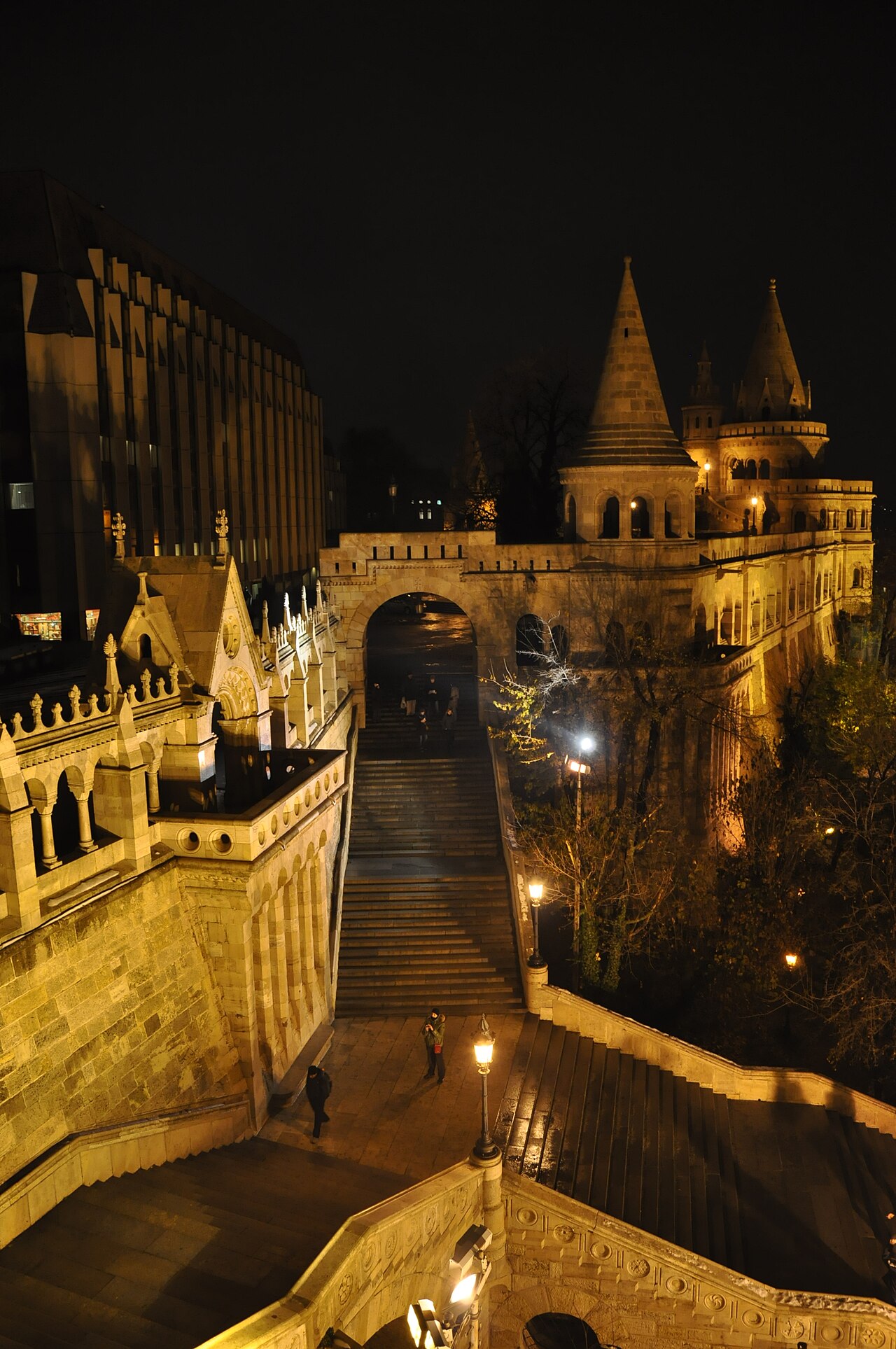
The Buda Castle Quarter is the component most people photograph without walking. Frigyes Schulek's Fisherman's Bastion, completed in 1902, is a viewing terrace built against the hill below Matthias Church — a structure whose entire purpose is to look across the river at the other side of the inscribed property. Standing on it, you are inside one component of the World Heritage site and looking at another.
The baths are the counterweight to all that walking, and their hours are more useful than their reputation. Széchenyi runs 7 a.m. to 8 p.m. Monday to Thursday, 7 a.m. to 10 p.m. on Friday, and 8 a.m. to 8 p.m. on Saturday and Sunday. Tickets can be bought online through the bath's own ticketing site to avoid the queue. The Friday late close is the one worth planning around: it turns the baths from a daytime activity that competes with sightseeing into an evening one that does not.
Picture the place
Fisherman's Bastion is built as a sequence of small turrets and linked walkways rather than a single platform, so the view across the Danube arrives in framed sections — you move from arch to arch rather than standing in one place and taking it in whole.
The easily missed detail
The 2002 entry in UNESCO's record is an approved extension to the 1987 inscription, not a second property. That is why Andrássy Avenue feels like a separate city from the Castle Quarter and is still the same designation: a boulevard and its underground railway were added to a river-and-castle property fifteen years later. For a visitor, it means the official list of what matters in Budapest includes a shopping street, which is not how most itineraries treat it.
A practical rhythm
- Morning — The Castle Quarter on the Buda side, including the Bastion terraces, before the hill fills.
- Afternoon — Andrássy Avenue, the component added in 2002 and the one most first visits skip.
- Friday evening — The baths until 10 p.m., which is only possible one day a week.
What could complicate the plan
Hungarian rainfall is unpredictable enough that the national record notes a month can pass with no precipitation at all while the wettest years run to three times the driest, so a plan built entirely on outdoor components needs an indoor alternative on standby. Weekend bath hours start an hour later and finish two hours earlier than Friday's. Hungary sits inside the Schengen Area, and ETIAS — the travel authorization for visa-exempt non-EU travelers — is scheduled to begin in the last quarter of 2026 at a fee of EUR 20, with under-18s and over-70s exempt from the fee.
What to do next
The food-and-drink question in this chapter covers where to eat around these three districts; the when-to-visit question sets out the rainfall pattern to plan the outdoor components against.
Sources
- UNESCO World Heritage Centre, Budapest — property components and criteria
- UNESCO World Heritage Centre, inscription document — 1987 inscription and 2002 approved extension
- Széchenyi Thermal Bath — daily opening hours and online ticketing
- HungaroMet (Hungarian Meteorological Service) — year-to-year rainfall variability
- European Commission, Migration and Home Affairs — ETIAS fee and exemptions