Budapest / Hungary When to visit
When should I visit Budapest, Hungary, for the best experience?
The short answer
Late April through early June, or September into October — Hungary's heaviest rain falls between May and July, and the national meteorological record shows September and October have become significantly wetter than they used to be, which makes early autumn the shoulder season that has shifted most.
The answer, with local context
HungaroMet's national characterization, built on the 1991–2020 normals, puts annual precipitation across Hungary between 500 and 800 mm — roughly 20 to 31 inches — with a clear southwest-to-northeast gradient. The driest band, along the Zagyva, Tisza and Hármas-Körös rivers, takes only about 500 to 550 mm (20 to 22 inches); the southwest and the higher ground of the Bükk Mountains exceed 800 mm (31 inches). Every 100 meters of altitude adds about 35 mm (1.4 inches) a year, which is why Buda's hills and Pest's flats are not quite the same proposition in a wet week.
Two shifts in that record change how you choose a month. January is now the driest month of the Hungarian year, where February held that position in earlier reference periods. And the secondary November rainfall maximum that used to exist has disappeared. Between them, those two changes have made late autumn and midwinter drier than the old picture suggested, and have loaded more of the year's rain into May, June and July — the months most visitors assume are safest.
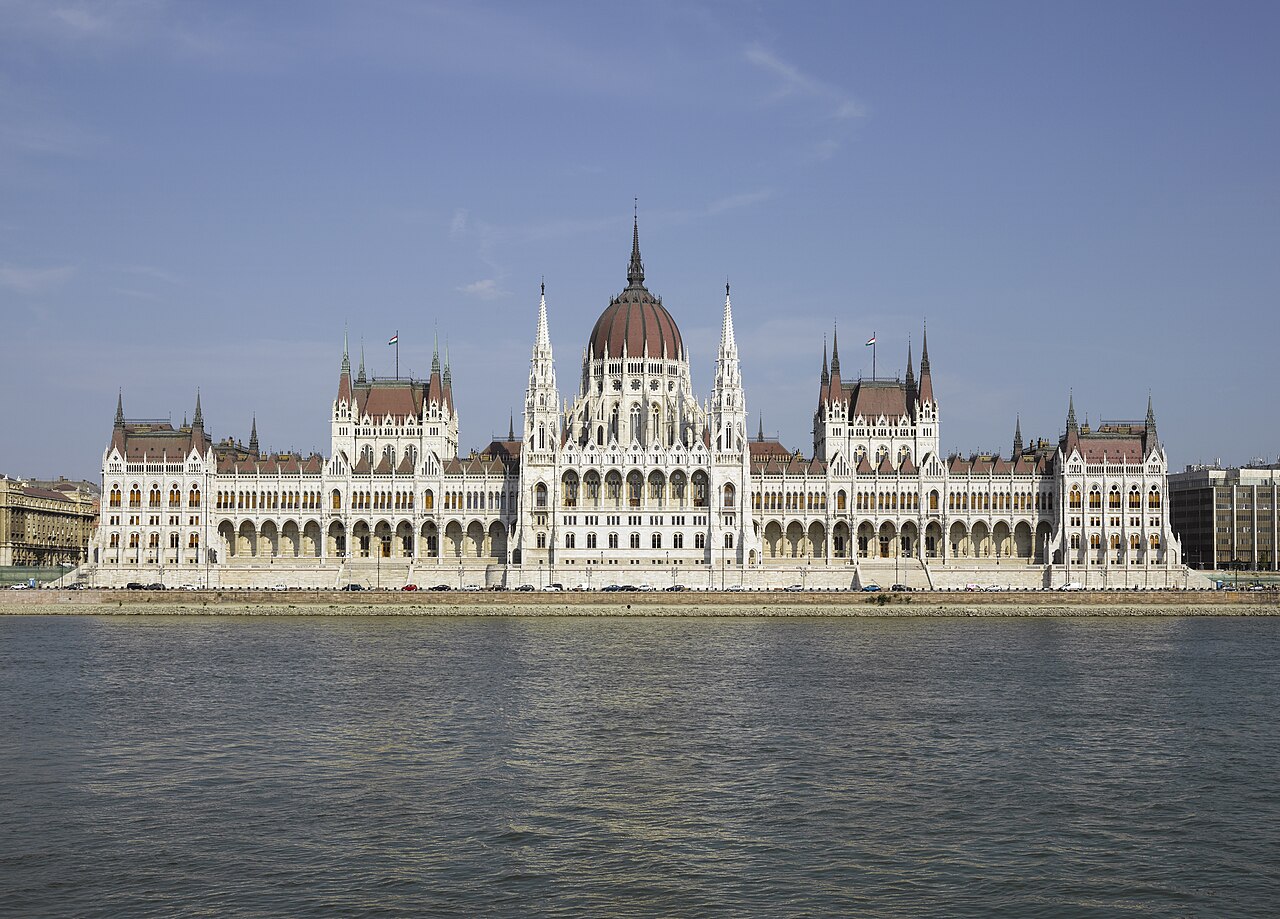
Budapest's World Heritage property is laid out along and above the river, which makes weather a structural issue rather than a comfort one. UNESCO inscribed it in 1987, with an approved extension in 2002, under criteria (ii) and (iv), as "Budapest, including the Banks of the Danube, the Buda Castle Quarter and Andrássy Avenue." All three components are linear and largely outdoors.
Picture the place
The Danube runs roughly north to south through the city with Buda's hills on the west bank, so the Castle Quarter takes the evening light full on while the Pest embankment opposite falls into shadow first — the two halves of the inscribed property are never lit the same way at the same hour.
The easily missed detail
Hungary's rainfall is extraordinarily variable from year to year. The national record notes that the wettest years can bring three times the precipitation of the driest, and that a given month can pass with no rain at all. Averages are a weaker guide here than in western Europe, and the practical response is to choose a month for daylight, temperature and opening hours and to treat rainfall as something to have a fallback for — which, in a city with Budapest's bathing infrastructure, is an unusually easy problem to solve.
A practical rhythm
- Late April to early June — Long days before the May-to-July rainfall peak fully arrives.
- September to October — Warm, but now measurably wetter than the old normals suggested.
- January — The driest month in the current reference period, and the one where the indoor city comes into its own.
What could complicate the plan
Hungary is a Schengen state, so a visa-exempt visitor's 90 days in any 180-day period covers Hungary and every other Schengen country together. The Entry/Exit System has been fully operational across all Schengen countries since 10 April 2026, which adds biometric registration at first entry. Within the city, the thermal baths run shorter hours at the weekend than midweek — the Széchenyi complex opens at 8 a.m. on Saturday and Sunday against 7 a.m. Monday to Friday — so a two-day weekend trip loses an hour at the start of each day.
What to do next
The things-to-do question in this chapter covers the Castle Quarter and the baths in detail, including the hours this seasonal choice has to fit.
Sources
- HungaroMet (Hungarian Meteorological Service), precipitation in Hungary — annual totals, regional gradient, wettest and driest months, year-to-year variability
- UNESCO World Heritage Centre, Budapest — official property name and criteria
- UNESCO World Heritage Centre, inscription document — 1987 inscription and 2002 extension
- Széchenyi Thermal Bath — weekday and weekend opening hours
- European Commission, Migration and Home Affairs — Schengen 90-in-180 short-stay rule