Busan / South Korea When to visit
When should I visit Busan, South Korea, for the best experience?
The short answer
April through May and September through October are excellent months for exploring Busan, combining comfortable sightseeing weather with the city's beaches, coastal temples and hillside neighborhoods.
The answer, with local context
Busan occupies South Korea's southeastern coastline, where mountains descend toward the sea. The city offers a different seasonal experience from inland destinations: its beaches, fishing ports and waterfront neighborhoods are central to its appeal.
The Korea Tourism Organization recommends spring, from March through May, and autumn, from September through November, for walking and outdoor sightseeing. Summer, from June through August, is the principal season for beach activities, but it also overlaps with humid conditions and seasonal rainfall.
Late April is particularly attractive at Democracy Park. The tourism authority's 2026 spring guide identifies mid- to late April as the typical period for double cherry blossoms there. The park sits on the slopes of Bosusan Mountain, approximately 169 meters above sea level, with views toward the coast.
The long record explains why the shoulder months stand out so clearly. NOAA's archive of the WMO 1981–2010 station normals lists Busan as station 47159, at 35.10 degrees north and 129.03 degrees east and 69 meters above sea level, with an annual average of 1,519.1 millimeters of precipitation falling on 75.2 days of at least a millimeter — around a fifth of the year's days.
September and October are appealing for combining the city's major neighborhoods with coastal walks. Gwangalli Beach, west of Haeundae, extends approximately 1.4 kilometers and offers views across the water toward Gwangandaegyo Bridge.
Picture the place
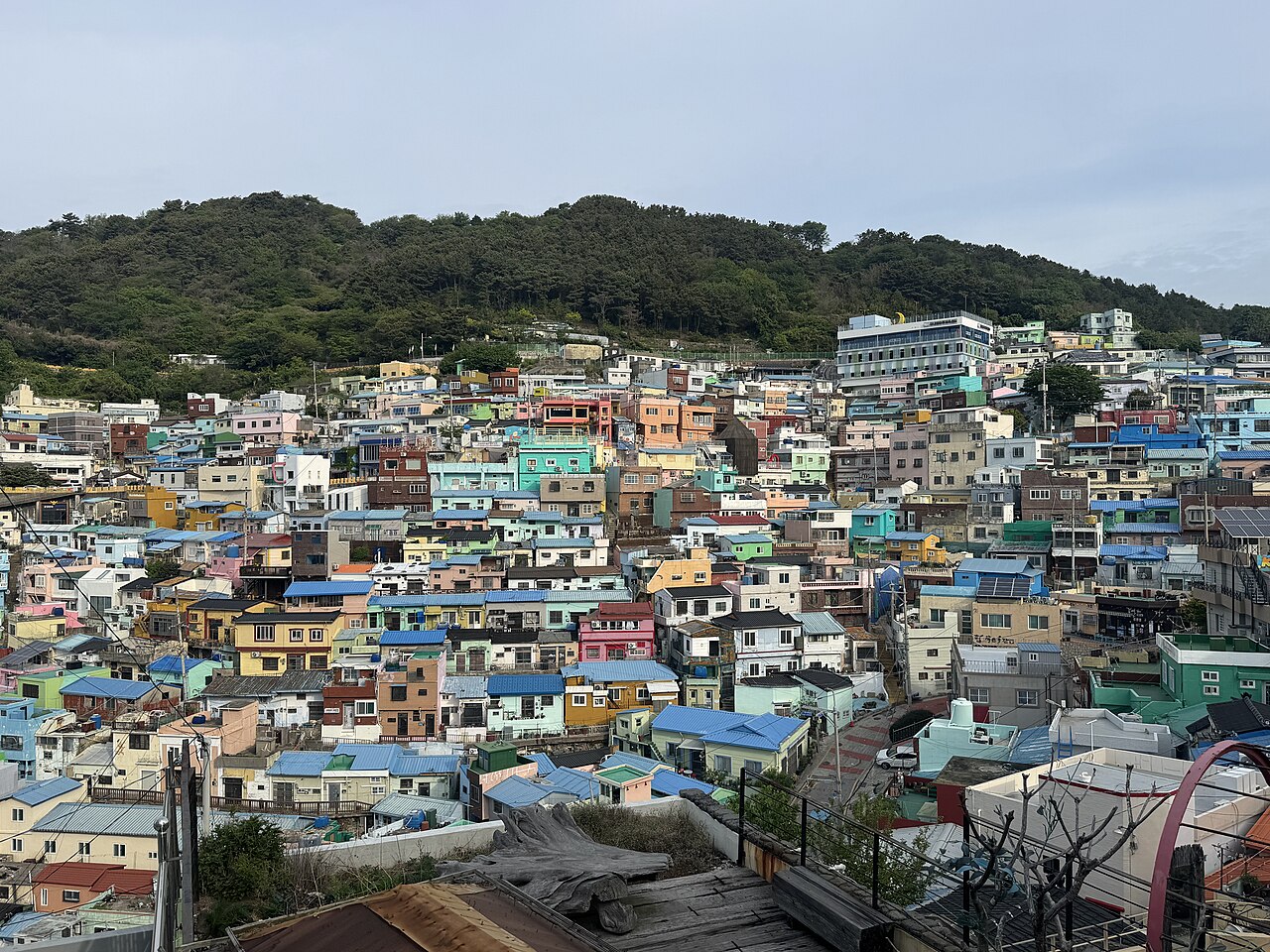
Busan's coast alternates between sandy bays, rocky headlands and built-up waterfront districts. Inland, densely packed houses climb steep hillsides, while bridges and apartment towers frame the shoreline.
The easily missed detail
The best season for walking around Busan is not necessarily the best season for swimming. Beach swimming is associated with the summer operating season, while spring and autumn are better suited to long outdoor days with less heat.
A practical rhythm
Morning — coastal sightseeing: Explore Gwangalli or Haeundae while the waterfront is quieter.
Afternoon — hillside neighborhoods: Walk through Gamcheon Culture Village or visit Democracy Park.
Evening — waterfront: Return to Gwangalli for views of the illuminated bridge.
What could complicate the plan
The Korea Tourism Organization identifies June through October as part of Korea's potential typhoon season. Heavy rainfall, high winds and rough seas can disrupt waterfront excursions and boat operations. One administrative date now sits in front of any trip: the K-ETA exemption for US passport holders ran only through 31 December 2025, so from 1 January 2026 a K-ETA has to be obtained before traveling, and the country's advisory stands at Level 1, exercise normal precautions.
What to do next
explores Busan's temples, traditional markets and neighborhoods beyond its famous beaches.
Sources
- Korea Tourism Organization — seasonal travel recommendations and weather risks.
- Korea Tourism Organization — Democracy Park's spring blossoms and elevation.
- Korea Tourism Organization — Gwangalli Beach dimensions and setting.
- NOAA National Centers for Environmental Information, WMO 1981–2010 station normals, Busan — station number, coordinates, elevation, annual precipitation total and wet-day count.
- U.S. Department of State, South Korea travel advisory — "Level 1 - Exercise normal precautions", issued 28 May 2025, and the K-ETA exemption for U.S. passport holders extended only through 31 December 2025 (retrieved 5 November 2026)