Busan / South Korea Food and drink
Where should I eat in Busan, and which local food or drink is worth trying?
The short answer
Start with dwaeji-gukbap, milmyeon and seafood around Seomyeon, Nampo-dong and Jagalchi, then try street snacks at Gukje Market and Bupyeong Kkangtong Market.
The answer, with local context
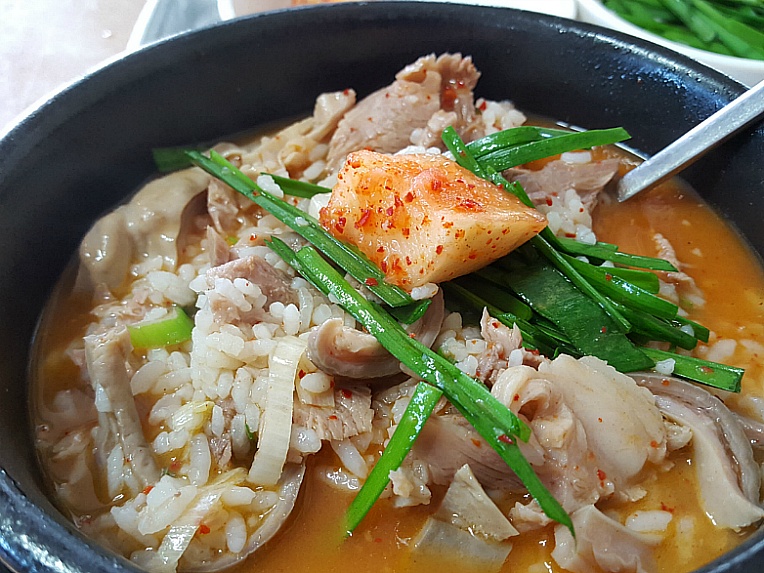
Dwaeji-gukbap is one of Busan's signature dishes. This pork-and-rice soup contains pieces of pork in a rich broth, often served with chives, kimchi and salted shrimp. The Korea Tourism Organization identifies Seomyeon Local Food Street, near Seomyeon Market, as a notable area for the dish.
Its guide explains the traditional toryeom technique, in which warm broth is repeatedly poured over rice to bring it to the desired temperature. Customers may season their soup with salted shrimp, salt or other condiments.
Milmyeon is another Busan specialty. The dish uses wheat noodles, commonly served cold with broth or a spicy sauce. It differs from buckwheat-based cold noodles associated with other Korean regions.
The side dishes carry heritage status of their own. UNESCO inscribed kimjang, the making and sharing of kimchi in the Republic of Korea, on its Representative List in 2013, recognizing the communal late-autumn work that stocks a household through winter. The diced radish kimchi that arrives beside a bowl of pork soup is the everyday end of that practice.
Gukje Market Food Street has more than 60 years of history and is known for dishes including bibim dangmyeon, spicy glass noodles, tteokbokki, rice cakes in spicy sauce, and Chungmu gimbap, rice rolls served with accompaniments.
For a seafood-focused experience, Jagalchi Market offers fish and shellfish associated with Busan's port economy. Street-food options elsewhere include ssiat hotteok, a sweet filled pancake typically containing seeds and nuts.
Picture the place
A bowl of dwaeji-gukbap arrives with pale broth, rice and sliced pork, surrounded by small dishes of kimchi and seasonings. At the markets, diners occupy small stools beside food stalls.
The easily missed detail
Dwaeji-gukbap is a pork dish, even when the broth appears pale and relatively mild. Salted shrimp is a common seasoning, which is important for travelers avoiding shellfish.
A practical rhythm
Breakfast or lunch — Seomyeon: Try pork-and-rice soup at a specialist restaurant.
Afternoon — Gukje Market: Sample bibim dangmyeon or ssiat hotteok.
Evening — Jagalchi: Explore seafood dining and the surrounding market district.
What could complicate the plan
Gukje Market Food Street lists the first and third Sundays of each month as regular market holidays, while individual restaurant hours differ. Some seafood prices depend on the species, weight and preparation service. Carrying cash in is simple — no declaration is needed on entry or exit, and the passport need only be valid at the time of entry — but a K-ETA must be obtained before traveling, the exemption for US passport holders having ended on 31 December 2025.
What to do next
Return to to choose travel dates that suit Busan's markets, beaches and outdoor attractions.
Sources
- Korea Tourism Organization — dwaeji-gukbap preparation, variations and dining areas.
- Korea Tourism Organization — Gukje Market dishes and operating information.
- Korea Tourism Organization — Seomyeon's pork-soup restaurants.
- UNESCO Intangible Cultural Heritage, Kimjang, making and sharing kimchi in the Republic of Korea — Representative List inscription year and the practice it recognizes.
- U.S. Department of State, South Korea travel advisory — no currency declaration needed on entry or exit, passport must be valid at the time of entry, K-ETA required from 1 January 2026 (retrieved 5 November 2026)