Cartagena / Colombia Things to do
What are the most worthwhile things to do in Cartagena on a first visit?
The short answer
Walk the walls, climb the Castillo San Felipe de Barajas — the largest fortress Spain built in the Americas — cross the Centro plaza by plaza, and end in Getsemaní after dark; then give one full day to the water and the Rosario Islands.
The answer, with local context
Everything in Cartagena starts with the fortifications, because the city exists in its present form for no other reason. Founded in 1533 by Pedro de Heredia, Cartagena became Spain's treasure port for Andean gold and silver — and a target. After Francis Drake sacked it in 1586, the Crown spent two centuries building: some 6.8 miles (11 km) of walls, raised between 1616 and 1796, up to 56 feet (17 m) thick at the base and studded with more than twenty bastions. UNESCO inscribed the Port, Fortresses and Group of Monuments of Cartagena in 1984, recognising the most extensive fortifications in South America. Walk them at sunset from the Baluarte de Santo Domingo; cross through Las Bóvedas, the 23 vaults built in the 1790s as stores and barracks and later used as a prison, now holding craft shops.
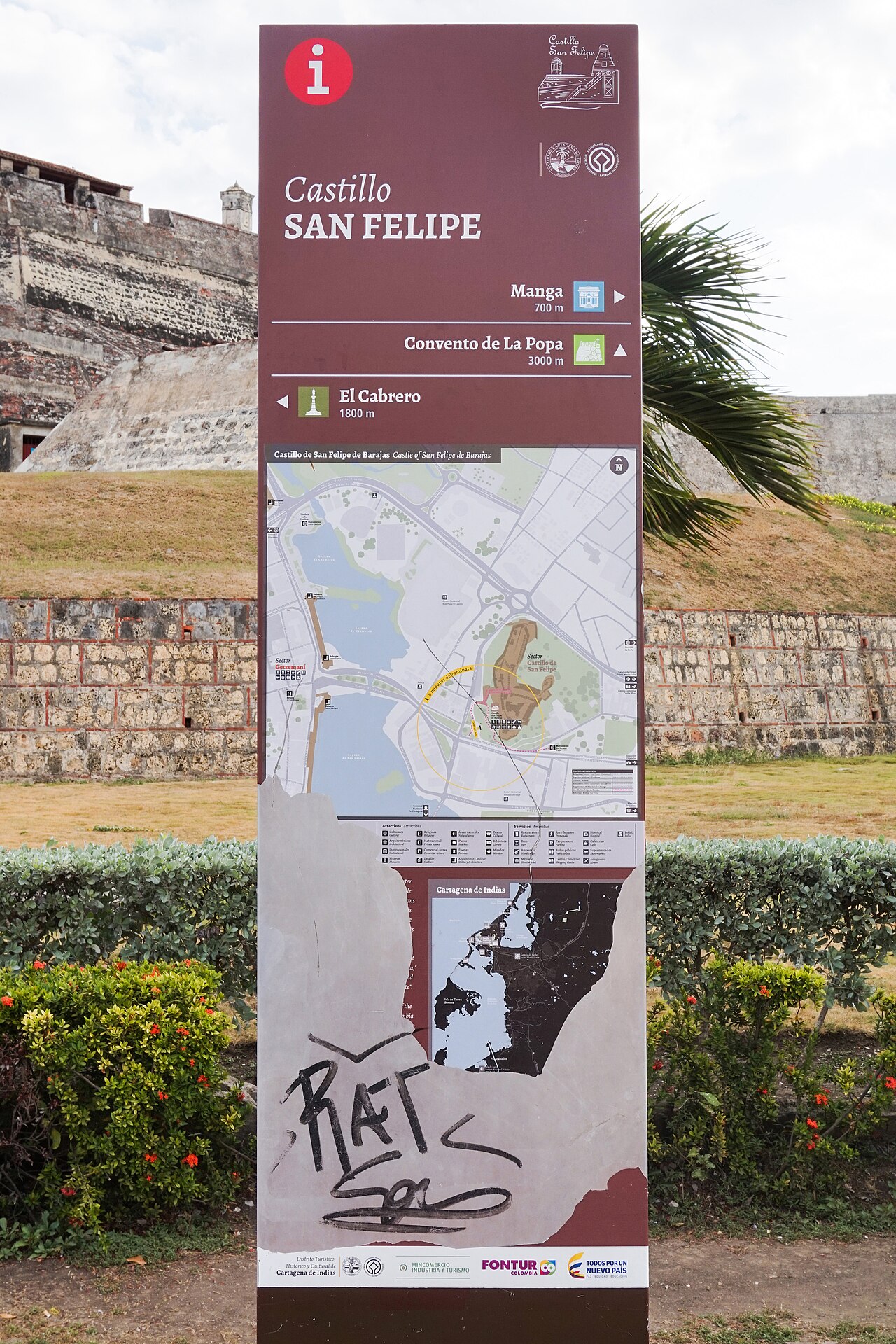
The Castillo San Felipe de Barajas, on the 130-foot (40 m) hill of San Lázaro just east of the walls, is the system in concentrated form: begun in 1536, in its main form by 1657 and expanded under the engineer Antonio de Arévalo in the 1760s, it is the largest fortress the Spanish built anywhere in their colonies, honeycombed with tunnels designed in part to carry sound — defenders could hear enemy miners digging beneath them. Its legend was made in 1741, when Admiral Edward Vernon attacked with 186 ships and some 23,600 men, and Blas de Lezo — a commander who had already lost a leg, an eye and the use of an arm in earlier wars — held the city with about 3,600 men and six ships. The 67-day siege failed at San Felipe; London had minted commemorative medals for a victory that never happened.
Inside the walls, read the city through its institutions: the Clock Tower gate, the old city's principal entrance, its clock first fitted in 1874; the Inquisition Palace, seat of the tribunal established in Cartagena in 1610, now a museum whose serene patio gives no hint of its purpose; the cathedral and the Plaza de Bolívar. Then cross the bridge into Getsemaní, the artisans' barrio whose people forced the pace of independence in 1811, now the city's living room of street art, small bars and the Plaza de la Trinidad. Above everything stands La Popa, the Augustinian convent founded in 1607 on the city's highest hill at some 490 feet (150 m) — go for the view back over walls, bay and towers. And one day belongs to the sea: the 27 islands of the Rosario archipelago, protected since 1977 within the Corales del Rosario national park, an hour by boat — or drive to Barú, tied to the mainland by a bridge since 2014.
Picture the place
At the top of San Felipe in the last hour of light the fortress turns the color of honey — tier upon tier of coral stone above the city, the bay forts winking in the distance, and the tunnel mouths dark at your feet where three centuries of sentries once listened for digging.
The easily missed detail
Cartagena keeps a statue of its defender at the fortress gate, and it is anatomically honest: Blas de Lezo stands in bronze with one leg, one working arm and one eye — the "Mediohombre," the Half-Man, who beat the largest amphibious force Britain assembled before the twentieth century. Colombia remembers him; the medals London struck in advance of his defeat are the rarest souvenir of the siege.
A practical rhythm
- Morning — The fortress first: San Felipe opens into cool stone and empty tunnels if you arrive at opening, and La Popa's viewpoint belongs to the morning light.
- Midday — The Centro at midday is a museum circuit in the shade of the balconies — the Inquisition Palace, the Museo del Oro Zenú and a long lunch while the streets empty of heat.
- Evening — Sunset on the walls at Santo Domingo, then Getsemaní after dark: the Trinidad plaza fills, the murals glow under the street lights, and the barrio eats and dances outside.
What could complicate the plan
The Rosario day is weather's hostage — in the dry season the afternoon return crossing can be rough, and in October the rain can cancel boats outright, so schedule the islands early in the trip with a spare day behind them. Cruise-ship mornings flood the Centro between ten and two; the fortress and the walls absorb them better than the plazas do. And Caminito-style wandering has one rule here: the walled city and Getsemaní are comfortable at night, but the bridges between them and the walk to Bocagrande are best taken by taxi after dark.
What to do next
Give the old city two days and the islands one, book the fortress for your first morning, and let the food answer in this group plan the evenings — Getsemaní holds both the best table and the best street food.
Sources
- UNESCO World Heritage Centre — Port, Fortresses and Group of Monuments, Cartagena (1984): the most extensive fortifications in South America
- Ministerio de Cultura de Colombia — the Castillo San Felipe de Barajas, the largest Spanish fortress in the Americas, and the record of the 1741 siege and Blas de Lezo's defence
- Parques Nacionales Naturales de Colombia — the Corales del Rosario y de San Bernardo National Natural Park, protecting the Rosario archipelago since 1977