Cartagena / Colombia When to visit
When should I visit Cartagena, Colombia, for the best experience?
The short answer
Mid-February to March — the driest weeks of the year in a city where the temperature never changes, the Christmas crowds and prices have gone, and the trade winds still cool the ramparts at night.
The answer, with local context
Cartagena has one temperature and two seasons. IDEAM, Colombia's national weather service, gives the city 1991–2020 normals of almost surreal constancy at Rafael Núñez airport: average highs between 88°F and 90°F (31.1–32.3°C) in every month of the year, lows that never drop below 75°F (24°C), and humidity between 79 and 83 percent year-round. Everything therefore turns on rain. The year's total is about 42 inches (1,074 mm), and 94 percent of it falls between May and November. The dry season, December to April, holds just 2.6 inches (67 mm) of it — and January, February and March together record barely 0.16 inches (about 4 mm): January averages 0.5 mm of rain, February 0.3 mm, March 3.2 mm, with fewer than one rainy day in each.
Mid-February to March takes the driest of that already dry run at the moment the city exhales. The December 16 to January 6 peak — when hotels charge up to three times their low-season rates — is over, Colombian schools are back in session, and the northeast trade winds that define the dry season are still blowing, taking the edge off 89°F (31.7°C) afternoons and making the walls at sunset the pleasantest seat in Colombia. The season also carries culture: FICCI, the Cartagena International Film Festival, founded in 1960 and the oldest film festival in Latin America, fills the walled city's cinemas in the dry-season months, and the Hay Festival's Cartagena edition lands in late January.
The trap months are September and, above all, October — the wettest month by a distance, with 9.3 inches (236.5 mm) of rain across about twelve days, 22 percent of the year's total in a single month — followed by November at 7 inches (178.3 mm), the second-wettest, which is a pity because November holds the Fiestas de Independencia around November 11, the anniversary of the city's 1811 declaration of independence. The seasons trade one more thing: the dry months are the windy months, and the crossing to the Rosario Islands is at its roughest then, while the rainy season's seas run calm and the water is at its clearest — the sea itself swings from 81°F (27°C) in February to 84°F (29°C) by September.
Picture the place
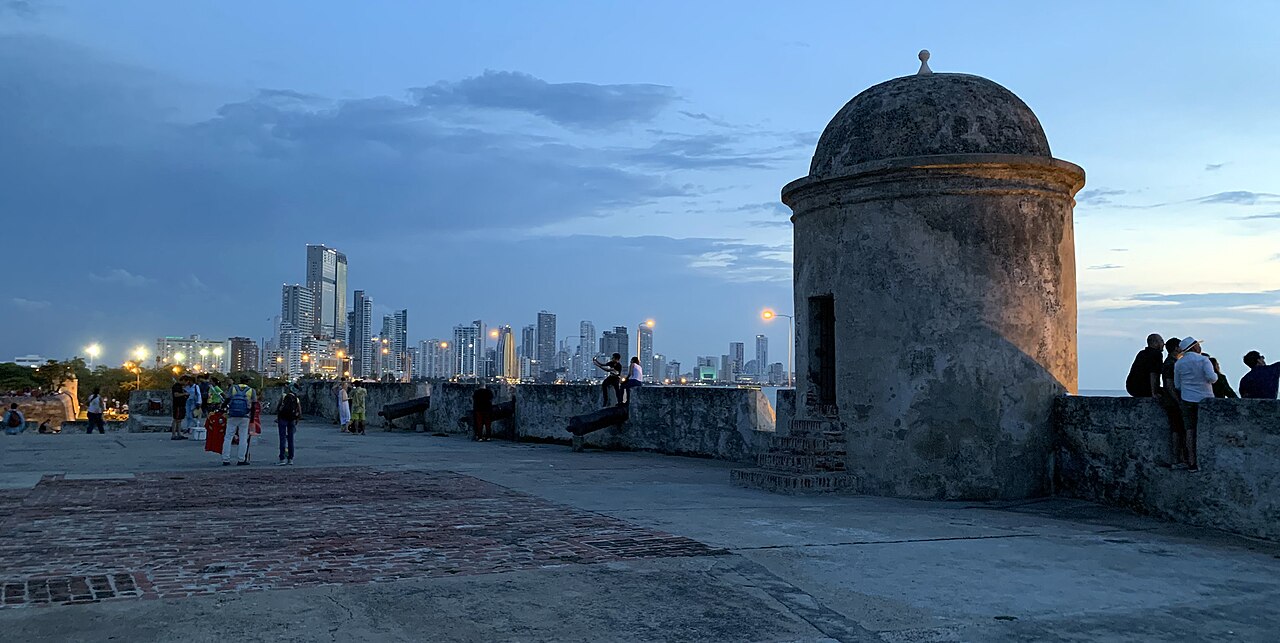
From the Baluarte de Santiago Apóstol at nightfall in February the two Cartagenas stand in one frame: the coral-stone rampart under your feet, the dark bay, and across the water the white towers of Bocagrande lit against a sky that has not rained in weeks — with a wind coming off the Caribbean strong enough to lean on.
The easily missed detail
Cartagena sits at 10 degrees north, south of the Caribbean's main hurricane track, and direct hits are uncommon — but the official hurricane season, June 1 to November 30, is exactly the rainy season, and October storms elsewhere in the Caribbean can still send swell and rain bands over the walls. The dry season is not just drier; it removes the city's only real weather risk.
A practical rhythm
- Morning — Cartagena rewards the early start like few cities: be inside the Castillo San Felipe or walking the Centro by 9 a.m., before the heat peaks and the cruise crowds land, and leave the Rosario boat for a morning departure before the afternoon wind builds.
- Midday — The hours from noon to three are for the long lunch, the museum and the siesta — the Inquisition Palace and the Gold Museum are air-conditioned arguments for the middle of the day.
- Evening — The city's day begins again at sunset on the walls and ends late in Getsemaní; in February the plazas are dry, warm and full until well past midnight.
What could complicate the plan
Price is the dry season's tax: the same February that empties of rain fills with film people and the last of the northern winter escapees, so book the walled-city hotels early. Semana Santa, whenever it falls, spikes the city's rates and crowds again for a week. And the trade winds cut both ways — the February breeze that saves the evenings makes the Rosario crossing a genuinely rough hour in the afternoon, so seasick-prone travelers should take the morning boat and the early return.
What to do next
Fix mid-February to March, book inside the walls, and check this year's FICCI dates before the flights — the festival week is worth planning around, either to join it or to miss it.
Sources
- IDEAM — Cartagena climate normals, 1991–2020 (Rafael Núñez airport): highs of 31.1–32.3°C year-round, February rainfall of 0.3 mm, October's 236.5 mm, and 94 percent of the year's rain between May and November
- Colombia Travel (ProColombia) — the Caribbean coast's dry season from December to April and the Independence festivities around November 11
- FICCI — the Cartagena International Film Festival, founded in 1960, the oldest in Latin America