Catania / Italy When to visit
When should I visit Catania, Italy, for the best experience?
The short answer
February 3–5, for the Feast of Saint Agatha — Catania's patron draws one of Italy's greatest religious festivals into streets of black lava stone, while Etna stands snow-capped above and the blood oranges are in season.
The answer, with local context
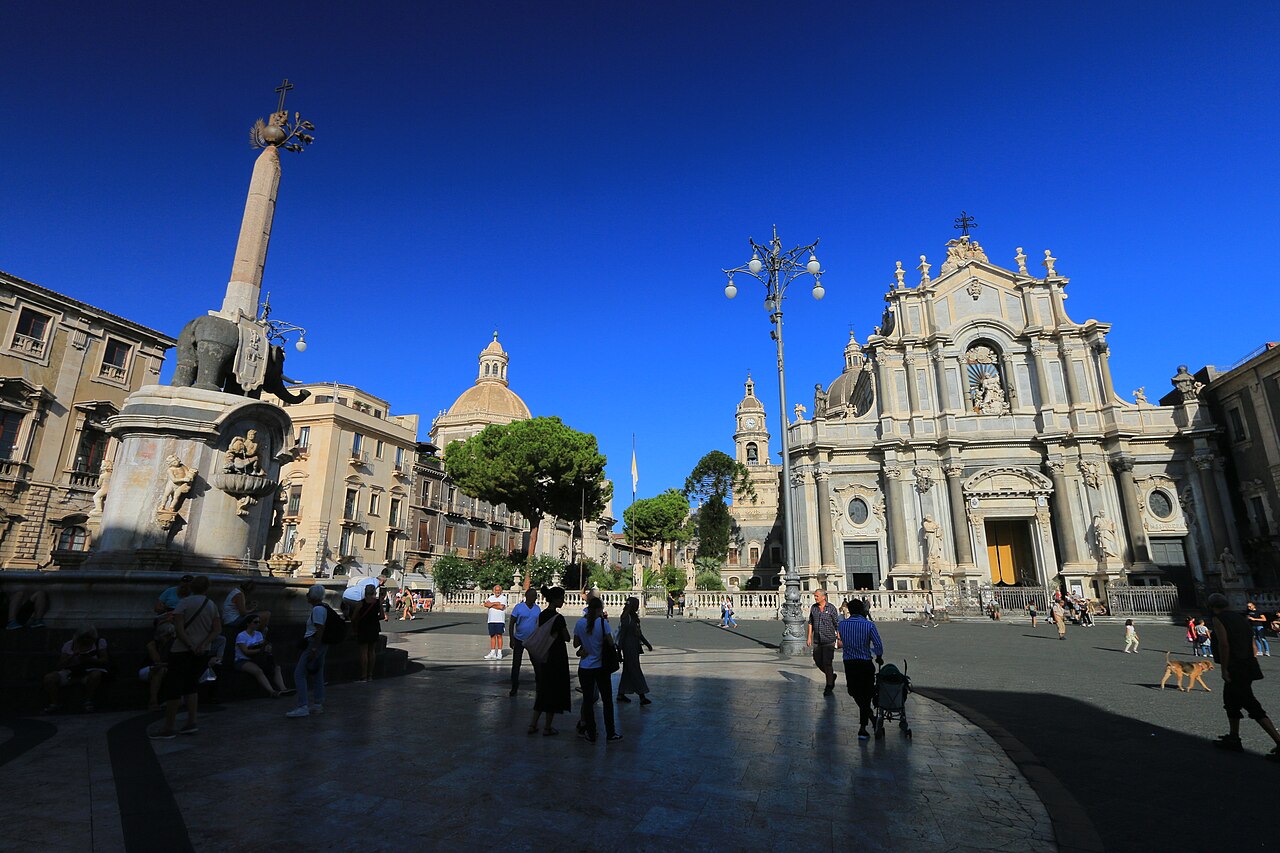
Catania's calendar has a pole star, and it is not summer. The Festa di Sant'Agata, held every February 3–5 (with a smaller summer echo on August 17), honors the city's martyred patron, killed in 251 AD and credited by Catanians with saving the city from Etna's lava more than once. For three days the saint's silver reliquary bust and fercolo are carried through the baroque center by teams of devotees in white — the cittadini in their sack-like tunics and black caps — while the great candelore, towering gilded candle-machines weighing up to 2,600 pounds (1,200 kg) and each belonging to a guild or quarter of the city, sway through the streets shoulder-high. The city claims crowds approaching a million across the feast; even discounting civic pride, it ranks with Italy's largest religious gatherings, and February visitors get it at 60°F (16°C) in a city still dressed for its own people.
The season doubles the argument outdoors. February is when Etna performs its famous double portrait — snow on the summit cones above black recent lava — and skiing at Rifugio Sapienza and Piano Provenzana runs in view of the Ionian Sea. It is also the heart of the blood-orange season: Sicily's Arancia Rossa di Sicilia IGP oranges, grown on the plain of Catania under Etna's mineral soils, are harvested from January into April, and the Pescheria fish market is stacked with them alongside winter's swordfish and sea urchins. The city itself — rebuilt in lava-stone baroque after the 1693 earthquake and UNESCO-listed with the Val di Noto towns since 2002 — reads best in low winter light.
Summer is the season to argue against: Catania in July and August is one of Italy's hottest cities, with sirocco days past 104°F (40°C), the crowds bound for the beaches of La Plaia and the Riviera dei Ciclopi, and the feast's August reprise a shadow of February. April and May are the honorable alternatives — almond and orange blossom done, the sea warming, Etna accessible high — but they are Catania at ease, not Catania at full voice.
Picture the place
On the night of February 4, Via Etnea is a river of white: ten thousand candles, the candelore rocking like ships under their teams, and above the baroque skyline the dark pyramid of Etna wearing its February snow like a second saint's veil.
The easily missed detail
The feast's sweets are the history. Minne di Sant'Agata — "Saint Agatha's breasts" — are dome-shaped ricotta cassatelle with a cherry on top, made by Catania's pasticcerie for the feast in memory of the martyr's torture; their greener cousins, the olivette (marzipan olives), mark her legend of the olive tree that sprang up where she rested. They appear in windows for a few weeks around February 3 and again in August — outside those windows, Catania's bakers mostly will not make them, and a February visitor eats what no summer tourist can order.
A practical rhythm
- Book for the 3rd to the 5th — The feast builds: candelore out on the 3rd, the great processions on the 4th and 5th; arrive on the 2nd to settle in
- Stay on the feast route — A hotel near the Duomo or Via Etnea puts the processions outside your window and Etna at the end of the street
- Etna between processions — Take the clearest morning for the volcano; the feast owns the afternoons and nights
What could complicate the plan
The feast swallows the center: streets close, buses divert, hotels sell out months ahead and price like it, and the procession's pace is devotional, not schedulable — the fercolo returns when it returns, often near dawn. February Etna days can be storm-closed at altitude even when the city is mild. And the crowds around the Duomo on February 4 are dense enough to require patience and a plan for where to stand.
What to do next
Reserve a Duomo-side hotel for February 2–6 as early as you can, and hold one flexible day for Etna's weather.
Sources
- Comune di Catania / Arcidiocesi di Catania — the Festa di Sant'Agata, February 3–5, with its candelore and the processions of the reliquary
- UNESCO World Heritage Centre — Late Baroque Towns of the Val di Noto, inscribed 2002, including Catania, rebuilt after the 1693 earthquake
- Consorzio di Tutela Arancia Rossa di Sicilia IGP — the blood-orange harvest on the Catania plain, January to April
- INGV Osservatorio Etneo (Catania) — Etna's winter summit conditions and activity bulletins