Cornwall / United Kingdom Things to do
What are the most worthwhile things to do in Cornwall on a first visit?
The short answer
Walk the causeway to St Michael's Mount, stand in the cliff-carved Minack Theatre, tour the mining engine houses of the west, and cross the 2019 bridge at Tintagel — then spend a day inside the Eden Project's biomes.
The answer, with local context
Work west to east, the way the light improves. St Michael's Mount, off Marazion, is Cornwall's emblem and its tide lesson: a castle-crowned tidal island (home of the St Aubyn family, cared for with the National Trust) joined to shore by a granite causeway that surfaces for a few hours around low water. Walk out over the cobbles, tour the castle's subtropical terraces, and come back by boat as the tide closes the road — checking the day's official crossing times is the first skill Cornwall teaches. An hour west, the coast turns theatrical in the literal sense at the Minack, where Rowena Cade began cutting a theater into the gully above Porthcurno beach in the early 1930s and built it, largely by hand, for the rest of her life; the museum alone justifies the visit if no performance is on, and Porthcurno below — white sand, turquoise water, once the landing point of the world's submarine telegraph cables — is among Britain's most startling beaches.
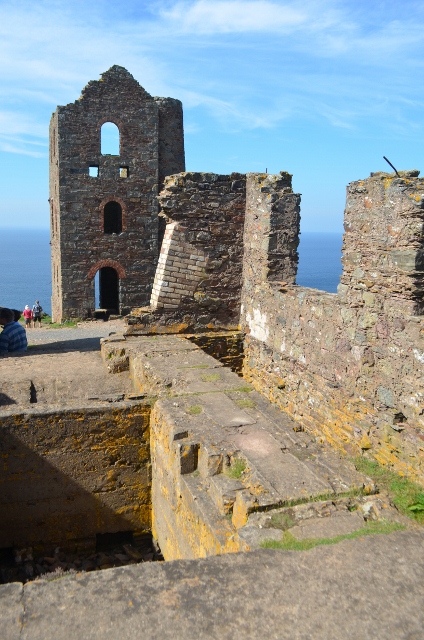
West Cornwall is also the engine room of the county's UNESCO listing. The Cornwall and West Devon Mining Landscape (inscribed 2006) covers ten areas of the 19th-century copper and tin boom — at its height this region produced around two-thirds of the world's copper — and its signature silhouette is the cliff-top engine house: the Crowns at Botallack, teetering above the surf where miners worked seams under the seabed, and Wheal Coates above Chapel Porth near St Agnes. Walking the coast path between them, with the Levant Mine's working beam engine (restored, in steam on demonstration days) in between, is the finest industrial walk in Britain. North of here, Tintagel answers with myth: English Heritage's castle, tied to King Arthur since Geoffrey of Monmouth's 12th-century history, occupies a wave-split headland rejoined in 2019 by a slender slate-and-steel footbridge that cantilevers across the chasm — cross it early or late to have the island's ruins and the Atlantic to yourself.
Give the green southeast its day. The Eden Project, opened in 2001 in a worked-out china clay pit near St Austell, houses the world's largest indoor rainforest in its Rainforest Biome, and even skeptics concede the engineering: two vast honeycomb domes of plants climbing from olive grove to jungle canopy. Pair it with the Lost Gardens of Heligan a few miles on — a great Victorian garden that slept under bramble from the First World War until Tim Smit's restoration began in 1990, now jungle valleys, the mud-maid sculptures and kitchen gardens. St Ives belongs on any first list for its double life of working harbor and art colony: Tate St Ives (opened 1993) above Porthmeor beach, and Barbara Hepworth's studio and sculpture garden, preserved as she left it — she worked at Trewyn Studio from 1949 until her death in 1975. If days allow, the Isles of Scilly, 28 miles beyond Land's End, are the bonus level: boats and planes from Penzance and Land's End reach Tresco's Abbey Garden and a slower England entirely.
Picture the place
At Botallack the engine houses stand at the cliff's very lip, gulls wheeling through the ruined chimney arches, and the path runs on grass an inch from a 200-foot drop to water the color of bottle glass.
The easily missed detail
Cornwall's finest hour is at low tide and most visitors miss it by an hour either way. Beyond the Mount's causeway, spring low tides open walks the maps barely show: the walk from Marazion along the sand to Penzance, the crossing from Looe to St George's Island, and the seabed causeways of the Isles of Scilly, where at the lowest springs of the year you can walk dry-shod between Tresco and Bryher. The county runs on the tide tables the way other places run on train times — buy the local booklet or download the times on day one.
A practical rhythm
- Base twice — West Cornwall (Penzance or St Ives) for the Mount, Minack and mines; the southeast (Fowey or St Austell) for Eden, Heligan and the harbors
- Tides first, tickets second — Set St Michael's Mount by the tide, Eden and Tintagel by pre-booked slots, and let the coast path fill the seams
- One path day — St Agnes to Portreath or the Lizard's Kynance Cove section: the Coast Path is Cornwall's museum with no walls
What could complicate the plan
Tintagel's island closes in high winds (the bridge is exposed) and the Mount's opening days contract outside the main season — both need a same-week check. St Ives' lanes defeat cars: use the park-and-ride or the St Erth branch-line train, one of Britain's prettiest. The Eden Project is largely weatherproof but its outdoor gardens in a wet week change the calculus toward Heligan's valley shelter or the Maritime Museum at Falmouth.
What to do next
Fix the Mount day from the tide tables, book Eden and Tintagel, and give the far west two full days — Cornwall punishes rushing more than most counties.
Sources
- UNESCO World Heritage Centre — Cornwall and West Devon Mining Landscape, inscribed 2006: ten areas of the copper and tin industry that supplied around two-thirds of world copper at its peak
- National Trust / St Michael's Mount — the tidal island, its causeway crossing windows and castle
- English Heritage — Tintagel Castle and the footbridge opened in 2019; the site's Arthurian association from Geoffrey of Monmouth
- Eden Project — opened 2001 in a former china clay pit; the Rainforest Biome as the largest indoor rainforest
- Minack Theatre Trust — Rowena Cade's cliff theatre, begun in the early 1930s above Porthcurno