Cornwall / United Kingdom Food and drink
Where should I eat in Cornwall, and which local food or drink is worth trying?
The short answer
A pasty eaten on a harbor wall, a jam-first cream tea, and fish landed that morning in Newlyn or Padstow — with a Camel Valley sparkling wine or a pint of Doom Bar to finish.
The answer, with local context
Begin with the county's edible flag. The Cornish pasty is protected law, not just lunch: since 2011 it holds PGI status, so a true Cornish pasty must be made in Cornwall, D-shaped, crimped along the side (never the top), and filled with raw beef (at least 12.5%), potato, swede — which Cornwall calls "turnip" — and onion, seasoned with salt and pepper and nothing else. It was engineered as the miner's lunch: the crimp a handle for arsenic-dusted hands (the edge was traditionally thrown away), the filling a full meal that kept warm in a pocket of the mine. The bakers locals argue over — Philps of Hayle and Marazion, Ann's Pasties on the Lizard, Pengenna at Bude and St Ives, the Chough in Padstow — matter less than the rule: eat it hot, within the county, preferably in sight of the sea.
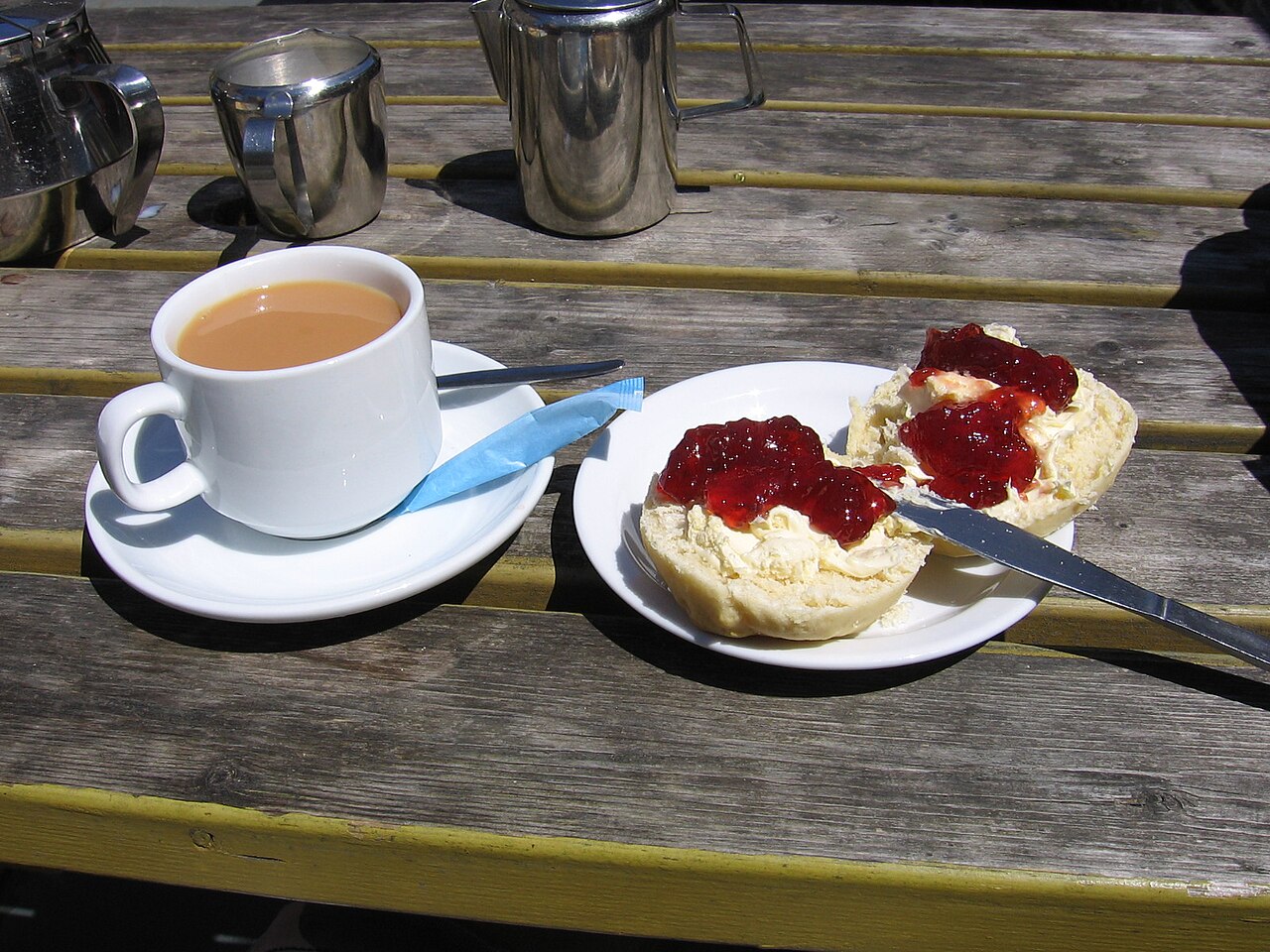
The cream tea is the second sacrament, and it has a correct order that starts a fight with Devon: in Cornwall the jam goes on first, then the clotted cream — because the cream is the butter of the thing and one does not put jam on butter. The cream itself is protected: Cornish clotted cream holds PDO status (granted 1998), made only from Cornish milk and at least 55% butterfat, with the golden crust Rodda's of Scorrier has been producing since 1890. Traditionally it crowns a Cornish split — a soft white yeast bun — rather than a scone, and finding a split on a menu marks a kitchen that knows its county. For the sweet shelf add saffron buns (the golden yeasted rolls that perfume Cornish bakeries) and Cornish fairings, the ginger biscuits Furniss has baked since 1886.
The fish coast is the main course, divided by harbor. Newlyn, beside Penzance, is Cornwall's working port — go for the day-boat fish in its quayside restaurants and cafés, and look for Cornish hake (MSC-certified) and Cornish sardines (PGI), the rebranded pilchard, on menus county-wide. Padstow is the dining capital Rick Stein built from the Seafood Restaurant he opened in 1975; the town now spans his empire from fine dining to fish and chips, with Paul Ainsworth's No. 6 carrying a Michelin star a few doors away. Port Isaac answers with Nathan Outlaw's Fish Kitchen, and the Roseland hides the Hidden Hut above Porthcurnick beach, whose feast nights (booked in minutes, eaten at long tables) are a Cornish summer institution. To drink: the county's beers are Sharp's Doom Bar — named for the lethal sandbank at the Camel's mouth — and St Austell Brewery's Tribute (the brewery dates to 1851); its cider comes from Healey's farm (the Rattler is the famous cloudy pour); and its wine is genuinely distinguished — Camel Valley's sparkling wines, made since 1989 on the river's sunny slopes, have beaten French houses in international tastings. End where the miners would: a pasty at a harbor wall is the full stop.
Picture the place
On Padstow's quay at six o'clock: gulls posted on every bollard, a pasty steaming through its paper bag, the Camel estuary going gold, and the day's boats ticking as they cool.
The easily missed detail
Cornwall's most theatrical dish appears one night a year: stargazy pie, baked for Tom Bawcock's Eve (December 23) in Mousehole, its pilchard heads and tails poking through the crust to "gaze at the stars" — commemorating the fisherman said to have saved the village from famine by braving a storm for the catch. The same village's Christmas harbor lights are lit from mid-December; the pie, eaten amid them, is the county's folklore served hot. Outside Mousehole in December, order the sardines and know their story.
A practical rhythm
- Pasty for the path — Buy at a baker by 11, eat on the Coast Path an hour later; never trust a pasty with carrot in it
- Jam first, always — When in Cornwall: split or scone, strawberry jam, then the cream — and let any Devonian at the table object
- Book the harbors — No. 6, the Fish Kitchen and Stein's Seafood Restaurant take reservations weeks out; the Hidden Hut's feast nights vanish in minutes
What could complicate the plan
Port towns keep seasonal hours — many kitchens close days or whole weeks outside the summer, and Sunday evenings can be a desert of closed doors even in Padstow. Fish follows weather: a stormy week in the Atlantic means the "catch of the day" boards shorten honestly. And the pasty's PGI protects the recipe, not the quality — motorway-service pasties within the county are legal and dreadful in equal measure; the queues at the named bakers are the review system that works.
What to do next
Pick one harbor dinner to book (Padstow or Port Isaac), one bakery to champion, and drink one glass of Camel Valley Brut with the fish — the county in three decisions.
Sources
- Cornish Pasty Association / UK GI register — the Cornish pasty PGI (2011): made in Cornwall, side-crimped, at least 12.5% beef with potato, swede and onion only
- UK PDO register — Cornish clotted cream, PDO since 1998: Cornish milk, minimum 55% butterfat
- Rodda's — clotted cream made at Scorrier since 1890
- Marine Stewardship Council — the certified Cornish hake fishery; Cornish sardines hold PGI status
- Camel Valley Vineyard — sparkling wines produced on the Camel estuary since 1989