Croatia country guide Places and experiences
What should a first-time traveler see in Croatia beyond the obvious highlights?
The short answer
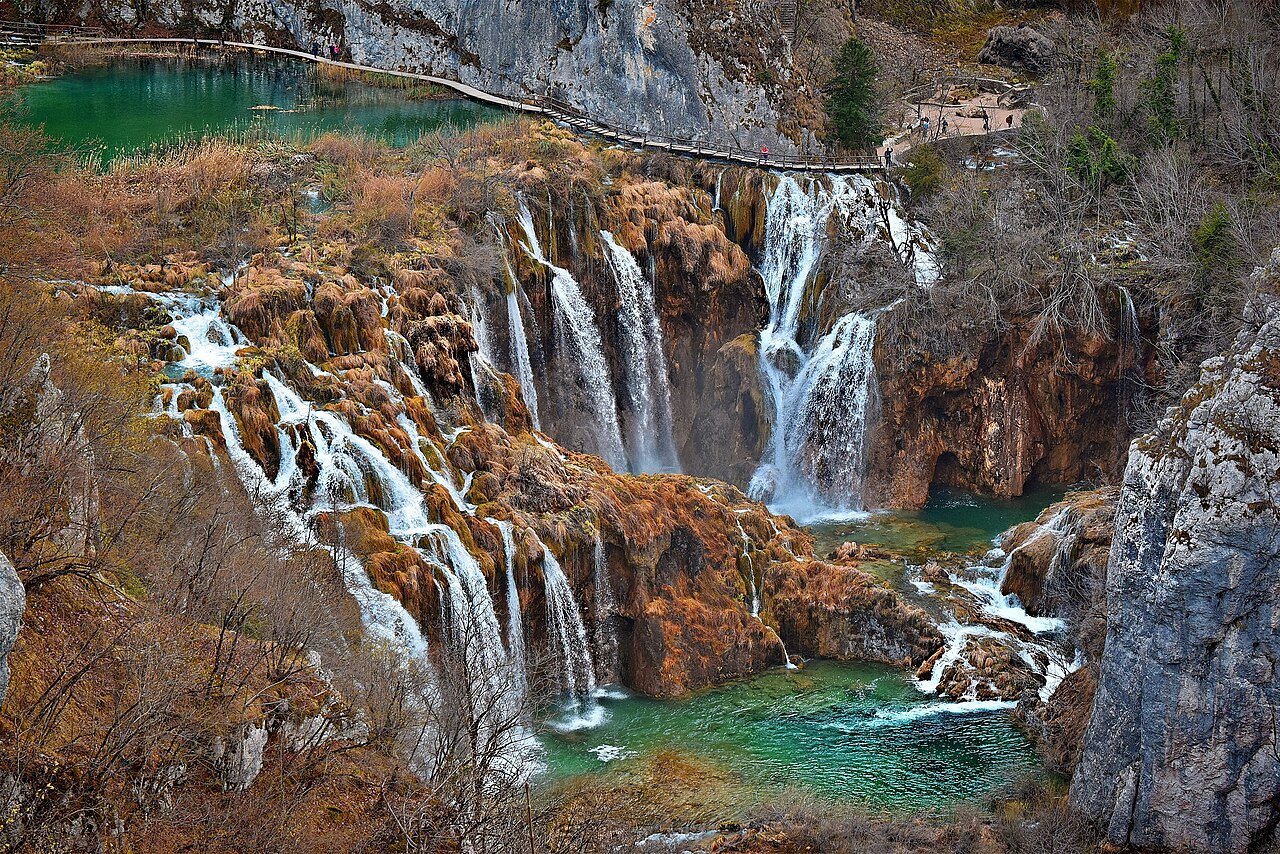
Istria, inland Dalmatia and the karst lakes — Croatia's World Heritage list runs well past the coast, taking in the Euphrasian Basilica complex at Poreč, inscribed in 1997, and Plitvice Lakes National Park, inscribed in 1979.
The answer, with local context
Plitvice was declared a national park in 1949 and inscribed by UNESCO thirty years later. It is a karst system in which travertine barriers build up and shift, so the waterfalls are not fixed features but a landscape still forming. The park authority runs the site through two entrances, with electric boats across Lake Kozjak and panoramic road trains linking the station points, which means the shape of your day is largely decided by which entrance you book.
On the Istrian peninsula, the Euphrasian Basilica complex in the historic center of Poreč was inscribed in 1997 for its sixth-century mosaics, which survive in situ rather than in a museum. The same year brought the Historic City of Trogir onto the list, a small island town between the mainland and Čiovo whose street grid is still the Hellenistic one. Šibenik's Cathedral of St James followed in 2000, built entirely of stone without timber or brick, and the Stari Grad Plain on Hvar in 2008 — a Greek field system of dry-stone walls laid out in the fourth century BC and still farmed on the same lines.
Dalmatia's inland is the genuinely overlooked half. The Dinaric uplands behind the coast hold the Krka and Zrmanja river canyons, the Velebit range and the Lika plateau, and the drive from the motorway down to the sea crosses a climatic boundary in a matter of miles.
Picture the place
On the Stari Grad Plain the dry-stone walls run in long straight lines across the valley floor, dividing the ground into rectangles that have held the same orientation for over two thousand years — the field boundaries, not the buildings, are the monument.
The easily missed detail
The Pelješac Bridge opened on 26 July 2022, connecting the Pelješac peninsula to the Croatian mainland and removing the need to cross into Bosnia and Herzegovina at the Neum corridor on the drive south. That changes the arithmetic of a Dalmatian road trip completely: a route that used to involve two extra international border crossings is now continuous, and it makes Pelješac, Ston and the Mljet ferry realistic additions rather than detours.
A practical rhythm
- Istria first — Poreč's 1997-inscribed basilica complex and the inland hill towns; the peninsula is closer to Venice in temperament than to Dubrovnik.
- Then the karst — Plitvice, a national park since 1949, worked from whichever of the two entrances your ticket names.
- Then inland Dalmatia — Trogir's Hellenistic grid, Šibenik's all-stone cathedral and Hvar's ancient field walls, rather than another coastal promenade.
What could complicate the plan
Plitvice's trails are boardwalk over water for long stretches, and the park's upper and lower lake sections have been closed separately in the past for conservation and winter safety, so a single-ticket plan can collapse if one half is shut. The boats and panoramic trains that make the long circuits feasible do not all run year-round either. Inland Croatia also sits at altitude in places, which means winter driving conditions on the Lika plateau bear no resemblance to the coast on the same day.
What to do next
Read the Croatia trip-planning answer in this group to see how to string these together without backtracking, and the Croatia food question for what Istria and inland Dalmatia actually put on the table.
Sources
- UNESCO World Heritage Centre — Croatian inscriptions and their years, including Plitvice Lakes (1979), Poreč (1997), Trogir (1997), Šibenik (2000) and the Stari Grad Plain (2008)
- Plitvice Lakes National Park (public institution) — the park's two entrances, Lake Kozjak electric boats and panoramic train services
- Hrvatske ceste / Government of Croatia — opening of the Pelješac Bridge on 26 July 2022 and the bypassing of the Neum corridor