Cusco / Peru Things to do
What are the most worthwhile things to do in Cusco on a first visit?
The short answer
Read Cusco as two cities in one footprint: the Inca stone city — Qorikancha and the fortress of Sacsayhuamán — and the Spanish colonial city built directly on top of it, from the Plaza de Armas to the artisans' quarter of San Blas.
The answer, with local context
UNESCO inscribed the City of Cuzco in 1983 for exactly that layering, and the place to feel it is the Qorikancha. This was the richest temple of the Inca Empire, its interior walls once sheeted in gold; the Spanish stripped the gold and built the Santo Domingo convent over the temple's foundations — and then the earthquakes graded the workmanship. Major quakes, in 1650 and again in 1950, when a magnitude 7.0 shock struck the city, brought down colonial masonry while the Inca walls beneath stood unmoved; the 1950 collapse is what re-exposed the temple's perfect, mortarless curves to the modern eye. The city's other essential interior is the Cathedral on the Plaza de Armas, where the Cusco School of painting localized the faith: in Marcos Zapata's Last Supper of 1753, the dish at the center of Christ's table is a roasted cuy.
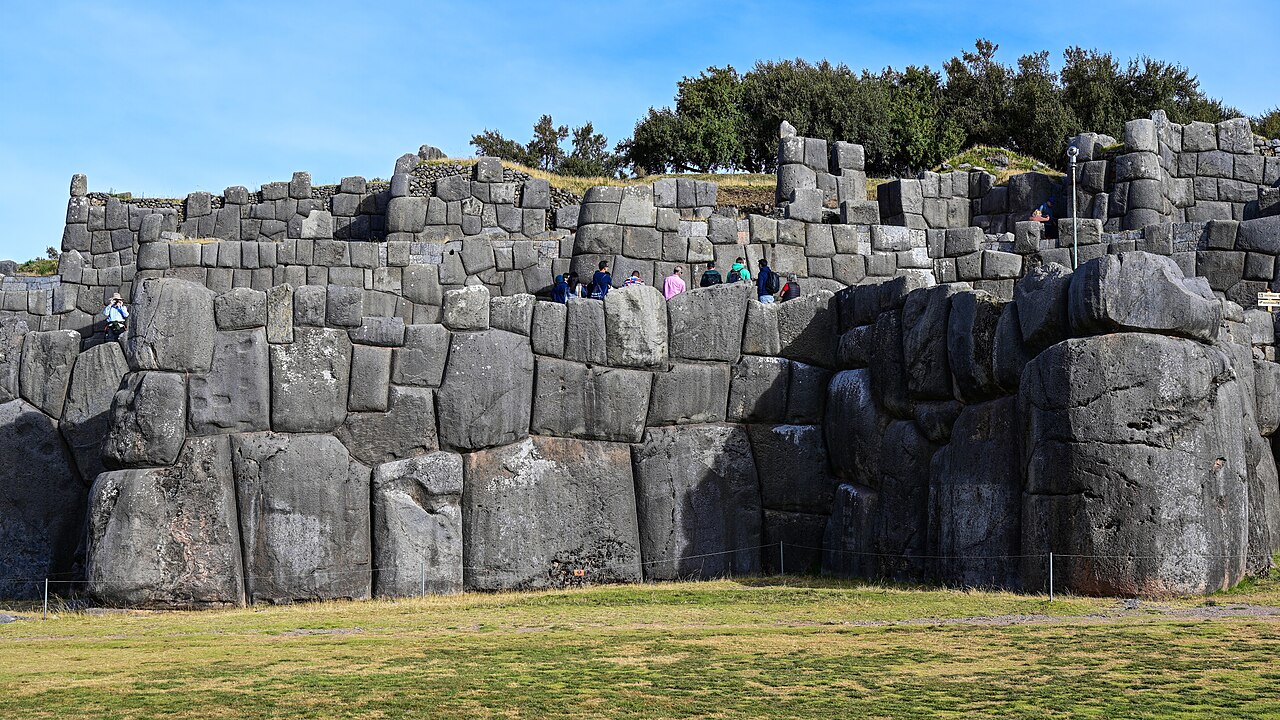
Above the city, 1.2 miles (2 km) north and 1,000 feet higher at 12,140 feet (3,700 m), Sacsayhuamán makes the empire's argument in stone. Three zigzag terrace walls, each roughly 1,180 feet (360 m) long, are built of limestone blocks fitted without mortar; the largest are estimated at 125 to 200 tons, and the tallest stands about 28 feet (8.5 m). The same ticket logic governs the rest of the circuit: the Boleto Turístico's full ticket, S/130, covers entry to 16 sites over 10 days — Sacsayhuamán and its companion sites Q'enqo, Puka Pukara and Tambomachay among them, and the Sacred Valley ruins of Pisac and Ollantaytambo beyond — while the Qorikancha and the Cathedral are not on it and charge their own entries. In the streets between, the famous detail is free: on Hatunrumiyoc, the Twelve-Angled Stone sits in an Inca palace wall at pavement level, one block cut to twelve angles and fitted so tightly that the joints read as lines drawn on the stone.
Picture the place
At Sacsayhuamán in the late afternoon the zigzag walls throw long triangular shadows across the esplanade, and the blocks — some as tall as a two-story house, each face a different polygon — meet at seams you cannot slip a credit card into, with the whole red-roofed city spread below.
The easily missed detail
The Qorikancha's gold is gone, but the temple's other treasure survives in plain sight: the perfectly curved Inca wall at its western end, built of black andesite fitted to tolerances that modern masons admire, which served as the Dominican church's foundation for four centuries and outlasted the church itself in 1950. Most visitors photograph the convent courtyard; the wall around the back, on the street side, is the masterpiece.
A practical rhythm
- Morning — Sacsayhuamán first, on the Boleto's city circuit with Q'enqo, Puka Pukara and Tambomachay, while the light rakes the walls and before the tour buses consolidate.
- Midday — The interiors belong to the middle of the day: Qorikancha and its museum, then the Cathedral and the Plaza's arcades, then lunch in San Blas as the quarter wakes up.
- Evening — Walk Hatunrumiyoc at dusk, when the day crowds thin and the Twelve-Angled Stone can be examined at touching distance, and let San Blas's workshops and cafés close the day uphill.
What could complicate the plan
The altitude taxes the itinerary before the sights do: Sacsayhuamán at 12,140 feet is a third-day excursion, not a first-day one, whatever the map suggests. The Boleto's ten days run from first use and its circuits are fixed, so buying it before the Sacred Valley days are planned wastes its best value; and because the Qorikancha and Cathedral sit outside it, the city's two finest interiors are the ones travelers most often leave unpaid and unvisited. In June, finally, the festival calendar periodically closes streets and fills the Plaza — a gift if you planned for it, a bafflement if you didn't.
What to do next
Buy the full Boleto on the morning you start the Sacsayhuamán circuit, keep the Qorikancha for the same day's midday, and hold San Blas for the evening — then eat as the next answer prescribes.
Sources
- UNESCO World Heritage Centre — the City of Cuzco, inscribed in 1983 for its Inca and Spanish colonial layers
- COSITUC (Comité de Servicios Integrados Turísticos Culturales del Cusco) — the Boleto Turístico: the full ticket at S/130 covering 16 sites, valid 10 days; the Qorikancha and the Cathedral excluded and ticketed separately
- Ministerio de Cultura (Peru) — Sacsayhuamán's three zigzag walls and megalithic blocks, and the Qorikancha–Santo Domingo complex, where the 1950 earthquake exposed the Inca temple walls beneath the fallen convent