Czechia country guide Places and experiences
What should a first-time traveler see in Czechia beyond the obvious highlights?
The short answer
Southern Bohemia, Moravia and the hop country — Czechia holds 17 World Heritage properties, including Holašovice, a single Bohemian village inscribed in 1998, and Žatec and the Landscape of Saaz Hops, added in 2023.
The answer, with local context
Holašovice is a working farming village of around two dozen homesteads arranged around a green, inscribed in 1998 as an exceptionally complete example of a Central European vernacular settlement — the buildings are in the South Bohemian Folk Baroque style and the plan has not been redrawn since the Middle Ages. It is one of the few World Heritage properties that is simply a village doing what it has always done.
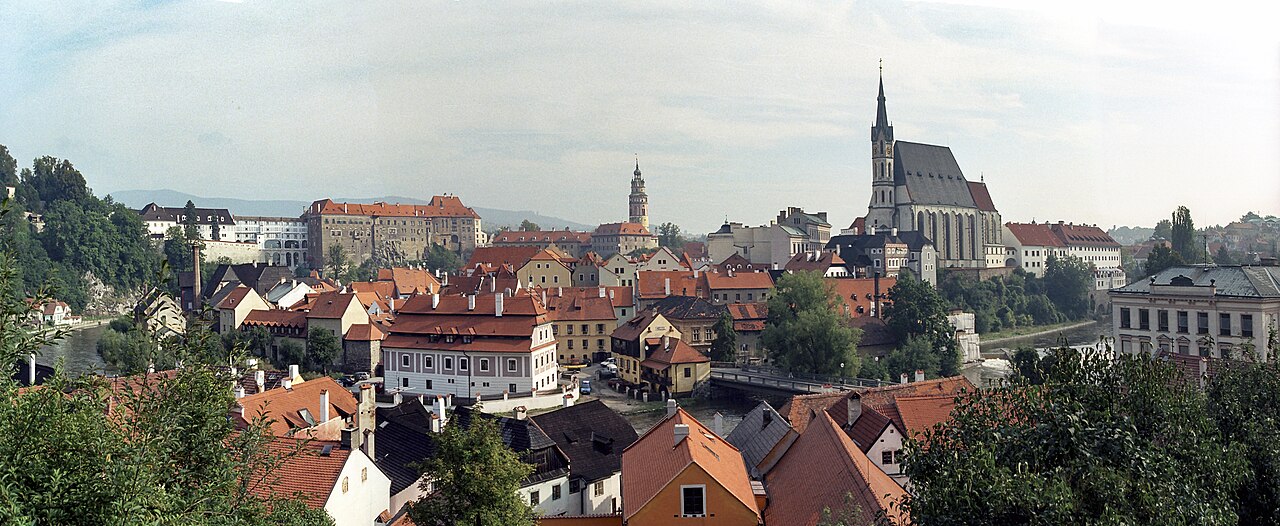
Southern Bohemia carries two more. Český Krumlov's historic center was inscribed in 1992, a town looped by a meander of the Vltava under a castle complex that grew over five centuries. Telč, inscribed the same year, is a Moravian town whose main square is a single continuous arcaded facade of gabled houses around a long triangular space. Kutná Hora, inscribed in 1995, was Bohemia's silver town, and its St Barbara's church and the Sedlec monastery complex were built on that wealth.
The 2023 inscription is the most recent and least visited. Žatec and the Landscape of Saaz Hops recognizes the hop-growing region in northwest Bohemia along with the town's drying, storing and trading quarter — the industrial architecture of hops rather than a monument. The hops themselves were already protected: Žatecký chmel was registered as a Protected Designation of Origin by Commission Regulation (EC) No 503/2007 of 8 May 2007.
Czech living tradition is worth routing around too. The Ride of the Kings, a village procession in the Moravian Slovakia region, was inscribed on UNESCO's Representative List in 2011, and the Shrovetide door-to-door processions and masks of the Hlinecko area in 2010.
Picture the place
In Žatec the hop warehouses are tall, narrow brick buildings with tiers of shuttered openings for ventilation, standing above the town like a row of chimneys — a skyline built entirely around drying a crop.
The easily missed detail
Czechia's continental interior gets genuinely cold, and the Clementinum's absolute minimum of −17.7°F (−27.6°C), recorded on 1 March 1785, is a reminder that the cold can run into what elsewhere counts as spring. For a trip built on small towns and villages rather than a capital, that is a practical constraint: Holašovice has no museum to retreat into, and the Moravian and Bohemian village traditions on the UNESCO intangible list are tied to fixed calendar dates rather than a visitor season.
A practical rhythm
- Southern Bohemia — Český Krumlov and Telč, both inscribed in 1992, plus Holašovice's 1998-inscribed village green, all within a short drive of one another.
- Central Bohemia — Kutná Hora, inscribed 1995, for the silver-funded churches and the Sedlec complex.
- Northwest and Moravia — Žatec's 2023-inscribed hop landscape, and the 2011-inscribed Ride of the Kings in Moravian Slovakia if the dates align.
What could complicate the plan
Most of these are small places with limited accommodation and thin public transport, so the practical unit here is a car rather than a rail pass. The intangible-heritage events are fixed to the local calendar — Shrovetide processions and the Ride of the Kings happen when they happen, not on demand — and a village of two dozen homesteads has no capacity for a coach-scale visit. Winter in the Bohemian interior is a real constraint on a village-focused itinerary, not a mood.
What to do next
Read the Czechia food answer in this group for what the hop country and the Moravian south actually serve, and the Czechia when-to-visit question for the climate record behind these seasons.
Sources
- UNESCO World Heritage Centre — Czechia's total of 17 properties and the inscription years for Český Krumlov, Telč, Kutná Hora, Holašovice and Žatec; Representative List inscriptions of the Ride of the Kings (2011) and the Hlinecko Shrovetide processions (2010)
- Commission Regulation (EC) No 503/2007 — registration of Žatecký chmel as a Protected Designation of Origin on 8 May 2007
- Czech Hydrometeorological Institute (CHMI), Prague Clementinum — absolute minimum temperature of −27.6 °C on 1 March 1785