Czechia country guide When to visit
When is the best time to visit Czechia for Prague?
The short answer
May, June or September — the Czech Hydrometeorological Institute's Prague Clementinum station gives a July mean of 70.7°F (21.5°C) for 1991–2020 against an annual mean of 52.3°F (11.3°C), and the shoulder months land between the two without midsummer's crowds or heat.
The answer, with local context
The Clementinum is one of the longest-running weather stations in Europe. Regular observations began there in 1752 and the continuous temperature record runs from 1775, at an altitude of 191 meters in the middle of Prague. Its 1991–2020 normals give a January mean of 34.9°F (1.6°C), a July mean of 21.5°C and annual precipitation of 17.9 inches (453.9 mm). Those are means across the full day, not average daytime highs, so July afternoons run well above the quoted figure.
The record also shows how much the baseline has moved. For 1961–1990 the Clementinum's annual mean was 50.0°F (10.0°C) and January sat at 31.6°F (−0.2°C); by 1991–2020 the annual mean was 11.3°C and January had risen above freezing to 1.6°C. The warmest year in the series was 2018, at 55.0°F (12.8°C). The station's absolute maximum is 100.0°F (37.8°C), recorded on 27 July 1983.
Czechia is dry by European standards — the Clementinum's annual total of 453.9 mm is less than Copenhagen or Zagreb receives — but what rain there is arrives in convective summer bursts. The station's heaviest 24-hour fall on record is 3.54 inches (90.0 mm), on 19 July 1981, and July 1981 also holds the monthly record at 8.44 inches (214.3 mm).
Picture the place
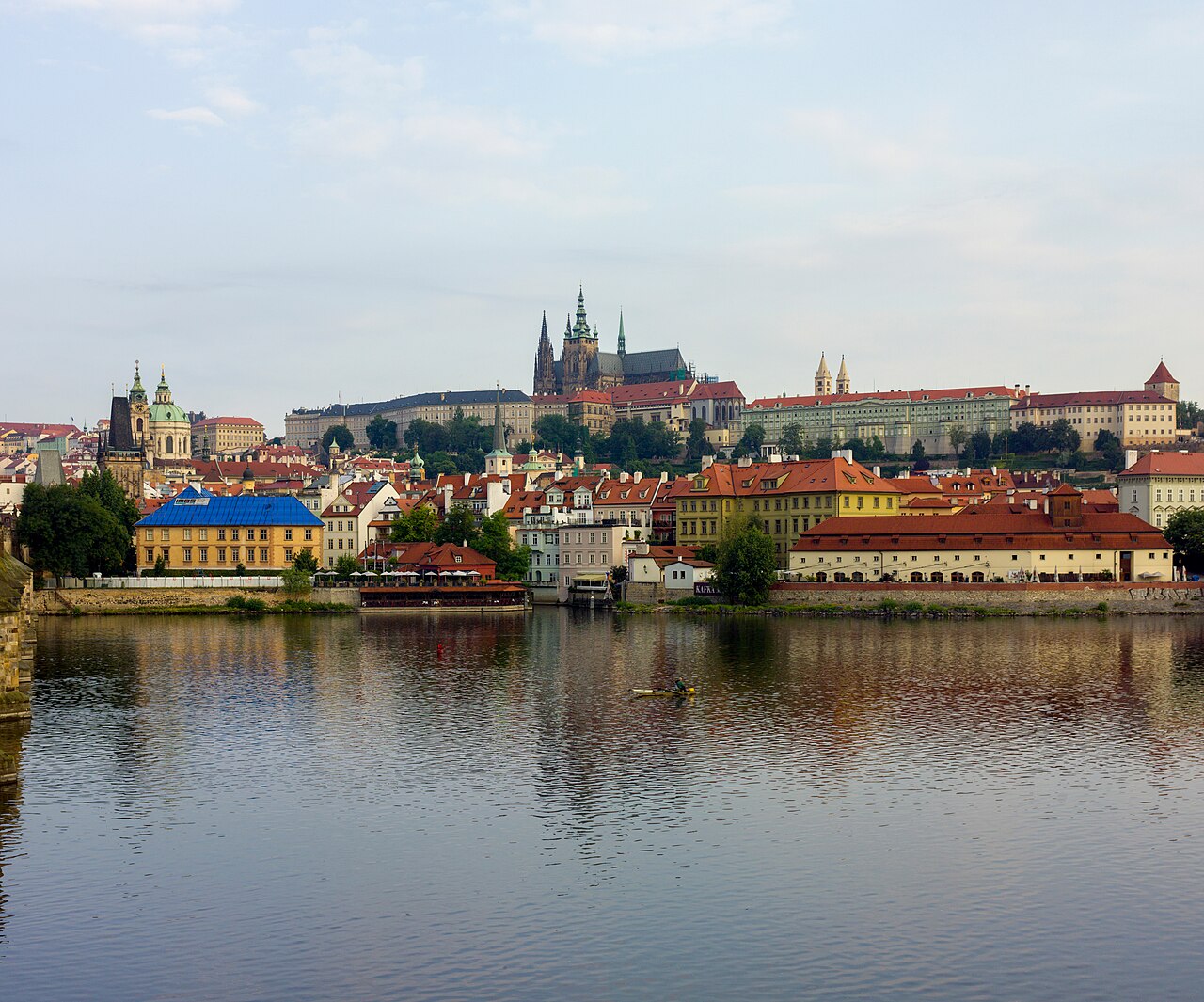
Prague sits in a bend of the Vltava with the castle ridge on one bank and the Old Town on the other, so in the low sun of late September the river reflects a lit hillside while the streets below it are already in shadow — the city's relief, not its weather, is what the season changes most visibly.
The easily missed detail
Prague Castle's gardens close to the public from 13 November to 28 February, and the Royal Garden, Stag Moat and South Gardens reopen on a staggered schedule through March, hitting their longest hours of 10:00 to 20:00 only in July and August. The castle complex grounds stay open 06:00 to 22:00 year-round, but St Vitus Cathedral's last entry moves from 16:40 in the April-to-October season to 15:40 from November to March. A winter visit therefore sees a materially smaller castle than a summer one, independently of weather.
A practical rhythm
- May to June — Between the January and July extremes, with the castle's historical buildings on their 09:00 to 17:00 summer hours and the gardens fully open.
- July to August — Hottest and busiest, with the gardens at 10:00 to 20:00; the Clementinum's convective rainfall records all fall in this part of the year.
- November to February — Gardens shut, cathedral last entry at 15:40, and the Historic Centre of Prague, inscribed by UNESCO in 1992, left to carry the visit on its own.
What could complicate the plan
The gardens closure from 13 November is the single largest seasonal loss at the castle, and the shorter winter hours for the historical buildings — 09:00 to 16:00 rather than 17:00 — compress what you can see in a day that already has little daylight. St Vitus Cathedral keeps different Sunday hours, opening at 12:00 rather than 09:00, because it remains an active cathedral, so a Sunday morning plan built around it will not work.
What to do next
The Czechia places-and-experiences question in this group covers the country beyond Prague; the Czechia trip-planning answer handles entry rules and internal distances.
Sources
- Czech Hydrometeorological Institute (CHMI), Prague Clementinum basic facts — station history and altitude, 1961–1990 and 1991–2020 normals, absolute and record values
- Prague Castle Administration — seasonal opening hours, garden closure dates and cathedral last-entry times
- UNESCO World Heritage Centre — inscription of the Historic Centre of Prague in 1992