Dolomites / Italy Things to do
What are the most worthwhile things to do in Dolomites on a first visit?
The short answer
Hike the Tre Cime circuit from Rifugio Auronzo to Locatelli, circle Lago di Braies at dawn, ride the gondola to Seceda's ridgeline, and cross the Alpe di Siusi by lift and meadow — the four landscapes that define the range.
The answer, with local context
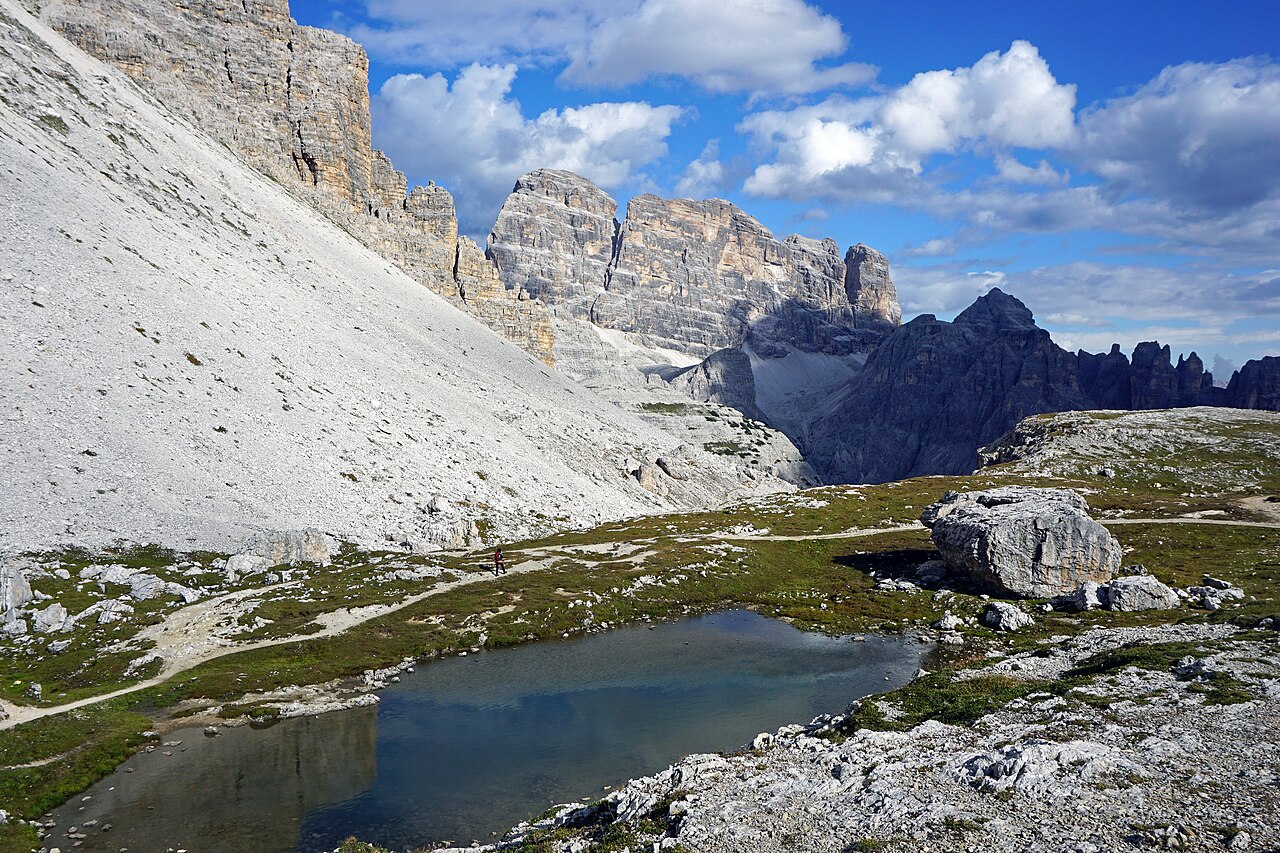
The Tre Cime di Lavaredo are the trademark: three battlement towers of pale rock (the Cima Grande reaches 9,839 ft / 2,999 m) on the border of South Tyrol and the Veneto, walked in a half-day circuit on path 101 from Rifugio Auronzo (7,661 ft / 2,333 m) past Rifugio Lavaredo to Rifugio Locatelli (Dreizinnenhütte), from whose terrace the north faces — the postcard view — fill the sky, and back along the 105. Getting there is now a managed exercise, and the rules are part of the visit: the 4.6-mile toll road from Misurina to Auronzo is reservation-only in season (a €40 car slot booked online in advance, valid 12 hours), while buses from Dobbiaco and Cortina and the longer approach from Val Fiscalina to Locatelli avoid the road entirely. Book the dawn slot or stay late: the circuit is the Dolomites' busiest walk, and its quality doubles outside the 10-to-4 window.
Lago di Braies, in the Fanes-Sennes-Prags Nature Park, is the range's mirror: a jade-green lake at 4,908 feet (1,496 m) under the Croda del Becco, ringed by an easy 2.2-mile (3.5 km) shore path past its wooden boathouse, and the trailhead of the Alta Via 1, the great 93-mile (150 km) hut-to-hut traverse running south to Belluno. Its access is likewise published and binding: in the 2026 season the valley road was closed to cars from 9:00 a.m. to 4:00 p.m. between July 1 and September 15 except with an online reservation, and the 439/442 buses needed pre-booked seats too — the local authority's answer to the lake's fame. Walkers and cyclists need no reservation, which is the authority's nudge: come under your own power, or come early.
The west answers with two lift-built panoramas. Seceda, reached by gondola and cable car from Ortisei in Val Gardena (from summer 2026, by online pre-booked time slot), tops out at 8,264 feet (2,518 m) on a ridgeline that drops in a green cliff toward the jagged Odle/Geisler group — the Dolomites' most dramatic short walk, along the ridge toward the Pieralongia and Firenze huts. Across the valley system, the Alpe di Siusi (Seiser Alm) is Europe's largest high-alpine meadow, some 22 square miles (57 km²) of flower pasture under the Schlern massif; its access road to Compatsch is closed to private cars from 9:00 a.m. to 5:00 p.m. by the nature-reserve rules, so the gondola from Siusi is both the rule and the pleasure. Fill remaining days with the runners-up that many prefer: the milky-turquoise Lago di Sorapis (path 215 from Passo Tre Croci, about two hours each way), Lago di Carezza reflecting the Latemar, the WWI tunnels of the Lagazuoi (reached by cable car from Passo Falzarego, an open-air museum of the mountain war of 1915–18), and Cortina d'Ampezzo itself — co-host of the 2026 Winter Olympics — for its Corso Italia and its mountain museums.
Picture the place
Locatelli's terrace at 6 p.m.: the Tre Cime turning the color of embers, marmots whistling from the scree below the hut, and the circuit path emptying as the day crowds descend to their booked cars — the peaks reverting to the people who walked up.
The easily missed detail
The range is bilingual to its bedrock, and the map conventions trip visitors daily: every major place carries an Italian and a German name (Braies/Prags, Dobbiaco/Toblach, Ortisei/St. Ulrich), a third — Ladin — names the valleys around the Sella (Gardena/Gröden, Badia, Fassa), and trail signage mixes all three. The rifugio system itself (Italian rifugio, German Hütte) is the Alps' best dining network: hut lunches require no reservation, cash is still king at altitude, and a night's half-board in a CAI hut must be booked weeks ahead in season.
A practical rhythm
- Tre Cime at the edges — First or last slot of the day on the circuit; add the Cadini di Misurina viewpoint spur (20 minutes from Auronzo) while you're up there
- Braies by bus or bike — Under the valley rules, the 442 bus or an e-bike beats the reservation lottery; walk the shore loop before 9 a.m.
- One lift, one valley per day — Seceda with Val Gardena's villages; the Siusi with the Schlern; never both in a day
What could complicate the plan
Every famous node now has a gate: the Auronzo slots sell out on August and September weekends, Braies bus reservations fill by mid-morning in season, and Seceda's timed cable-car slots punish spontaneity. Altitude and weather set the second gate — afternoon thunderstorms are the Dolomites' summer rhythm, and the Tre Cime circuit at 7,900 feet (2,400 m) is no place to be caught in one; start early as a rule, not a preference. Wild camping is prohibited in the nature parks, and drones are banned without special permits.
What to do next
Book, in this order: the Auronzo slot, rifugio nights if hut-to-hutting, Seceda's cable-car slot, and the Braies bus — the itinerary is whatever remains possible around those four reservations.
Sources
- Comune di Auronzo di Cadore / pass.auronzo.info — the Rifugio Auronzo toll road: mandatory online booking, €40 per car for a 12-hour slot in season
- Valle di Braies / Fanes-Sennes-Braies Nature Park — the summer valley restriction (2026: July 1–September 15, 9:00 a.m.–4:00 p.m.), with bus, foot and cycle access exempt from reservation
- Dolomiti Superski — the Seceda lifts from Ortisei (2,518 m), with timed online booking introduced for summer 2026
- Alpe di Siusi marketing / Seiser Alm nature reserve — Europe's largest high-alpine meadow (about 57 km²); the Compatsch road closed to private cars 9:00 a.m.–5:00 p.m.
- Fondazione Dolomiti UNESCO — the nine systems of the 2009 World Heritage property, including Sesto, Fanes and the Odle groups