Fiji country guide Places and experiences
What should a first-time traveler see in Fiji beyond the obvious highlights?
The short answer
Levuka, on Ovalau Island — Fiji's only World Heritage property, inscribed in 2013 under criteria (ii) and (iv) by Committee decision 37COM 8B.25, and the country's first colonial capital.
The answer, with local context
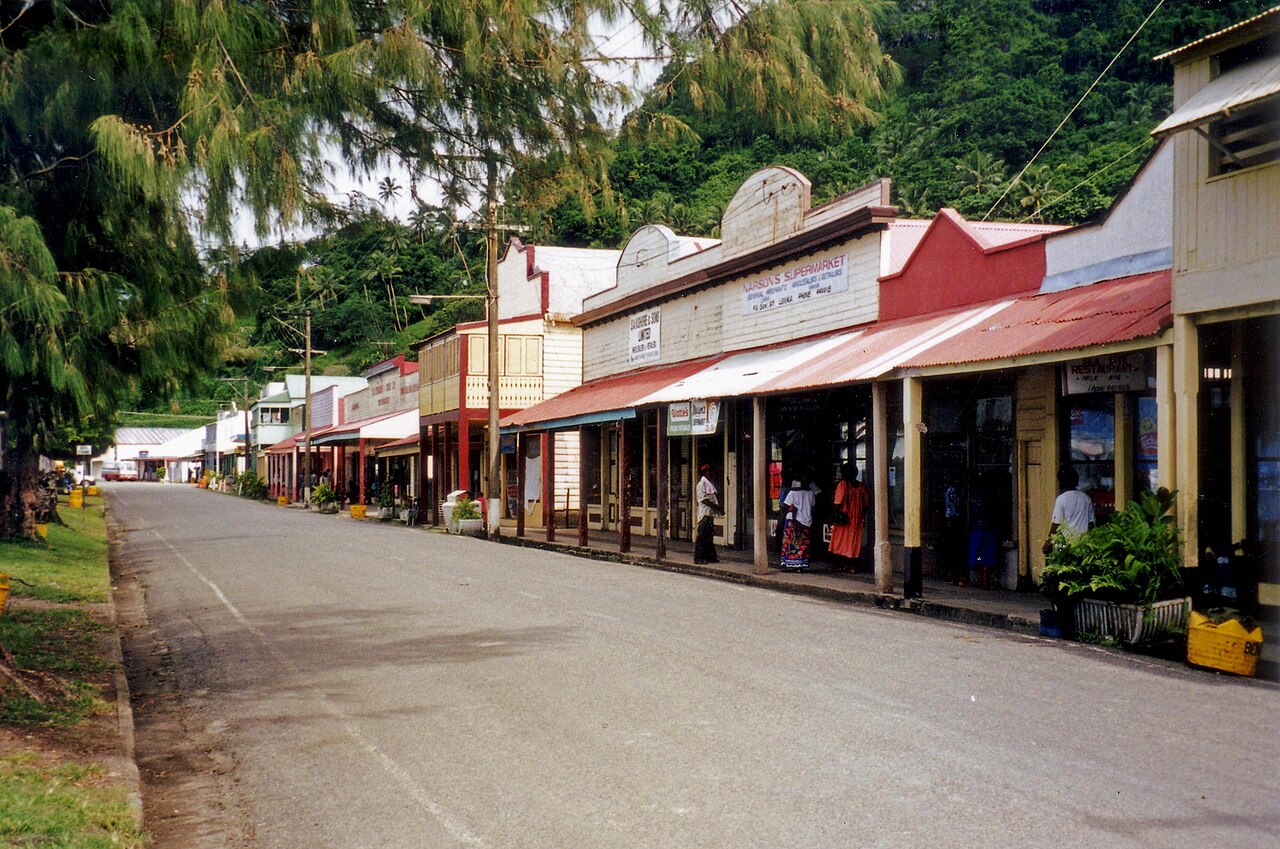
Levuka is the opposite of the Fiji most visitors book. It grew from the 1820s as a commercial port, and UNESCO describes a town whose layout follows the contours of the land rather than a surveyor's grid, running along a beach front lined with coconut and mango trees behind a sea wall on Beach Street. Criterion (ii) recognizes it as a record of cultural exchange during 19th-century European maritime expansion in the Pacific; criterion (iv) recognizes the urban type itself and the way it fuses colonial and local building traditions.
The dates give the town its arc. Sacred Heart Cathedral and its Presbytery were built in the 1860s, and the Royal Hotel was founded in the late 1860s. In 1874 Tui Cakobau ceded the town to the British, making Levuka Fiji's first colonial capital; in 1882 the capital moved to Suva, though trading companies kept operating there. That 8-year window as capital is why the surviving fabric is so concentrated — the Morris Hedstrom bond store, the Town Hall, Levuka Public School, the Masonic Lodge and the former Government House site at Nasova — and mostly single- or two-storey timber with corrugated iron or weatherboard cladding, which is why it reads as a Pacific port town rather than a colonial showpiece.
Away from the heritage town, the second thing worth building a trip around is the small-island conservation work in the west. Monuriki, a 40.4-hectare uninhabited island, carries the third largest surviving population of the Fijian crested iguana. Goats and non-native Pacific rats were cleared in 2011, 10 breeding pairs were taken into captivity that year, 32 captive-bred animals were released in 2015, and 2017 saw 16 original founders and 32 more captive-bred offspring returned. The island also supports wedge-tailed shearwater, banded rail and the Fijian peregrine falcon.
Picture the place
Levuka sits between a steep island interior and the water, with the sea wall along Beach Street holding the line between them, and almost every building in it is timber under corrugated iron. Ovalau's own terrain does the rest: the town could only ever be long and narrow, because there was nowhere else to go.
The easily missed detail
Levuka is governed by its own law. The Fiji World Heritage Decree 2013 provides the property's legal protection, and a Management Plan prepared in 2009–2010 and amended in 2013 guides implementation, overseen by a World Heritage Council of 13 members. That is an unusually specific framework for a town of this size, and it means restoration and building work inside the property is controlled — so what is open and what is scaffolded varies, and the timber stock is under continuous repair in a climate that averages up to 3,000 mm (118 inches) of rain a year on the wet side of Fiji.
A practical rhythm
- Beach Street — Walk the sea wall end to end; the town's whole 19th-century commercial frontage is on this one line.
- The 1860s buildings — Sacred Heart Cathedral and Presbytery, and the Royal Hotel, bracket the decade before cession.
- Nasova — The former Government House site marks where Fiji was ceded in 1874, 8 years before the capital moved to Suva.
What could complicate the plan
Levuka is on a different island from the international airport and the resort belt, so reaching it means domestic transport, and Fiji's wet season from November to April brings river flooding in nearly every year along with the cyclone risk that produced 117 cyclones in the national EEZ across the 1969 to 2010 seasons. Small-island conservation sites like Monuriki are managed access, not open landings. On paperwork, FCDO advice updated 10 August 2026 requires a passport valid for at least 6 months beyond arrival, an onward or return ticket presented at the border, and a yellow fever certificate for arrivals from listed countries, with visa-free stays capped at 4 months.
What to do next
The Fiji when-to-visit question in this group sets out the dry-season window that makes inter-island travel easiest, and the Fiji food question covers kava and what the agricultural economy actually produces.
Sources
- UNESCO World Heritage Centre, Levuka Historical Port Town — inscription year and decision code, criteria, town layout, named buildings and their dates, 1874 cession, 1882 capital move, Fiji World Heritage Decree 2013, management plan, World Heritage Council
- IUCN, community-based conservation and recovery of native species, Monuriki Island, Fiji (2019), via the SPREP library — island area, eradication and reintroduction dates and numbers, bird species present
- Fiji Meteorological Service with the Pacific-Australia Climate Change Science and Adaptation Planning program — wet-season months, Suva rainfall average, cyclone totals, wet-season flooding
- UK Foreign, Commonwealth and Development Office, Fiji travel advice — passport validity, visa-free period, onward ticket, vaccination certificate